A S$150,000 AI Workstation: How Much Productivity Must It Generate to Justify the Investment?

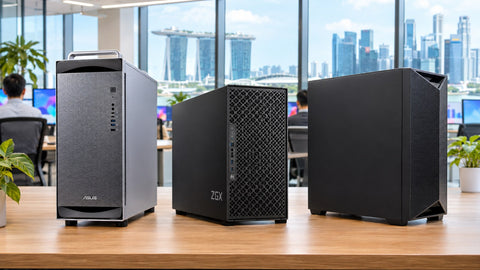
On the illustrative three-year model below, a DGX Station costs about S$248,700 to own and run, including the hardware, a UPS, backup storage, electricity, deployment and a fifth of an engineer's time. To pay that back in staff time alone, it has to save about 2,490 working hours a year at Singapore's median wage cost. Spread across 50 employees, that is roughly one hour per person per week; across 100 employees, about half an hour. The bar is achievable, but only if the system is actually used for work that people would otherwise do by hand, and only if the saved time goes into something valuable. The hardware itself, such as the HP ZGX Fury G1n or ASUS ExpertCenter Pro ET900N G3, is price on request at SourceIT. We assume S$150,000 here.
What goes into a three-year cost?
| Cost item (3 years) | Assumption | Amount (S$) |
|---|---|---|
| DGX Station GB300 system | Assumed ballpark (public US pricing of roughly US$93,000–125,000 for most OEMs is about S$119,000–160,000 before GST at USD/SGD 1.2774) | 150,000.00 |
| UPS | APC Smart-UPS SRT 3000VA (listed 5 Nov 2026) | 4,165.00 |
| Backup NAS | Synology RackStation RS822RP+ (listed 5 Nov 2026) | 2,086.80 |
| Backup drives | 4 × Synology HAT5300 12TB at S$1,059.60 (listed 5 Nov 2026) | 4,238.40 |
| Deployment and integration | One-off allowance for setup, single sign-on, a chat front end and first integrations | 20,000.00 |
| Electricity | 1 kW average, 24/7, at SP Group's Q4 2026 tariff of 31.16¢/kWh with GST (S$2,729.62 a year) | 8,188.85 |
| Operations | 20% of a DevOps engineer on S$100,000 a year (S$20,000 a year) | 60,000.00 |
| Total | 248,679.05 |
Source: SourceIT product listings (5 Nov 2026); SP Group regulated tariff for 1 Oct–31 Dec 2026; Morgan McKinley's 2026 Singapore salary guide, which puts DevOps engineers with 5–10 years' experience at S$80,000–150,000. The S$150,000 hardware figure, the deployment allowance and the 20% staffing share are assumptions, not quotations. Electricity at the full 1.6 kW around the clock would be S$4,367.39 a year, an upper bound. NVIDIA AI Enterprise, if you need it, is a separate subscription and isn't included.
How much time must it save to pay for itself?
Start with the cost of an employee's hour. The Ministry of Manpower puts Singapore's 2025 median gross monthly income for full-time employed residents at S$5,775, including employer CPF. Over 52 weeks of 40 hours, that is about S$33.32 an hour. Dividing the S$248,679 total by S$33.32 gives about 7,464 hours over three years, or about 2,488 hours a year.
| Employees using the system | Hours saved per person per year | Per week (48 working weeks) |
|---|---|---|
| 25 | 99.5 | about 2 hours 4 minutes |
| 50 | 49.8 | about 1 hour 2 minutes |
| 100 | 24.9 | about 31 minutes |
| 200 | 12.4 | about 16 minutes |
If the people using it cost twice the median, the requirement halves to about 1,244 hours a year. These are break-even figures only. They count time as value, which holds only if the hours saved turn into more output, faster turnaround or avoided hiring.
An AI system pays for itself in redeployed time, not in time that simply disappears into a longer lunch.
How sensitive is the answer to the assumptions?
The two biggest inputs are the hardware price and the staffing cost. Holding everything else constant:
| Hardware | Ops staff per year | 3-year total (S$) | Hours to save per year |
|---|---|---|---|
| S$120,000 | S$0 (existing team absorbs it) | 158,679 | 1,588 |
| S$120,000 | S$20,000 | 218,679 | 2,188 |
| S$150,000 | S$0 | 188,679 | 1,888 |
| S$150,000 | S$20,000 | 248,679 | 2,488 |
| S$150,000 | S$30,000 | 278,679 | 2,788 |
| S$180,000 | S$30,000 | 308,679 | 3,088 |
Staffing matters as much as a S$30,000 swing in the purchase price. If your IT team already runs Linux servers and containers, much of that cost is absorbed. If not, budget for it honestly. Our post Now Who's Going to Manage It? covers what the role involves.
Is time saved the only return?
No, and for some buyers it isn't the main one. Three other returns are worth modelling separately:
- Avoided API and subscription spend. If the system takes over high-volume work you currently pay a commercial API to run, the avoided bill is a direct saving. See How Many Tokens Must a DGX Station Generate Before It Pays for Itself? and One DGX Station or 100 AI Subscriptions.
- Work you couldn't do before. Processing archives overnight, or running AI over data that can't leave the building, creates value that has no API comparison. The 24/7 AI Factory covers batch use.
- Risk reduction. Keeping confidential data in-house reduces exposure, though it doesn't replace governance. That value is real but hard to price.
The same arithmetic also shows why a subscription can be an easy win per person. A US$20-a-month seat costs about S$25.55 at USD/SGD 1.2774, which pays for itself if it saves one employee about 46 minutes a month at S$33.32 an hour. A shared server has a much higher entry ticket and only pays off with broad, sustained use.
How should you test the case before buying?
- Pick three measurable workflows. Examples are drafting replies, summarising reports or searching internal documents. Time them today.
- Pilot small. Run the same workflows on a smaller system such as the NVIDIA DGX Spark 4TB (S$9,300, listed 5 Nov 2026) or through an API, and measure the time saved and the quality.
- Multiply by real adoption. Use the number of people who actually adopt the tool, not your headcount.
- Compare with this table. If the measured savings clear the break-even line with room to spare, the larger system is justified.
Our posts Why AI Projects Look Amazing in Demos but Fail in Real Offices and The Hidden Costs of Owning an AI Workstation are worth reading before the pilot. Can a DGX Station Become Your Company's AI Department in a Box? covers the use cases.
Buying in Singapore
SourceIT lists the HP ZGX Fury G1n, ASUS ExpertCenter Pro ET900N G3, MSI XpertStation WS300, GIGABYTE W775-V10-L01 and Supermicro ARS-511GD-NB-LCC, all price on request, plus the UPS, NAS and drives in the table above. Send us your user count and target workflows, and we will quote a matched system so you can replace the S$150,000 assumption with a real figure. For a quotation, use Request for Quotation on the product page, call (65) 6978 3502, email Sales@sourceit.com.sg or use our contact page.
Frequently asked questions
What does a DGX Station cost to run over three years? On this article's illustrative assumptions, about S$248,679. That covers S$150,000 for the hardware, S$10,490.20 for a UPS and backup storage, a S$20,000 deployment allowance, S$8,188.85 for electricity and S$60,000 for a fifth of an engineer's time.
How many hours must it save? About 2,488 hours a year at S$33.32 an hour, which is Singapore's 2025 median gross monthly income including employer CPF, spread over a 40-hour week. That is about one hour a week each for 50 employees.
What if my IT team can absorb the work? Removing the S$20,000-a-year staffing allowance cuts the requirement to about 1,888 hours a year at a S$150,000 hardware price.
How much electricity does it use? At most 1.6 kW. Running flat out around the clock at the Q4 2026 tariff of 31.16¢/kWh with GST would cost about S$4,367 a year. This model assumes a 1 kW average, about S$2,730 a year.
Should I count saved time as cash? Only if it is redeployed into more output, faster service or avoided hiring. Measure it in a pilot first, using the people who actually adopt the tool.

SourceIT Approved
Researched and verified by the SourceIT team for Singapore buyers.