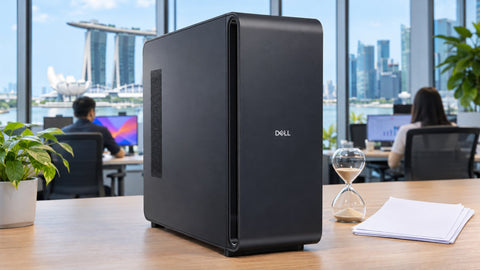
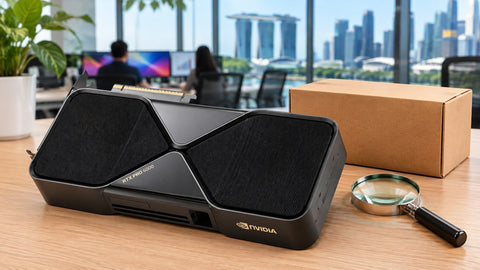
Usually not as much as companies assume. When you use a hosted AI model, you own your prompts, documents and outputs. Business terms at the major vendors say that data is not used for training by default. What you don't control is the model itself: which version is available, how much each token costs, how long logs are kept, which regions process requests, and who is allowed to buy the service at all. The vendor sets those terms and has changed them repeatedly. Owning the data protects your information. Controlling the AI means managing those dependencies, by contract, by architecture, and for some workloads by running open-weight models on hardware such as the NVIDIA DGX Station GB300.
Which parts of a hosted AI service does the vendor decide?
Every dependency in the table has changed at least once in the past two years. The right-hand columns show how much control you have under each approach.
| Dependency | Dated example | What you control on a cloud API | What you control self-hosted |
|---|---|---|---|
| Model availability | OpenAI retired GPT-4o from ChatGPT on 13 Feb 2026; GPT-4o and GPT-4.1 leave the API on 14 Jan 2027. Anthropic's Claude Sonnet 4.5 retires on 30 Nov 2026. | Which supported model you call; notice periods (OpenAI: at least six months for GA models; Anthropic: at least 60 days) | The weights you downloaded keep working |
| Price per token | Gemini 4 Argon goes from $2/$10 to $4/$20 per million input/output tokens on 1 Dec 2026 (Google pricing page) | Commitments and discounts you negotiate; batch and caching | Mostly fixed after purchase: power, support, staff |
| Tokens per task | Anthropic says Claude 4.7 and later use a tokenizer that produces "approximately 30% more tokens for the same text" | Little; you can measure and switch | Your choice of model and tokenizer |
| Plan structure | Claude Enterprise moved to US$20 per seat plus usage at API rates in Apr 2026 | Contract renewal terms | Not applicable |
| APIs and features | OpenAI's Assistants API shut down on 26 Aug 2026 | Migration timing within the notice period | Open-source serving stacks you can pin |
| Spend and rate limits | Anthropic usage pauses until the 1st of the next month when a tier's monthly spend cap is reached | Tier upgrades and limit requests | Limited only by your hardware |
| Who may buy | Anthropic barred entities more than 50% owned by companies headquartered in unsupported regions (4 Sep 2025) | None | Open-weight licence terms only |
| Availability | Anthropic reported elevated errors for at least 7.5 hours on 2 Mar 2026 | Fallback to a second provider | Your own uptime, which you must engineer |
Sources: OpenAI deprecations page and retirement notice (29 Jan 2026); Anthropic model deprecations, pricing, rate-limits and sales-restriction pages; Google Gemini API pricing; BleepingComputer (2 Mar 2026). All accessed 5 Nov 2026. Vendor terms change frequently; check the current pages.
Isn't data ownership the part that matters most?
It matters, and the major vendors' business terms are clear about it. OpenAI states that "data sent to the OpenAI API is not used to train or improve OpenAI models" unless you opt in. Anthropic says it does not use inputs or outputs from commercial products for training by default and deletes them within 30 days. Google and Microsoft make similar commitments for their business AI products.
But ownership and control are different things. Owning your data means nobody else may use it. Controlling the AI means your processes keep working, at a predictable cost, whatever the supplier decides. A customer-service flow tuned on one model can start behaving differently when that model is retired. A finance team's monthly reporting automation can double in cost when a price schedule changes. The data was yours throughout. What you lost was continuity.
You can own every byte you send to an AI service and still have no say in the model that answers.
How much control can you keep while staying on cloud AI?
Quite a lot, if you design for it:
- Put a gateway in front of every model. Tools such as LiteLLM's proxy let staff and applications call one internal endpoint while IT routes requests to OpenAI, Anthropic, Google or a local model. Switching suppliers becomes a configuration change rather than a rewrite.
- Pin versions and keep an evaluation set. Call dated model versions where the vendor allows it. Keep a set of real test prompts so you can check a replacement model before the retirement date arrives.
- Negotiate the terms that matter to you: retention (OpenAI and Anthropic both offer Zero Data Retention to approved customers, with exclusions), data residency options, notice periods and price protection.
- Plan for outages. Decide which processes can wait and which need a second provider or a local fallback. See what happens when a cloud service goes down.
What extra control does running your own model add?
A self-hosted open-weight model removes four of the dependencies in the table outright: availability, price per token, plan structure and who may buy. You download the weights, serve them through an OpenAI-compatible server such as vLLM or NVIDIA NIM, and keep that exact version for as long as it is useful. A DGX Station GB300, with 252GB of HBM3e and 496GB of LPDDR5X, can host open models in the 100B-parameter class and above for many users at once. Our private AI cloud post explains how departments can share one.
The trade is that you take on the dependencies the vendor used to carry: uptime, security patching, backups and upgrades. Answer quality is also a factor. As of 5 Nov 2026, the best model on Artificial Analysis's open-weights list scored 33 on its Intelligence Index, against 55 to 60 for the leading closed models. For many internal tasks, such as summarising, extracting and classifying, that gap may not matter. For hard reasoning or coding, it may. Test with your own work before deciding.
What should you ask an AI vendor before you depend on it?
- How much notice do you give before retiring a model, and is that in the contract?
- Can we pin a dated model version, and for how long?
- Where are our prompts processed, not just stored, and can we choose?
- How long are prompts and outputs retained, and are we eligible for zero retention?
- What happens to our price when a new model generation launches?
- What are our spend and rate limits, and what happens when we hit them?
- Is there an export of our configurations, agents and conversation history in a usable format?
The answers tell you how much of your AI you actually control. For the bigger picture on keeping workloads close to home, read Sovereign AI: Why Should Your Company's Intelligence Live on Someone Else's Server? and AI token inflation. For the staff side of the risk, see are businesses too dependent on ChatGPT.
Buying in Singapore
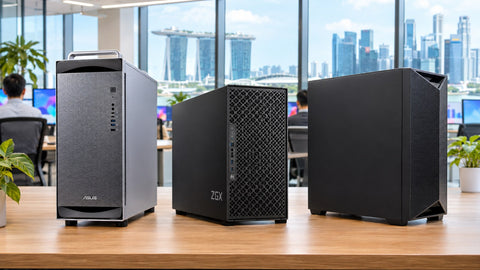
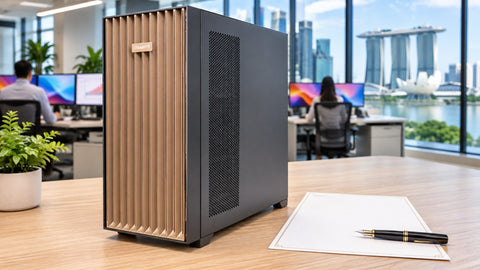
If you want an internal fallback or a fully self-hosted model, SourceIT lists DGX Station GB300 systems from HP, MSI, ASUS, GIGABYTE and Supermicro, all price on request. For a smaller start, the HP ZGX Nano G1n with 128GB of unified memory and 4TB is S$11,499, and the NVIDIA DGX Spark 4TB is S$9,300 (both listed 5 Nov 2026). See the full DGX Spark and DGX Station collection. For a quotation, use Request for Quotation on the product page, call (65) 6978 3502, email Sales@sourceit.com.sg or use our contact page.
Frequently asked questions
If a vendor doesn't train on my data, what is the risk? Dependence rather than misuse. The vendor still decides which models exist, what they cost, how they behave and how long logs are kept. Each of those has changed at major vendors within the past two years.
How much notice do vendors give before retiring a model? OpenAI's deprecations page says generally available models get at least six months' notice. Anthropic commits to at least 60 days. Preview models can be withdrawn faster.
Can I avoid lock-in without leaving cloud AI? Largely, yes. Route requests through an internal gateway, keep an evaluation set of your own prompts, pin model versions and negotiate retention and notice terms in the contract.
Do open-weight models ever expire? The weights you download keep working regardless of what the publisher releases next, subject to the licence. You are responsible for security updates to the serving software around them.
Are open-weight models as good as closed ones? Not at the top end yet. On Artificial Analysis's index, the best open-weights model scored 33 against 55 to 60 for leading closed models as of 5 Nov 2026. For routine internal tasks the gap may be acceptable; test with your own data.