AI Hardware Depreciation: How Fast Does It Lose Value, and When Should You Upgrade?

AI hardware is announced on a roughly yearly rhythm, and each generation makes the last look slow on a chart. That creates a fear of buying anything. The fear confuses two things. Resale value does fall quickly once a successor ships. Usefulness falls much more slowly, because a system that runs your model for your users at an acceptable speed today will do exactly the same in three years. For a business, the sensible way to treat an AI system is as a tool with a working life of about three to five years, costed per month, and replaced when a specific limit is reached, not when a new model is announced.
Why does AI hardware seem to age so fast?
- Frequent launches. New accelerators arrive about once a year, with large headline gains.
- Growing models. The largest models keep getting larger, so the frontier always needs newer hardware.
- Efficiency gains. Newer chips do more work per watt, which matters at data-centre scale.
All three are real, and all three matter most to organisations chasing the frontier or paying data-centre power bills. An office running an internal assistant is in a different position.
Why does it stay useful for longer than that?
- Software keeps improving on existing hardware. Better quantisation, inference engines and techniques such as speculative decoding have made the same machine faster over time.
- Smaller models keep getting better. A model that fits in a given amount of memory this year is typically more capable than one of the same size a year earlier. See small vs large language models.
- Your workload is not the frontier. Document questions, drafting, summarising and coding help do not need the largest model in existence.
- Old systems get second jobs. A retired main server becomes a test machine, an embedding server or a development box.
What does it really cost per month?
CALC. Take a desktop AI system bought for S$10,350, used for 3 years, then sold or redeployed at an assumed 20 percent of its purchase price.
- Residual value: 10,350 x 0.20 = S$2,070.
- Net cost over the period: 10,350 - 2,070 = S$8,280.
- Per month: 8,280 / 36 = S$230.
- Shared by 15 staff: 230 / 15 = S$15.33 per person per month.
Assume the worst case, that it is worth nothing at the end: 10,350 / 36 = S$287.50 a month, or S$19.17 per person for 15 staff. Electricity, setup time and support are extra. The residual percentage is an assumption for illustration, not a forecast; resale prices for AI hardware depend heavily on supply at the time. The fuller comparison with subscription pricing is in local AI vs cloud API cost model.
On tax, Singapore's capital allowance rules let businesses write off qualifying computer equipment over a short period, which affects the after-tax cost. The treatment depends on your circumstances, so confirm it with your accountant.
Hardware does not become slower when its successor is announced. It becomes cheaper to replace. Those are different facts, and only one of them is a reason to act.
What are good reasons to upgrade?
| Signal | What it means |
|---|---|
| The model you need does not fit in memory | A hard limit; no software fix |
| Users queue at peak times despite tuning | Capacity is exhausted |
| Response speed is below what the task needs | Compute or memory bandwidth limit |
| Drivers, firmware or the software stack are no longer supported | Security and compatibility risk |
| Warranty has ended and a failure would stop the business | Risk, not performance |
| Power or cooling cost of the old system exceeds the cost of replacing it | Mostly a data-centre concern |
What are poor reasons to upgrade?
- A new generation was announced.
- A benchmark shows a higher number on a workload you do not run.
- The current system has not been tuned: wrong engine, no batching, model at unnecessarily high precision. Check continuous batching and quantisation first.
- A general sense of falling behind. See your next IT upgrade could be a downgrade.
How do you buy so that it lasts?
- Buy memory headroom. Memory is the limit that software cannot work around. It is the specification most worth stretching for. See why 128GB of unified memory matters.
- Stay on the mainstream software platform. Hardware with broad framework support keeps receiving optimisations for years.
- Prefer systems that scale. Some desktop AI systems can be linked in pairs; workstations can take a second GPU.
- Size for the workload you have, plus a margin. Not for a hypothetical one.
- Do not wait for the next generation indefinitely. There is always one. The months spent waiting are months without the tool.
- Plan the second life. Decide in advance what the system will do when it is replaced.
- Keep records. Measure usage and speed, so the upgrade decision is made on data. See AI monitoring and observability.
Buying in Singapore
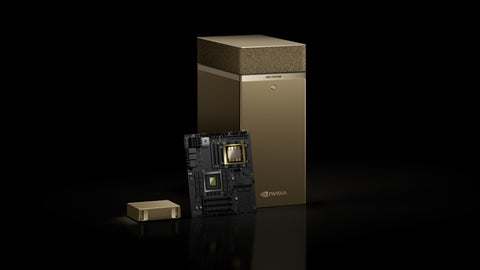
Desktop AI systems with 128GB of unified memory: the NVIDIA DGX Spark 4TB (S$9,450), the ASUS Ascent GX10 1TB (S$10,350) and the HP ZGX Nano G1n 4TB (S$11,499). For a workstation that can be upgraded in place, the NVIDIA RTX PRO 6000 Blackwell Workstation Edition with 96GB (S$29,100) (listed 11 Nov 2026; prices change; ask for a current quotation). DGX Station GB300 systems such as the ASUS ExpertCenter Pro ET900N G3 are price on request. To start, use Request for Quotation on the product page, call (65) 6978 3502, email Sales@sourceit.com.sg or use our contact page.
Frequently asked questions
How long does AI hardware last? For business inference workloads, a working life of about three to five years is a reasonable planning assumption. Resale value falls faster than usefulness, because the system keeps doing the job it was bought for.
When should I upgrade my AI hardware? When a specific limit is reached: the model you need no longer fits in memory, users queue at peak times after tuning, software support ends, or the warranty has expired on a system the business depends on.
Should I wait for the next generation before buying? Only if the launch is imminent and you need what it adds. There is always a newer generation coming, and waiting has a cost in months without the capability.
What specification keeps an AI system useful longest? Memory. It determines which models fit and cannot be compensated for by software, whereas speed often improves over time through better inference software.

SourceIT Approved
Researched and verified by the SourceIT team for Singapore buyers.