In factories, buildings and field sites, an AI gateway is a small computer that sits between equipment and the wider network. It collects data from sensors, cameras and machine controllers, runs an AI model on that data locally, acts on the result or raises an alert, and forwards only the useful summary to a server or the cloud. It is an ordinary IoT gateway with enough computing power to make decisions on site. One clarification before going further: the same term is also used in software for a service that routes and controls requests to language models. This article is about the hardware kind; the software kind is covered in AI model serving explained.
What does an AI gateway do?
- Connects. It speaks the languages of the equipment: serial ports, industrial protocols such as Modbus and OPC UA, messaging protocols such as MQTT, and network cameras.
- Collects and cleans. It timestamps, filters and buffers readings, and keeps collecting if the uplink fails.
- Infers. It runs a model on the data: is this vibration pattern abnormal, is this part defective, is someone inside the safety zone.
- Acts. It triggers a local response, such as an alarm, a signal to a controller or a work order.
- Reports. It sends results, not raw data, upstream for dashboards and long-term analysis.
- Is managed. It receives model and software updates remotely.
How is it different from an IoT gateway or an industrial PC?
| IoT gateway | AI gateway | Edge AI server | |
|---|---|---|---|
| Main job | Translate and forward data | Collect, infer and act locally | Heavy inference for a whole site |
| Compute | Low-power processor | Processor plus AI accelerator | One or more GPUs |
| Typical models | None, or simple rules | Vision, anomaly detection, small language models | Many streams, larger models |
| Location | In the cabinet | In the cabinet or on the machine | Server room or rack on site |
| Depends on uplink | For anything intelligent | No | No |
Why not send everything to the cloud?
Three reasons, in most projects. Reaction time: a decision that must be made within milliseconds cannot wait for a round trip. Data volume: vibration sensors sampled thousands of times a second and multiple video streams produce more than is sensible to upload. Continuity: production should not stop because the internet did. A gateway also keeps raw operational data on site, which simplifies conversations about confidentiality. The numbers are worked through in edge AI vs cloud AI.
What is it used for?
| Use | Input | What the model decides |
|---|---|---|
| Predictive maintenance | Vibration, temperature, current | Normal or developing fault |
| Visual quality inspection | Camera on the line | Pass or reject, defect type |
| Worker safety | Cameras | Person in a restricted zone, missing protective equipment |
| Energy optimisation | Meters, building systems | Abnormal consumption, setpoint changes |
| Cold chain and environment | Temperature, humidity, door sensors | Excursion likely before it happens |
| Counting and flow | Cameras, sensors | Throughput, queue length |
A sensor produces numbers. A gateway turns them into a decision at the place and moment the decision is useful.
What should you look for in the hardware?
- AI performance for the actual model. One camera with a small detection model is a very different load from eight cameras or a language model. Size from the workload.
- Memory. It sets how large a model, and how many at once, the gateway can hold.
- Interfaces. Serial ports, digital inputs and outputs, multiple Ethernet ports, PoE for cameras, and whatever fieldbus the equipment uses.
- Environment. Fanless cooling, wide operating temperature, tolerance of dust and vibration, DIN-rail or wall mounting, and a wide-range DC power input.
- Storage. Industrial-grade solid-state storage, with enough room to buffer data during an outage.
- Software and lifecycle. A supported operating system, container support, remote management and a product that will still be available in five years.
- Security. Secure boot, encrypted storage, and a network design that separates the plant side from the office side.
The environmental points are covered in more depth in AI mini PC vs industrial computer.
Developer kit or finished gateway?
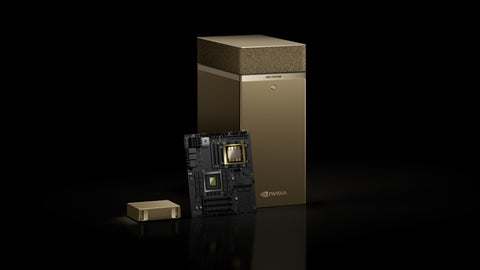
NVIDIA Jetson is a widely used platform for AI gateways. The developer kits are the place to build and test: NVIDIA states up to 67 TOPS for the Jetson Orin Nano Super and up to 275 TOPS for the Jetson AGX Orin 64GB. A developer kit is an open board with a fan, intended for the bench. For a factory floor, the same Jetson module is normally deployed inside a ruggedised, fanless enclosure from an industrial computer maker, with the ports and certifications the site needs. Prototype on the kit, then specify the production unit from what you learned.
Source: NVIDIA Jetson product specifications. Compiled 11 Nov 2026.
Buying in Singapore
For prototyping, the NVIDIA Jetson Orin Nano Super 8GB Developer Kit (S$696) for single-camera and sensor work, the Jetson AGX Orin 64GB Developer Kit (S$5,871.60) for multi-stream vision, and the Jetson AGX Thor 128GB Developer Kit (S$9,075.60) for robotics and on-device language models (listed 11 Nov 2026; prices change; ask for a current quotation). Ruggedised production gateways are not listed in our store; tell us the environment, interfaces and model and we will source and quote them. To start, use Request for Quotation on the product page, call (65) 6978 3502, email Sales@sourceit.com.sg or use our contact page.
Frequently asked questions
What is an AI gateway? In industrial and IoT settings, an AI gateway is an edge computer that collects data from sensors, cameras and machines, runs AI models on it locally and sends only the results to central systems.
How is an AI gateway different from an IoT gateway? An IoT gateway mainly translates and forwards data. An AI gateway adds an AI accelerator so it can analyse the data and act on it on site, without depending on a cloud connection.
Is an AI gateway the same as an LLM gateway? No. An LLM gateway is software that routes and controls requests to language models. An industrial AI gateway is hardware that connects equipment to edge AI. The two share a name only.
Can a Jetson developer kit be used as an AI gateway? It is suitable for development and pilots. For permanent installation in harsh environments, the same Jetson module is usually deployed in a ruggedised, fanless enclosure.

SourceIT Approved
Researched and verified by the SourceIT team for Singapore buyers.