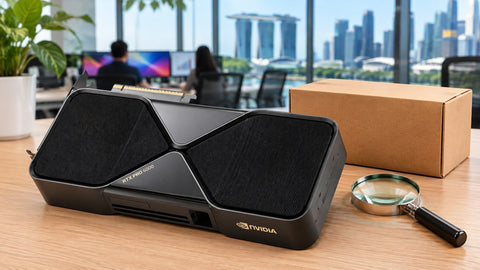
For now, in part. The RTX 5090 and the RTX PRO 6000 Blackwell both use NVIDIA's GB202 chip, and both have become harder and more expensive to buy as standalone cards in 2026. US street prices for the RTX 5090 ran at three to four times its MSRP in October and November. NVIDIA's own US price for the RTX PRO 6000 rose from US$8,565 at launch to US$16,000. Memory shortages are the main reason NVIDIA has given. Meanwhile complete systems from OEMs have often been easier to get, and sometimes barely dearer than the card alone. That is a market shift, not an announced policy: NVIDIA still sells both cards, and it says the RTX 5090 will keep shipping.
How much have standalone prices moved?
| Item | Earlier price | Late-2026 price | Source |
|---|---|---|---|
| GeForce RTX 5090 (US) | US$1,999 MSRP (Jan 2025, unchanged) | About US$6,542 (eBay average, Nov 2026) to US$8,477 (tracker, 26 Oct 2026) | NVIDIA; eBay data; Tom's Hardware |
| RTX PRO 6000 Blackwell (US) | US$8,565 (Mar 2025) | US$13,250 (Jun 2026), then US$16,000 (Aug–Oct 2026) | NVIDIA Marketplace listings |
| 32 GB DDR5-6000 kit (US) | US$90 (Jul 2025) | US$459 (Jul 2026) | Tom's Hardware |
| 32 GB DDR5 kit (Singapore) | S$195 (Aug 2025) | S$763 (Aug 2026) | Sim Lim Square check, The Straits Times |
| RTX 5060-series card (Singapore) | S$572 (Aug 2025) | S$824 (Aug 2026) | Same |
Source: NVIDIA product and Marketplace pages; eBay lowest-three average (Nov 2026); Tom's Hardware price tracker (26 Oct 2026) and DDR5 report (28 Jul 2026); The Straits Times via Malay Mail (13 Sep 2026). NVIDIA gave no reason for the RTX PRO 6000 price changes. US prices exclude sales tax; Singapore prices include GST.
By our arithmetic, the RTX PRO 6000's US list price rose about 87% between March 2025 and August 2026. The RTX 5090's US street price was about 3.3 to 4.2 times its MSRP in the October–November figures above.
Why is GPU supply so tight?
Memory is the factor NVIDIA has named. In January 2026 it said that "memory supply is constrained" while it continued to ship GeForce cards. TrendForce estimated that conventional DRAM contract prices rose 90–95% in the first quarter of 2026. Its September outlook expected increases to slow to 10–15% in the fourth quarter, but said GDDR7 output "remains limited" because advanced capacity is going to server memory. Micron left the Crucial consumer business, with shipments ending in February 2026, and in September it said fiscal 2027–28 would be "much tighter" than 2026. We explain why AI demand reaches the graphics card market in is AI taking graphics cards away from gamers.
The chip itself adds a second pressure. The same GB202 die goes into a 32 GB RTX 5090 and a 96 GB RTX PRO 6000. Gigabyte's CEO, speaking at CES in January 2026, described NVIDIA as potentially weighing revenue per gigabyte of memory when deciding which products get supply. In October, X user Zed__Wang (MEGAsizeGPU) claimed future GB202 supply would go to RTX PRO cards only. Both are claims, not NVIDIA statements, but they show why the consumer card feels the squeeze first.
What do "allocations" mean in practice?
Board partners don't buy GPUs on an open market. They receive allocations of chips, usually bundled with memory, and several reports in 2026 said those allocations were cut. Board Channels reported cuts of up to 40% for the first half of 2026, The Information reported a 20% GeForce supply cut, and der8auer's sources said in October that RTX 5090 chip and memory kits could no longer be ordered. NVIDIA has confirmed no percentage, and each of these is a report rather than a confirmed figure.
Retail showed the result. Micro Center began requiring photo ID and a signed no-export declaration to buy an RTX 5090, then marked listings "Not Carried". NVIDIA's US Marketplace removed the RTX 5090 in mid-October and the RTX 5080 around 30 October. For the RTX PRO 6000, reseller Viperatech claims that full systems are prioritised over standalone cards and quotes lead times of weeks to months. That is a vendor claim we could not verify. The question of whether this adds up to a deliberate push is the subject of is NVIDIA quietly pushing buyers towards complete workstations.
The card hasn't become a luxury product. It has become a scarce component, and scarce components cost most when you buy them on their own.
Are complete workstations the better buy now?
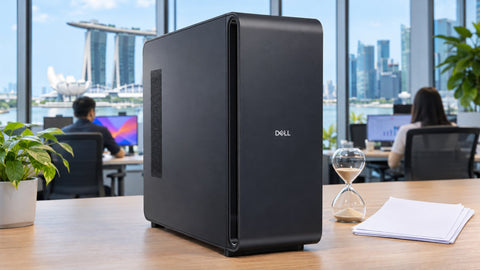
Often they are close. On 6 November 2026, Dell's US configurator listed the Pro Max Tower T2 from US$1,499 with an RTX PRO 6000 Workstation Edition option at US$15,550. That comes to about US$17,049 for a complete workstation, roughly US$1,049 more than NVIDIA's US$16,000 Marketplace price for the card alone. On the consumer side, several US RTX 5090 desktops sold at or below a standalone card's price between May and September 2026.
The trade-offs are real. That Dell configuration offers a single Workstation Edition card, no Max-Q option, a 128 GB memory ceiling and a default 12-month basic warranty, so a serious build needs upgrades. OEM systems also fix the case, power supply and slot layout. Our post on buying the RTX PRO 6000 alone or as a complete workstation works through that decision, and building an RTX PRO 6000 workstation versus a DGX Station covers the cost of each route.
Who should still buy the card on its own?
- You already own a suitable workstation. If the chassis, power supply and cooling are rated for the card, a standalone RTX PRO 6000 is the cheapest upgrade. Check the maker's supported-GPU list first.
- You are replacing an older pro card, such as an RTX A6000 or RTX 6000 Ada, in a system your IT team already supports.
- You need a specific edition. Multi-GPU workstations use the 300 W Max-Q, and some OEM configurators only offer one edition.
- You want the card's own warranty. NVIDIA gives RTX PRO cards a three-year warranty handled by the seller. It does not supply spare parts.
NVIDIA has not made the RTX PRO 6000 an OEM-only product: it sells the card on its own Marketplace, and its pages direct buyers to "find an NVIDIA partner". For whether the card is worth it at all, see RTX PRO 6000 Blackwell: brilliant or overkill, and for the RTX 5090 owner's view, RTX 5090 vs RTX PRO 6000: 32 GB vs 96 GB.
Is this permanent?
Probably not, but it may last. IDC told The Straits Times it expects elevated PC prices through 2027, with relief more likely from 2028. Micron expects fiscal 2027–28 to be tighter than 2026. Demand hasn't collapsed, though: Jon Peddie Research reported add-in board shipments up 10% quarter on quarter in the second quarter of 2026, with high-end sales rising as prices increased; its theory is that buyers rushed in before prices went higher. Price swings like these are why IT quotations now carry short validity periods, as we explained in why IT prices change overnight. The same memory squeeze is pushing up laptop prices too, as covered in AI is eating the world's RAM.
Buying in Singapore
Unlike the RTX 5090, SourceIT's RTX PRO cards are in stock at the time of writing. The RTX PRO 6000 Blackwell Workstation Edition and the 300 W Max-Q Workstation Edition are S$29,100 each, and the 48 GB RTX PRO 5000 Blackwell is S$14,971.20. For a complete system, the HP Z4 G5 with a Xeon W3-2425 and an RTX PRO 4000 Blackwell is S$11,608 (all listed 6 Nov 2026). We can also quote HP Z, Lenovo ThinkStation and Dell Pro Max workstations configured with an RTX PRO 6000. RTX 5090 cards are not in stock; ask us about availability. Prices change, so ask for a current quotation. Use Request for Quotation on the product page, call (65) 6978 3502, email Sales@sourceit.com.sg or use our contact page.
Frequently asked questions
Why did the RTX PRO 6000 price go up? NVIDIA's US Marketplace price rose from US$8,565 at launch in March 2025 to US$13,250 in June 2026 and US$16,000 in August 2026. NVIDIA did not give a reason, but it has said memory supply is constrained across its products.
Is NVIDIA stopping sales of standalone graphics cards? No. NVIDIA still sells the RTX PRO 6000 card on its Marketplace, and in October 2026 an NVIDIA senior vice president said the RTX 5090 had not been discontinued and would continue to ship.
Are GPU allocations being cut? Several reports in 2026 said board-partner allocations were reduced, by figures from 20% to 40%, and that RTX 5090 kits could no longer be ordered. NVIDIA has not confirmed any percentage.
Is a complete workstation cheaper than buying the card? Not usually cheaper, but often close. Dell's US configurator priced a Pro Max T2 with an RTX PRO 6000 at about US$1,049 more than NVIDIA's own card price in November 2026.
Will GPU prices come down in 2027? Forecasts suggest not quickly. IDC expects elevated PC prices through 2027, and Micron expects memory supply to be tighter in fiscal 2027–28 than in 2026.