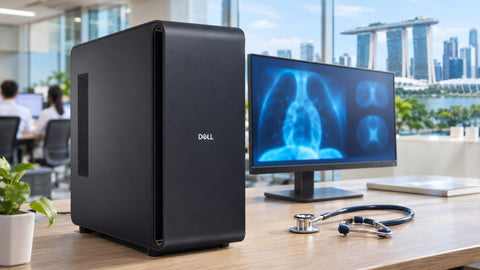
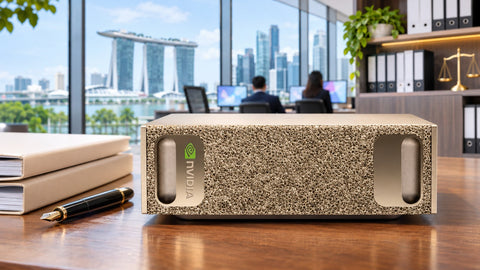
For many teams, an RTX PRO 6000 workstation is the better value. A single-card build costs well under a third of a DGX Station, runs x86 software and graphics, and on published inference results delivers similar throughput per dollar on models that fit in 96 GB. The DGX Station GB300 becomes necessary when your models no longer fit on one 96 GB card, when splitting them across PCIe cards starts to cost more performance than it saves in price, or when you need very large models served to many users from one quiet, 1,600 W box.
What does each route cost?
| Configuration | GPU memory | GPU power | Illustrative cost (S$) | Measured or estimated throughput, GPT-OSS-120B, 128 concurrent |
|---|---|---|---|---|
| 1x RTX PRO 6000 Workstation Edition + host | 96 GB | 600 W | 44,100 (29,100 card + 15,000 host) | 3,064 tok/s (measured, one card) |
| 2x RTX PRO 6000 Max-Q + host | 192 GB (2 x 96 GB) | 600 W | 83,200 (58,200 cards + 25,000 host) | About 6,100 tok/s if run as two copies (estimate, not measured) |
| 4x RTX PRO 6000 Max-Q + host | 384 GB (4 x 96 GB) | 1,200 W | 141,400 (116,400 cards + 25,000 host) | Not published for this model |
| DGX Station GB300 | 252 GB HBM3e + 496 GB LPDDR5X | 1,600 W system | About 150,000 (assumption) | 9,280 tok/s (measured, ASUS ET900N G3) |
Source: card prices from SourceIT's listings (S$29,100 each, listed 6 Nov 2026). Host costs of S$15,000 (single card) and S$25,000 (two to four cards, 2,000 W-class) are our illustrative assumptions for a validated Xeon W or Threadripper PRO tower with RAM and storage, not quotations. GB300 at the series ballpark: public US pricing of roughly US$93,000 to US$125,000 is about S$119,000 to S$160,000 before GST at USD/SGD 1.279 (6 Nov 2026). Throughput from StorageReview (vLLM, 512 in / 512 out). The two-card figure assumes two independent copies scale close to linearly, as replicas did in Helix's published tests; it is not a measurement.
Is a conventional workstation really better value?
On the numbers above, roughly yes for models that fit. Our arithmetic gives about 69 tok/s per S$1,000 for the single-card workstation, about 74 for two cards run as copies, and about 62 for the GB300. Those figures move with your host cost and the GB300 quote, so treat them as a range, not a ranking. The bigger point is what else the money buys:
- A lower entry price: about S$106,000 less than a GB300 for the single-card build, on these assumptions.
- A growth path: start with one card and add more as workloads justify them, if you choose a chassis and power supply that support it from day one.
- Everything else a workstation does: display output, rendering, CAD, video and x86 Windows or Linux tools. The GB300 needs an add-in card for any display.
- Lower risk per card: one failed card in a multi-card build leaves the others running. A GB300 is one superchip.
- Cheaper options in the same family: if 48 GB is enough, the RTX PRO 5000 Blackwell costs about half as much as the 6000.
Our RTX PRO 6000 verdict covers who the card suits, and our 600 W power guide covers what the host needs.
When does the GB300 become necessary?
Four signals tell you a workstation build has reached its limit.
- Your model doesn't fit on one card. A practitioner sizing rule leaves about 83 GiB for weights on a 96 GB card once the engine reserves memory. Llama 3.3 70B at BF16 (about 141 GB), Qwen3-235B at FP8 (about 236 GB) and DeepSeek-V3 at FP8 (about 689 GB) all exceed it. The first needs two cards, the second four, and the third more than four.
- Splitting stops scaling. RTX PRO 6000 cards have no NVLink, so a split model talks over PCIe. Published results show this works at two to four cards but falls behind NVLink systems at eight: CloudRift found 8-GPU H100 and H200 systems delivered 3 to 4 times the throughput of eight PCIe-bound RTX PRO 6000s on GLM-4.6-FP8. Expert-parallel layouts on PCIe were called "catastrophic" in one vLLM forum report.
- You need one big model for many users. GB300's 7.1 TB/s of HBM3e bandwidth and 20 PFLOPS of sparse FP4 compute are built for this. It's where the measured 3.0x gap on GPT-OSS-120B comes from.
- Power and space are tight. A four-card Max-Q workstation needs about 1,750 W before headroom and often a 2,200 to 2,700 W power supply. A GB300 system stays within 1,600 W.
Build the workstation for the models you run today; buy the GB300 when the model you need tomorrow won't fit on a card.
What do multi-card workstations cost you in effort?
More than the price list suggests. Two or four cards need a CPU platform with enough PCIe lanes, such as Threadripper PRO or Xeon W. Getting peer-to-peer transfers working between RTX PRO 6000 cards has needed IOMMU and ACS changes in user reports, with hangs reported on some boards. Choosing the right inference engine matters too: on the same eight cards, Helix measured a 7.8x difference between engines. A GB300 avoids most of this because a 252 GB model runs on one GPU. Our posts on multi-GPU AI without NVLink and four-card 384 GB builds go into the details.
Which should you choose?
- Build an RTX PRO 6000 workstation if your largest model fits in about 85 GB, you have one to three users, you also need graphics or x86 software, or you want to start small.
- Consider two to four cards if you run several models side by side, or one model up to about 330 GB that splits cleanly by layer or tensor across PCIe.
- Buy a GB300 if you need large models beyond 96 GB at high throughput, simple single-GPU software, or a shared departmental AI system. Our comparison of RTX PRO 6000 vs DGX Station GB300 sets the two side by side, and GB300 vs traditional RTX workstations covers the interconnect question.
Buying in Singapore
SourceIT lists the RTX PRO 6000 Blackwell Workstation Edition at S$29,100 here, the Max-Q at S$29,100 here and the 48 GB RTX PRO 5000 Blackwell at S$14,971.20 here (listed 6 Nov 2026; prices change, so ask for a current quotation). Our AI workstations and AI servers collection includes host systems. The HP Z4 G5 we list ships with an RTX PRO 4000 and an 1,125 W supply, so ask us before planning a 600 W card in it; we can quote validated multi-GPU towers on request. DGX Station GB300 systems such as the HP ZGX Fury G1n and Supermicro Super AI Station are price on request. Use Request for Quotation on the product page, call (65) 6978 3502, email Sales@sourceit.com.sg or use our contact page.
Frequently asked questions
Is an RTX PRO 6000 workstation cheaper than a DGX Station? Yes. With the card at S$29,100 and an assumed S$15,000 host, a single-card build is about S$44,100, against a GB300 ballpark of around S$150,000.
Is it better value for AI inference? For models that fit in 96 GB, roughly. Our arithmetic from published results gives about 69 tok/s per S$1,000 for a single-card workstation and about 62 for a GB300 on GPT-OSS-120B, depending on actual quotes.
When do I need a DGX Station instead? When your models exceed one card's memory and splitting across PCIe hurts, when one large model serves many users, or when you need more than 384 GB in one system.
Can four RTX PRO 6000 cards match a GB300? They give more total GPU memory (384 GB vs 252 GB of HBM3e), but as four separate 96 GB pools joined by PCIe. For one large model, the GB300 is usually simpler and faster.
Can I add cards to a workstation later? Yes, if the chassis, power supply and CPU platform support them. Plan for this when you buy the host.

SourceIT Approved
Researched and verified by the SourceIT team for Singapore buyers.