Partly, yes, but mostly through memory rather than graphics chips themselves. AI data centres now generate more than nine-tenths of NVIDIA's revenue. Memory makers have shifted their capacity towards the high-bandwidth and server memory that AI systems use, so the GDDR7 on gaming cards and the DDR5 in gaming PCs have become scarce and expensive. NVIDIA's own explanation for tight GeForce supply is that "memory supply is constrained". Gamers aren't being deliberately cut off, but they are competing with the most profitable buyers in the industry for the same scarce parts, and losing on price.
How much does AI now matter to NVIDIA?
| Quarter | Total revenue | Data Center | Gaming | Data Center share (our calc) |
|---|---|---|---|---|
| Q1 FY26 (to Apr 2025) | US$44.1 bn | US$39.1 bn | US$3.8 bn (record) | about 89% |
| Q4 FY26 (to Jan 2026) | US$68.1 bn | US$62.3 bn | US$3.7 bn | about 91% |
| Q1 FY27 (to Apr 2026) | US$81.6 bn | US$75.2 bn | No longer reported | about 92% |
| Q2 FY27 (to Jul 2026) | US$96.2 bn | US$89.0 bn | No longer reported | about 93% |
Source: NVIDIA quarterly results as published by NVIDIA and reported by Tom's Hardware and ServeTheHome. From Q1 FY27, NVIDIA reports an "Edge Computing" platform (US$6.4 bn and US$7.2 bn) that covers PCs, workstations, robotics, automotive and more, so it cannot be read as gaming revenue. NVIDIA's Q3 FY27 results are due on 17 November 2026.
Gaming revenue didn't collapse in FY26: it set a record in the first quarter. It simply became a much smaller part of a much larger business, about 9% of revenue in early 2025 and about 5% by early 2026 by our arithmetic. Then NVIDIA stopped reporting it separately.
Is AI taking the chips or the memory?
The clearest evidence points to memory. TrendForce estimated that conventional DRAM contract prices rose 90–95% in the first quarter of 2026, with PC DRAM up more than 100%. By September it expected increases to moderate to 10–15% in the fourth quarter. It added that GDDR7 output "remains limited as advanced-process capacity is increasingly allocated to applications such as server DRAM". Micron confirmed in December 2025 that it would exit the Crucial consumer business to support its "larger, strategic customers". In September 2026, Micron said it expected fiscal 2027–28 to be "much tighter" than 2026. Omdia estimated that memory costs had risen about fivefold since early 2025.
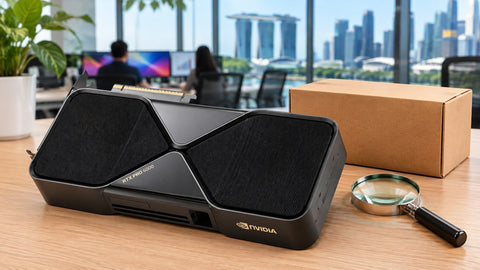
The chip side is less clear-cut. The RTX 5090 shares its GB202 chip with the RTX PRO 6000 Blackwell, which carries three times the memory and sells for several times the price. Leakers claim new GB202 supply is going to professional cards. That is plausible, but NVIDIA hasn't confirmed it. Gigabyte's CEO said in January 2026 that NVIDIA could weigh the revenue each segment earns per gigabyte of memory. That is a description of a possible approach, not a confirmed policy. Our RTX 5090 rumours explainer lists who said what. NVIDIA's data-centre parts also depend on TSMC's advanced packaging, but we found no source that ties that capacity to GeForce cards.
Gamers and AI data centres now want the same memory. When one buyer pays far more per gigabyte, it isn't hard to guess who gets served first.
What has it done to prices for gamers?
- Flagship cards: the RTX 5090 launched at US$1,999. Tom's Hardware found it at about US$8,500 on Amazon in October 2026, and the November eBay average was about US$6,542. TechSpot data cited by Wccftech put the RTX 5080 at about US$2,200 in October, against a US$999 launch price.
- Board partners: MSI told investors in March 2026 it expected to raise gaming hardware prices by 15–30%, calling 2026 "the most challenging year since the company was founded".
- AMD too: AMD's China reference price for the RX 9070 XT rose from ¥5,599 to ¥6,999 in September 2026, about 25% by our arithmetic. That is a China-only move, not a US price change.
- Singapore: IDC data reported by The Straits Times (13 Sep 2026) showed gaming desktop prices up 39% year on year, to nearly S$1,860 on average. A check at Sim Lim Square found 32 GB DDR5 kits up from S$195 to S$763 and RTX 5060-series cards up 44%, from S$572 to S$824.
Memory is the common thread, which is why office laptops have been hit too, as our post on AI eating the world's RAM explains.
Are gamers actually buying fewer graphics cards?
Not yet, by the industry's count. Jon Peddie Research counted about 12.5 million add-in graphics cards shipped in Q2 2026, up 10% on the previous quarter and about 7% on the year. Jon Peddie's explanation was that buyers rushed to purchase "before the prices went any higher". NVIDIA held about 94% of add-in card shipments at the end of 2025. Retailers tell a rougher story: four Sim Lim Square shops told The Straits Times that 2026 sales were down 20–80%. And JPR forecasts add-in card shipments to shrink about 2.5% a year to 2030.
Did anyone see this coming?
The warnings arrived early in 2026, mostly as leaks. In December 2025, Board Channels reported cuts to RTX 50 supply, and in January Korea's Kbench reported planned NVIDIA and AMD price rises. NVIDIA's on-record line in January was that demand was strong and "memory supply is constrained". At CES 2026, Jensen Huang called the idea of bringing back older GPUs "a good idea" without committing to it. In March he told an investor conference "I think the fact that everything is scarce is fantastic for us", speaking about data-centre demand. What few people expected was how long it would last.
When will it ease?
Not quickly, on current forecasts. IDC told The Straits Times it expects elevated PC prices through 2027, with relief more likely from 2028. Micron's outlook for 2027–28 is tighter, not looser. TrendForce's slower fourth-quarter increases are the only sign of moderation, and slower rises are still rises. NVIDIA has launched no new desktop GeForce cards in 2026. Reports that an RTX 50 Super refresh is on hold remain unconfirmed, since NVIDIA never announced one.
For gamers that means being pragmatic:
- Consider an RTX 5080 or RTX 5070 Ti instead of a flagship. Our value ladder shows where the money stops making sense.
- Compare complete systems against parts, as covered in buying the whole PC instead.
- Plan builds around what you can actually buy. Our look at why DIY building got harder covers the practical side.
Buying in Singapore
SourceIT has no GeForce add-in cards in stock at the moment, so ask us for current availability and a quotation. Complete compact gaming systems are in stock: the ASUS ROG NUC 16 with RTX 5080 Laptop GPU at S$5,650.03, the ROG NUC 16 with RTX 5070 Ti Laptop GPU at S$4,773.15, and the ROG NUC 16 Edition 20 with RTX 5090 Laptop GPU at S$11,888.40 (listed 6 Nov 2026). Laptop GPUs are smaller chips than the desktop cards of the same name, so compare performance figures before you decide. Prices change; ask for a current quotation. Use Request for Quotation on the product page, call (65) 6978 3502, email Sales@sourceit.com.sg or use our contact page.
Frequently asked questions
Is AI the reason graphics cards are so expensive in 2026? Largely, yes, through memory. Memory makers have shifted capacity to AI server memory, and DRAM contract prices rose 90–95% in early 2026, according to TrendForce. NVIDIA attributes tight GeForce supply to constrained memory.
Does NVIDIA still care about gaming? NVIDIA still ships GeForce cards and launched new technology for them in 2026, but data centres now produce more than 90% of its revenue. It stopped reporting gaming revenue separately in 2026.
Are RTX 5090 chips being used for AI cards instead? The RTX 5090 shares its GB202 chip with the RTX PRO 6000. Leakers say new supply is going to the professional card, but NVIDIA hasn't confirmed this.
How much have gaming PC prices risen in Singapore? IDC data reported by The Straits Times showed gaming desktops up 39% year on year in Q2 2026. Sim Lim Square checks found DDR5 and RTX 5060-series card prices sharply higher.
When will GPU prices fall? IDC expects elevated prices through 2027, and Micron expects memory to stay tight into 2027–28. Short-term dips are possible, but a return to launch prices soon looks unlikely.