RTX PRO 6000 Blackwell vs NVIDIA DGX Station GB300: Which AI Monster Deserves Your Money?

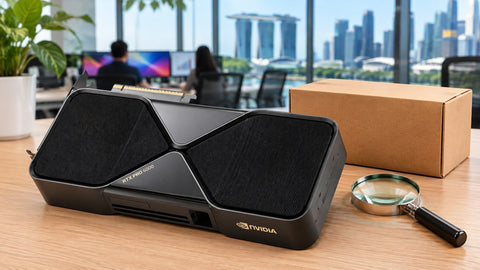
Choose by your largest job and your software. The RTX PRO 6000 Blackwell is the better buy when your models fit in 96 GB, when you need graphics, rendering or x86 applications, or when you want to add AI to a workstation you already run. The NVIDIA DGX Station GB300 earns its much higher price when one model needs more than one card's memory, when many users share one AI system, or when throughput on large models matters more than anything else. On the one like-for-like published test, a GB300 system produced about three times the output of a single RTX PRO 6000, but it costs roughly five times as much as the card.
How do they compare side by side?
| Attribute | RTX PRO 6000 Blackwell (Workstation Edition) | DGX Station GB300 |
|---|---|---|
| What it is | A PCIe graphics card for an x86 workstation | A complete deskside system built around one Grace Blackwell Ultra superchip |
| GPU memory | 96 GB GDDR7 with ECC | 252 GB HBM3e, plus 496 GB LPDDR5X CPU memory, 748 GB coherent |
| Memory bandwidth | 1,792 GB/s | 7.1 TB/s HBM3e; 396 GB/s LPDDR5X |
| Peak FP4 (with sparsity) | 4,000 AI TOPS (about 4 PFLOPS) | 20 PFLOPS |
| Power | 600 W for the card | 1,600 W for the whole system |
| CPU and OS | Your choice of x86 CPU; Windows or Linux | 72-core Arm Grace; Ubuntu-based NVIDIA stack (Windows edition announced) |
| Display output | 4x DisplayPort 2.1b | None on the GB300; needs an add-in RTX PRO card |
| Measured: GPT-OSS-120B, 128 concurrent | 3,064 output tok/s | 9,280 output tok/s (ASUS ET900N G3) |
| Measured: GPT-OSS-20B, 128 concurrent | About 9,000 tok/s | 22,161 tok/s (MSI XpertStation WS300) |
| SourceIT price | S$29,100 (listed 6 Nov 2026), card only | Price on request; we assume around S$150,000 |
Source: NVIDIA RTX PRO 6000 Blackwell datasheet and DGX Station pages (fetched 6 Nov 2026); StorageReview vLLM results for the ASUS ET900N G3, MSI WS300 and RTX PRO 6000. The S$150,000 is the ballpark this series uses: public US pricing of roughly US$93,000 to US$125,000 for most OEMs is about S$119,000 to S$160,000 before GST at USD/SGD 1.279 (6 Nov 2026).
Where does the GB300 pull ahead?
It wins on three things: memory in one GPU, memory bandwidth and FP4 compute.
- Bigger models without splitting: 252 GB of HBM3e holds models that would need three RTX PRO 6000 cards. Llama 3.3 70B at full BF16 precision is about 141 GB, so it needs two cards but fits easily in GB300's HBM.
- Bandwidth: 7.1 TB/s is about four times the RTX PRO 6000's 1,792 GB/s. Generating tokens is usually limited by how fast weights stream from memory, which is why the measured gap on GPT-OSS-120B (about 3.0 times) sits close to that ratio.
- Overflow capacity: past 252 GB, weights can sit in LPDDR5X over the 900 GB/s NVLink-C2C link. It's slower than HBM, but it lets a DeepSeek-class 671B model at FP8 (about 689 GB of weights) load on one machine, with little room left for context.
- Shared use: high concurrency is where GB300's compute shows. On GPT-OSS-20B at 128 concurrent requests, the MSI WS300 measured about 2.5 times the RTX PRO 6000 figure.
Our explainers on why GB300's 748 GB isn't all GPU VRAM and whether more memory is always better explain why the slower LPDDR5X tier changes the picture for the largest models.
Where does the RTX PRO 6000 make more sense?
- Models up to about 90 GB: gpt-oss-120b in its native MXFP4 format (about 65 GB), Llama 3.3 70B at FP8 (about 71 GB) and most 27B to 35B models fit on one card. StorageReview measured gpt-oss-120b at 163 tok/s for a single user in LM Studio.
- Graphics and simulation: the card drives four displays and runs ray tracing, CAD, Omniverse and video work. NVIDIA's Omniverse requirements recommend an RTX PRO 6000 Blackwell workstation. The GB300 has no display output at all.
- x86 software: Grace is an Arm CPU. MATLAB R2026b for Linux requires an x86-64 processor, and Ansys's Arm support lists RHEL and Rocky, not Ubuntu. An RTX PRO 6000 drops into the x86 workstation those tools already run on.
- Incremental budget: one card costs a fraction of a GB300 system, can go into an existing validated workstation, and can be joined by a second or fourth card later.
- Isolation: MIG splits one card into up to four 24 GB instances, which suits small teams with separate jobs.
If your model fits in 96 GB, you are paying for the GB300's bandwidth, not its memory.
What about software compatibility?
For AI frameworks, both platforms run CUDA, PyTorch, vLLM, TensorRT-LLM and NVIDIA's NGC containers, which ship for both x86 and Arm. The differences sit outside the AI stack:
- Operating system: DGX Station ships with NVIDIA's Ubuntu-based AI software stack. NVIDIA announced a Windows edition on 31 May 2026 with OEM availability promised for Q4 2026; check availability before you plan around it. An RTX PRO 6000 runs under whatever Windows or Linux your workstation uses.
- Drivers: the RTX PRO 6000 uses NVIDIA's RTX Enterprise drivers and is ISV-certified in many professional applications, per workstation and application version.
- Older or niche tools: anything x86-only, including some CAE solvers and in-house tools, belongs on the RTX workstation.
Our post on running software on DGX Station's 72-core Grace Arm CPU lists what works and what doesn't.
How should you decide?
- Size your largest model. Add weights at your chosen precision plus KV cache for your context length and user count. Under about 85 GB, one RTX PRO 6000 handles it.
- Count your users. One to three developers suit a card in a workstation. A department sharing one inference endpoint benefits from GB300's throughput.
- List your non-AI work. If the same machine must render, drive displays or run x86 tools, the RTX PRO 6000 is the natural fit.
- Check the budget per result, not per box. On GPT-OSS-120B at 128 concurrent, our arithmetic gives about 105 tok/s per S$1,000 for the card alone against about 62 for a GB300 at the S$150,000 assumption. Once you add a host workstation, the gap narrows sharply; our RTX PRO 6000 workstation build comparison works through that.
If you outgrow one card, the next step isn't always GB300. Two RTX PRO 6000 GPUs vs one DGX Station covers the middle ground, and our DGX Station GB300 buyer's guide covers the OEM options.
Buying in Singapore
SourceIT lists the RTX PRO 6000 Blackwell Workstation Edition at S$29,100 here and the 300 W Max-Q at S$29,100 here (listed 6 Nov 2026; prices change, so ask for a current quotation), with more in our NVIDIA graphics cards collection. DGX Station GB300 systems, including the HP ZGX Fury G1n, MSI XpertStation WS300, ASUS ExpertCenter Pro ET900N G3 and Dell Pro Max with GB300, are price on request. Tell us your largest model, user count and other software, and we'll quote both routes. Use Request for Quotation on the product page, call (65) 6978 3502, email Sales@sourceit.com.sg or use our contact page.
Frequently asked questions
Is a DGX Station GB300 faster than an RTX PRO 6000? For AI inference, yes. StorageReview measured 9,280 output tokens per second on GPT-OSS-120B at 128 concurrent requests on a GB300 system, against 3,064 on one RTX PRO 6000.
Can an RTX PRO 6000 run the same models as a GB300? Models up to about 90 GB of weights, yes, including gpt-oss-120b and Llama 3.3 70B at FP8. Larger models need several cards or the GB300's 252 GB of HBM3e.
Does the DGX Station run Windows? NVIDIA announced a Windows edition in May 2026 with OEM availability promised for Q4 2026. Current systems ship with NVIDIA's Ubuntu-based AI stack.
Can I use a DGX Station for rendering and CAD? Not on the GB300 itself, which has no display output and an Arm CPU. Graphics work needs an add-in RTX PRO card, which reduces the GB300's power budget.
How much does each cost in Singapore? SourceIT lists the RTX PRO 6000 at S$29,100 (6 Nov 2026), card only. DGX Station GB300 systems are price on request; this series uses around S$150,000 as a ballpark.