Four RTX PRO 6000 Blackwell cards are about the largest AI workstation you can build in a tower, and for the right work it is an excellent one. You get 384 GB of GPU memory, room for models such as Qwen3-235B at FP8, and four GPUs that can serve four teams at once. It isn't one 384 GB GPU, though. The memory is four separate 96 GB pools joined by PCIe, and any model larger than 96 GB must be split across cards in software. The build also needs the 300 W Max-Q edition, a workstation designed for four GPUs, and more power than one Singapore wall socket comfortably provides.
What does a four-card workstation look like?
| Item | 4x RTX PRO 6000 Blackwell Max-Q |
|---|---|
| GPU memory | 384 GB GDDR7 ECC, as 4 x 96 GB (separate pools) |
| Memory bandwidth | 1,792 GB/s per card |
| GPU power | 1,200 W (4 x 300 W) |
| Workstation power supplies (OEM examples) | Dell Precision 7960: 2,200 W; Exxact: 2,500 W; HP Z8 Fury G6i: 2,700 W across two PSUs; Lenovo ThinkStation PX: two 1,850 W PSUs |
| PCIe lanes for GPUs | 64 PCIe 5.0 lanes (4 x16), so Threadripper PRO or Xeon workstation CPUs |
| MIG instances | Up to 16 x 24 GB (4 per card) |
| Cards only, SourceIT price | S$116,400 (4 x S$29,100, listed 6 Nov 2026) |
Source: NVIDIA RTX PRO 6000 Max-Q specifications ("up to 384 GB of combined memory across a four-GPU configuration"); HP, Dell and Lenovo configurators and Exxact (March 2026) for power supplies; AMD and Intel for workstation CPU lane counts. Prices change, so ask for a current quotation; the host workstation is quoted separately.
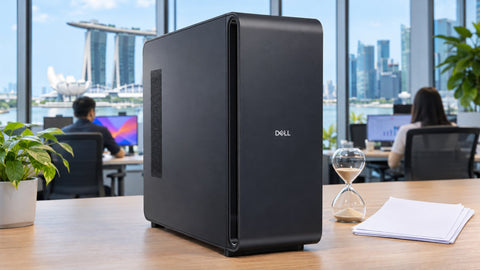
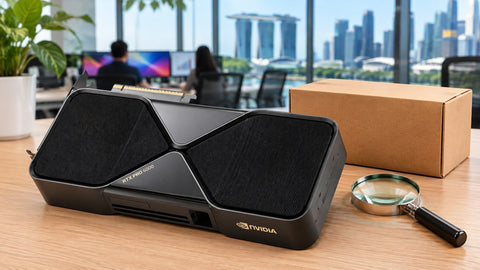
NVIDIA designed the Max-Q edition for this: it says the card can "seamlessly scale from one to four GPUs". HP's Z8 Fury G5 and G6i, Dell's Precision 7960, Lenovo's ThinkStation PX and Supermicro's SYS-551A-T are among the towers that list four double-width GPUs.
Why Max-Q, not four Workstation Editions?
The 600 W Workstation Edition uses a double flow-through cooler that blows hot air into the case, which works well for one card and badly for a stack of four. Puget Systems calls it "NOT suitable for most multi-GPU configurations". The Max-Q uses a blower that pushes air out of the back of the case, so each card gets cooler intake air. Integrator testing backs this up. VRLA Tech reports that four Workstation Editions on a 3,000 W power supply failed its validation, with the hottest card at 89 to 90°C, while four Max-Q cards passed on 2,800 W. Lenovo's ThinkStation P8 specification makes the same point: up to three Max-Q cards or one Workstation Edition.
The performance cost is modest. By NVIDIA's specs, the Max-Q has about 12% lower peak throughput (110 against 125 TFLOPS FP32), and Puget measured it 5 to 14% slower in most content-creation apps. All three editions are compared in Workstation vs Max-Q vs Server Edition.
How much power and cooling does it need?
- Power supply: the OEM systems above use 2,200 to 2,700 W of PSU capacity. Workstation PSUs only reach full output at 200 to 240 V; HP's Z8 Fury G6i, for example, rates each supply at 1,350 W at 115 V and 1,700 W at 200 V or above. Singapore's 230 V mains helps here.
- The wall socket: by our arithmetic, a 2,400 W system at 230 V and 94% efficiency draws about 11.1 A, and a 2,700 W system about 12.5 A. That is close to a 13 A socket's rating. This is our own calculation, not a vendor rule, but it's a good reason to have a licensed electrician check the circuit and to give the workstation a dedicated one.
- Cooling: Exxact's four-Max-Q workstation peaked at 85°C in a three-hour stress test with custom cooling, and Exxact says that "without the custom cooling" the cards throttled. Allow space around the tower, and think about the noise and heat of a 2 kW machine in an office. A server room may suit it better.
- UPS: APC's guidance is that neither the watt nor the VA rating of a UPS may be exceeded by the attached load. Size it to the system's real draw plus headroom; see whether a S$200 UPS can protect a S$10,000 workstation.
Our RTX PRO 6000 power and PSU guide covers connectors and sizing in more detail.
Why doesn't 384 GB become one memory pool?
Each card has its own memory on its own circuit board, and the RTX PRO 6000 has no NVLink to join them. Applications handle this in different ways, and none of them see one 384 GB space:
- Rendering: Maxon says plainly that "Redshift does not combine the VRAM when using multiple GPUs". Each card holds its own copy of the scene, so a four-card render node has 96 GB of usable scene memory, rendered faster. Puget measured three Max-Q cards rendering a Redshift frame in 24 seconds against 60 seconds on one card.
- LLMs: vLLM and similar engines shard the model's weights across cards. Capacity adds up only because the software splits the model and pays for the communication over PCIe.
- CFD: Ansys Fluent's GPU solver can use the combined memory of several cards, but notes that "multi-GPU performance is limited by the slowest card and the smallest VRAM in the set".
- MIG: it splits one card into smaller instances. It never merges cards.
Four cards give you 384 GB of GPU memory, not a 384 GB GPU. The software decides how much of it one job can really use.
How cards share data over PCIe, and the tuning it takes, is covered in multi-GPU AI without NVLink.
What can you actually run on 384 GB?
- Qwen3-235B-A22B at FP8 (236 GB of weights) fits with about 148 GB to spare for cache and overhead. NVIDIA's TensorRT-LLM benchmarks report 1,731 tokens per second per GPU on four RTX PRO 6000 Server Edition cards at FP4 (offline, 1,000 tokens in and out).
- Qwen3.5-397B in NVIDIA's NVFP4 build (251 GB) fits too. Community results vary widely by engine and settings. One vLLM forum report saw 50.5 tokens per second for a single user with P2P disabled under WSL2, while contributors to an RTX PRO 6000 community benchmark log report 70 to 86 tokens per second, and more with speculative decoding.
- Several models at once, such as one per team or one per agent, with each card or MIG instance isolated from the others.
- Not DeepSeek-V3 or R1 at FP8 (689 GB), or 1-trillion-parameter models. Those need a GB300 system or an eight-GPU server.
Outside AI, Ansys reports about 4.6 times the speed of a roughly 516-core CPU baseline on a 50-million-cell Fluent case with a four-RTX-PRO-6000 server (Ansys's own figure).
Is it the ultimate AI workstation?
For a tower, effectively yes: the major OEMs top out at four Max-Q cards. Eight cards move you into a server, such as the 4U liquid-cooled Comino Grando that StorageReview tested, and even then PCIe lanes run short. Whether four cards beat a single DGX Station GB300 depends on the work. Four cards cost S$116,400 before the host, and give more total memory and more parallel GPUs. A GB300, at around S$150,000 in this series' ballpark, gives 252 GB in one GPU at 7.1 TB/s, which suits one large model better. Our comparisons of two RTX PRO 6000 cards vs a DGX Station and GB300 vs traditional RTX workstations set out that trade-off, and one RTX PRO 6000 vs four gaming GPUs covers the cheaper route.
Buying in Singapore
SourceIT lists the RTX PRO 6000 Blackwell Max-Q Workstation Edition at S$29,100 (listed 6 Nov 2026) here, with more in our NVIDIA graphics cards collection. Four-GPU towers such as the HP Z8 Fury, Dell Precision 7960 and Lenovo ThinkStation PX aren't listed, but we can quote and source them configured. For power protection, the APC Smart-UPS SRT 5000VA is S$6,741.25 and the SRT 6000VA S$7,490 (listed 6 Nov 2026), with more in our APC Smart-UPS SRT collection. Use Request for Quotation on the product page, call (65) 6978 3502, email Sales@sourceit.com.sg or use our contact page.
Frequently asked questions
Can four RTX PRO 6000 cards share 384 GB as one memory? No. Each card has its own 96 GB. Software can split a model across all four, but they never form a single GPU or a single memory space.
Which RTX PRO 6000 should I use for four cards? The 300 W Max-Q. NVIDIA designed it for up to four per system, and its blower exhausts heat out of the case. Four 600 W Workstation Editions failed one integrator's validation.
How much power does a four-card workstation need? OEM four-GPU towers use 2,200 to 2,700 W of power supply capacity. At that level, have an electrician check for a dedicated circuit.
What is the largest model I can run on 384 GB? Models up to about 250 to 300 GB of weights, such as Qwen3-235B at FP8 or Qwen3.5-397B in NVFP4, leaving room for cache. DeepSeek-V3 at FP8 (689 GB) won't fit.
How much do four RTX PRO 6000 Max-Q cards cost? S$116,400 at SourceIT (4 x S$29,100, listed 6 Nov 2026), before the host workstation, power protection and installation.

SourceIT Approved
Researched and verified by the SourceIT team for Singapore buyers.