Would You Trust an AI Agent With Your Company's Credit Card?

Yes, you can trust an AI agent with your company's credit card, but only the way you would trust a new intern with a petty-cash float: a small, fixed limit, a narrow list of things to buy, a human sign-off before anything unusual, and a receipt for every cent. The card networks and AI platforms are already building exactly those controls, so the real question for a business in Singapore is not "if" but "how tightly".
Agentic commerce (AI agents that find, choose and pay for things on someone's behalf) has moved from demo to infrastructure. Below we look at what agents can already do, the controls that make payment delegation safe, and where a local agent on an ASUS Ascent GX10 fits as a controlled sandbox.
What can AI agents already pay for?
| Programme | Announced | How the agent pays | Built-in control |
|---|---|---|---|
| Visa Intelligent Commerce | 30 Apr 2025 | Tokenised "AI-ready" card credentials instead of card numbers | The cardholder sets spending limits and conditions |
| Mastercard Agent Pay | 29 Apr 2025 | Mastercard Agentic Tokens | Agents must be registered and verified; the user controls what the agent may buy |
| OpenAI Instant Checkout (Agentic Commerce Protocol, with Stripe) | 29 Sep 2025 | Card on file inside ChatGPT, merchant processes the order | The user confirms each step; single-item purchases at launch |
| Google Agent Payments Protocol (AP2) | 16 Sep 2025 | Open protocol used with agent frameworks | Signed Intent and Cart Mandates create an audit trail |
Visa says its tokens confirm that a consumer's chosen agent may act for them, and puts the principle simply: "Each consumer sets the limits, and Visa helps manage the rest." Mastercard's Agent Pay requires "trusted AI agents to be registered and verified" before they can pay. OpenAI's Instant Checkout, launched for US ChatGPT users, states that users "explicitly confirm each step before any action is taken". These are consumer-first launches, but they show businesses what good looks like.
Why would a business let an agent spend money at all?
Because a lot of company spending is small, repetitive and dull. Reordering toner, renewing a domain or buying a cable that matches a known part number all take a person time to log in, compare and fill forms. An agent that does the legwork and leaves a person to approve returns that time. One person supervising several agents is discussed in One Employee, Ten AI Agents: Is This the Future of Small Businesses?
The counter-argument is just as real. An agent that misreads an instruction, gets manipulated by text on a web page, or simply hallucinates a "better" option can spend money quickly and confidently. The OWASP Top 10 for LLM Applications calls this risk Excessive Agency (LLM06:2025) and traces it to three root causes: excessive functionality, excessive permissions and excessive autonomy. An agent holding an unrestricted corporate card ticks all three.
What controls make agent payments safe enough?
The good news is that the controls map neatly onto how finance teams already manage people:
- Spend limits per agent, not per company. Give each agent its own credential with a low ceiling and a narrow merchant or category list. Visa's model of cardholder-set limits and conditions is the template; ask your card issuer what virtual or tokenised card controls it offers for business accounts.
- Human approval before payment. OWASP's guidance is to "require a human to approve high-impact actions before they are taken". Google's AP2 formalises this as a Cart Mandate: the user approves the exact items and price, creating "a secure, unchangeable record of the exact items and price".
- Pre-approved rules for unattended buying. AP2's "human not present" mode lets a user sign an Intent Mandate upfront with "price limits, timing, and other conditions", so the agent can only act when those conditions are met. That suits standing orders such as consumables.
- Audit logs you can actually read. Google describes the intent-to-cart-to-payment chain as "a non-repudiable audit trail". Whatever platform you use, insist that every agent purchase records who instructed it, what was approved and what was paid.
- An identity for every agent. Microsoft Agent 365 gives each agent a unique ID, keeps a registry of agents and applies least privilege so agents access "only resources they need to complete their tasks". Knowing which agent bought what is the start of accountability.
Give an AI agent a budget, a shopping list and a supervisor, never a blank cheque.
Where should a business draw the line?
Our view at SourceIT is a three-tier rule that most SMEs can adopt this quarter:
- Let agents research and draft freely. Comparing specifications, building a quotation request or filling a cart costs nothing if a person checks it. Our sibling post Would You Let AI Negotiate With Your IT Supplier? covers how to use AI for better RFQs.
- Let agents pay for low-value, repeat items with approval. A named credential, a small per-transaction cap, a fixed supplier list and a one-tap human approval.
- Keep people in charge of everything else. New suppliers, contracts, subscriptions that auto-renew, anything involving personal data or large sums stays with a person, with the agent in an advisory role.
The bigger risk is quiet neglect: nobody remembers which agent holds which credential or reviews the logs. Our post Your AI Assistant Might Be Your Biggest Security Risk covers prompt injection and over-permissioned connectors, and Are Businesses Becoming Too Dependent on ChatGPT? looks at the dependency question.
Can a local AI agent be a safer sandbox?
Before an agent touches a live card, let it rehearse. A local AI computer lets you run an agent against copies of your price lists, supplier catalogues and approval workflows without sending those documents to a cloud service, and without a real payment credential in reach. You can watch every action it would have taken, tune the rules, and only then connect it to a tokenised card with limits.
The ASUS Ascent GX10 (128GB / 1TB), S$7,200.00 as listed on 23 Oct 2026 and in stock, is built on the NVIDIA GB10 Grace Blackwell Superchip. NVIDIA specifies the GB10 platform with 128 GB of coherent unified memory, support for models of up to 200B parameters and NVIDIA DGX OS, a Linux distribution based on Ubuntu. The ASUS Ascent GX10 (128GB / 2TB), S$8,050.00 and in stock, adds storage for more model versions and logs. For lighter Windows-based agent work at a desk, the ASUS Ascent QN10 AI Mini PC (Snapdragon X2 Elite, 32GB, 1TB, Windows 11 Pro) is S$2,375.00 and in stock. Browse the full range in the ASUS Ascent GX10 collection.
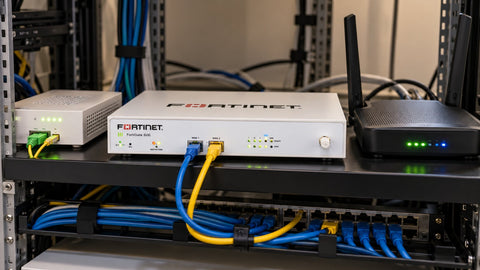
Put the agent machine on its own network segment behind a firewall such as the Fortinet FortiGate-40F with 24x7 FortiCare and 1 Year UTM (S$1,065.00; 3-year S$2,030.00; 5-year S$2,815.00; available to order), so you control which sites and services it can reach. For governing agents across Microsoft 365, the Microsoft Agent 365 Annual Subscription is S$230.00 per year as listed. For background on local AI, read the AI employee on your desk and when running AI locally beats the cloud.
The SourceIT verdict
Would we trust an AI agent with a company credit card? For low-value, bounded, repeat purchases with a per-agent limit, an approval gate and a readable log: yes, and businesses that set this up carefully will save real staff time. For open-ended buying, new suppliers or anything that renews itself: not yet. The infrastructure from Visa, Mastercard, OpenAI and Google is designed around human confirmation and limits; the businesses that get hurt will be the ones that switch those safeguards off for convenience. If you are weighing where agents fit at all, start with Why AI Projects Look Amazing in Demos but Fail in Real Offices.
Buying AI agent hardware in Singapore
SourceIT supplies ASUS AI systems, Fortinet firewalls and Microsoft subscriptions for Singapore businesses, schools and government buyers. Prices above are as listed on 23 Oct 2026. Use Request for Quotation on any product page, call (65) 6978 3502, email Sales@sourceit.com.sg, or see our corporate accounts page. We are GeBIZ and Vendors@Gov registered for public-sector buyers.
Frequently asked questions
Can AI agents make payments today? Yes. Visa Intelligent Commerce, Mastercard Agent Pay, OpenAI's Instant Checkout and Google's Agent Payments Protocol (AP2) all let AI agents take part in payments, each with controls such as tokens, limits or user confirmation.
What is the safest way to let an AI agent buy things for my company? Give each agent its own limited credential, restrict it to known suppliers and categories, require human approval before payment, and keep a log of every instruction, approval and transaction.
What is excessive agency in AI? It is OWASP's term (LLM06:2025) for an AI system that can take damaging actions because it has too many functions, too many permissions or too much autonomy. Limiting all three is the main defence.
What is an Intent Mandate in AP2? A signed record of a user's instructions and rules, such as price limits and timing. A Cart Mandate records the exact items and price the user approved.
Does ChatGPT buy things without asking? OpenAI says users of Instant Checkout explicitly confirm each step before any action is taken, and the launch supported single-item purchases for US users.
Why test AI agents on a local machine first? A local AI computer such as the ASUS Ascent GX10 lets you rehearse agent workflows on copies of your data, behind your own firewall and without a live payment credential, before connecting anything to real money.