Your Next AI Employee Might Be a Computer Sitting on Your Desk

Picture a colleague who reads every supplier PDF that lands overnight, drafts the first pass of tomorrow's quotations, sorts the IT tickets and never forwards a client file to a server in another country. That colleague is increasingly a computer on a desk: a local AI agent running on an ASUS Ascent GX10 or an NVIDIA RTX Spark laptop, using models that never leave the office. This post explains what a local agent is, which office tasks suit one, what hardware runs it, and the guardrails a Singapore organisation needs before handing it a mailbox.
Which office tasks suit a local AI agent
An agent is a language model with tools: it plans a task, reads and writes files, calls systems and keeps going until the job is done or it needs a human. The table matches common office work to the right machine and the control that should sit around it.
| Task | What the agent does | Where it runs best | Guardrail |
|---|---|---|---|
| Supplier and tender documents | Reads PDFs and price lists, extracts terms, flags changes against last quarter | Ascent GX10 (shared, always on) | Read-only folder access; human signs off any figure |
| Quotation and email drafts | Drafts replies and quotations from templates and approved price files | GX10, or an RTX Spark laptop for one user | Drafts only; a person sends |
| IT and service tickets | Classifies, summarises and suggests next steps; links known fixes | GX10 via a ticketing preset | No write access to production systems |
| Code review and scripts | Reviews pull requests, writes tests, explains legacy code | RTX Spark laptop or GX10 | Sandboxed filesystem; merge stays human |
| Internal knowledge questions | Answers from policies, manuals and past projects | GX10 shared through NVIDIA PAIR | Source citations in every answer |
| Overnight batch work | Summarises call notes, tags documents, builds weekly reports | GX10 (240 W, runs 24/7) | Logs reviewed each morning |
The pattern is consistent: the agent does the reading, sorting and first draft; a person owns the decision and the send button. If you are still deciding whether you need dedicated hardware at all, start with do you need an AI supercomputer?
The agent stack: OpenClaw, Hermes, NemoClaw and OpenShell
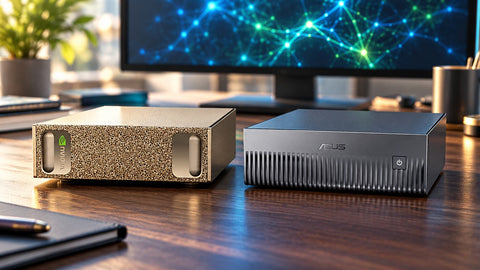
Three names come up in every local-agent conversation. OpenClaw is an open-source agent runtime and the default agent in NVIDIA's NemoClaw stack; Hermes and LangChain Deep Agents Code are the supported alternatives. NemoClaw is NVIDIA's open-source installer and CLI that wraps the agent, a managed local model server and policy presets into one guided setup. OpenShell is the sandbox underneath: it routes every model call through a local endpoint, keeps API keys on the host, makes system paths read-only and blocks outbound connections that the policy has not approved. ASUS validates NemoClaw, OpenClaw and Hermes on the GX10, which is why the machine carries the Agent Computer badge.
We have already written the full installation walkthrough, including commands, policy tiers and fixes for common errors, so this post does not repeat it: see how to set up OpenClaw and NemoClaw on the ASUS Ascent GX10. The short version is a one-line installer, an express option that picks a local model for you (NVIDIA's playbook reports a Qwen3.6 35B model at NVFP4 on a 128 GB unit) and about half an hour before the first answer.
The desk unit: Ascent GX10 as the office's shared agent
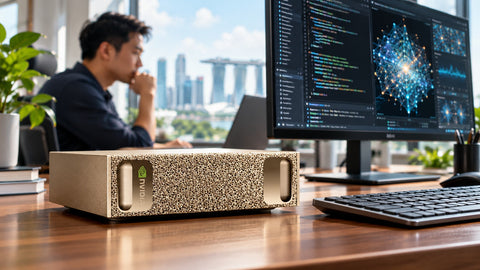
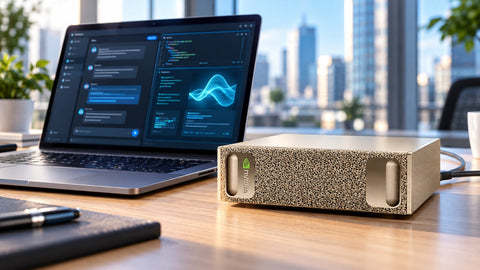
The ASUS Ascent GX10 is the natural home for an agent that several people rely on. Its NVIDIA GB10 Superchip has 128 GB of unified memory, enough for 70B-class models comfortably and 120B to 200B-class at FP4, so the agent can use a capable model rather than a small one. It draws power from a 240 W USB-C adapter, sits on any desk at 150 x 150 x 51 mm and runs DGX OS headless, so it can work through the night without a server room. NVIDIA's Personal AI Router (PAIR) then exposes the GX10's model as one local endpoint for every laptop in the office.
Pricing at SourceIT: GX10 1 TB at S$7,200, 2 TB at S$8,050 and 4 TB at S$9,850. Compute is identical; buy storage for the models and documents you will keep. The same GB10 chip is in the NVIDIA DGX Spark 4 TB at S$8,600, and our GB10 buyer's guide compares every OEM version. Whether a box at this price suits your role is the subject of who should buy a S$10,000 AI computer.
The personal agent: RTX Spark laptops
NVIDIA's RTX Spark laptops, launched on 16 October 2026, bring the same idea to one person's bag. NVIDIA's launch release says guided installers set up agents including GitHub Copilot, Hermes and OpenClaw without a command line, and that the OpenShell secure runtime and Microsoft Execution Containers help users control agent permissions. It also names Nemotron 3.5 Bolt 74B-A9B, a 74-billion-parameter model NVIDIA describes as optimised for tool calling and multistep tasks, for supported RTX Spark configurations.
SourceIT stocks three MSI Prestige N16 Flip AI+ RTX Spark configurations: 32 GB at S$4,974.08, 64 GB at S$6,331.28 and 128 GB at S$10,854.12. For agent work the 64 GB is the sensible floor, because the model, its working context and Windows share one memory pool; why 128 GB of unified memory matters shows the arithmetic. A laptop runs within a 45 to 80 W envelope and sleeps when the lid closes, so it suits an agent that works alongside its owner, while the GX10 suits one that works for the team. Our RTX Spark laptop guide covers the platform in depth.
Guardrails: PDPA, permissions and human review
Keeping the model local solves the data-residency question: prompts and documents stay on the machine, which removes an overseas transfer from your PDPA assessment. It does not make the agent safe by itself. Four controls matter more than model choice.
Least privilege. Give the agent its own account and read-only access to the folders it needs. OpenShell already makes system paths read-only and limits writes to the sandbox; mirror that in your file shares and mailboxes.
Network policy. NemoClaw's Balanced tier is the default; the Open tier adds Slack, Telegram, WhatsApp, Jira and Outlook presets. Start Balanced, watch which hosts the agent asks for, then allow only those. Unapproved connections are blocked and surfaced for a person to approve.
Human review. Agents draft, people send. Anything that commits money, quotes a price, changes a record or contacts a customer should need a human click. Keep the agent's logs and review them, at least in the first month.
Personal data rules still apply. The PDPC's advisory guidelines on personal data in AI recommendation and decision systems cover the information to give individuals when seeking consent and the position of third-party developers who build bespoke AI systems. Running locally helps with residency; purpose, consent and retention remain your obligations.
Does it pay, and when is cloud still better?
An always-on agent is the workload where local hardware earns its keep fastest, because it consumes tokens all night. Our 12-month local AI vs cloud cost model found a GX10 paying back in roughly 6 to 12 months against frontier API pricing under round-the-clock agent load, but not within a year for light office-hours use. When running AI locally beats cloud turns that into plain rules. Hard reasoning problems can still go to a cloud model; PAIR lets one endpoint route between the two.
Buying a local AI agent computer in Singapore
SourceIT is an authorised ASUS reseller with official ASUS Singapore warranty on the Ascent GX10. In deployments we commission, the unit arrives on current DGX OS, on your network, with NemoClaw onboarded against your chosen model and PAIR ready for your users; we can also help scope folder permissions and policy tiers. Education and NVIDIA Inception pricing may apply on the GX10. Use Request for Quotation on the product page, call (65) 6978 3502, or email Sales@sourceit.com.sg; we are GeBIZ and Vendors@Gov registered. For the full line-up, read the ASUS Agent Computer guide.
Frequently asked questions
What is a local AI agent? A language model with tools, such as file access, email drafting or ticket systems, running on hardware you own so prompts and documents stay on-premises. OpenClaw and Hermes are common open-source agents.
Can an AI agent replace an employee? It replaces tasks, not judgement. Agents handle reading, sorting and first drafts well; decisions, approvals and anything sent to a customer should stay with a person.
Which hardware runs OpenClaw locally? ASUS validates NemoClaw, OpenClaw and Hermes on the Ascent GX10, and NVIDIA's RTX Spark launch release lists guided installers for Hermes and OpenClaw on RTX Spark laptops.
Is a local agent PDPA-compliant? Local inference keeps data on-premises, which helps with residency. Consent, purpose limitation and retention still apply, so treat the agent like any other system that processes personal data.
Can the agent access the internet? Only the hosts its policy allows. Under NemoClaw, other connections are blocked and surfaced for a person to approve or deny.
GX10 or RTX Spark laptop for agents? The GX10 for a shared agent that runs all day for a team; an RTX Spark laptop with 64 GB or more for a personal agent that travels with its owner.

SourceIT Approved
Researched and verified by the SourceIT team. Last checked October 2026.