Edge AI runs the model on a device close to where the data is produced: beside the camera, on the machine, in the vehicle, in the shop. Cloud AI sends the data over the internet to a data centre and waits for the answer. The cloud offers the largest models and no hardware to own. The edge offers a response in milliseconds, operation when the connection drops, far less bandwidth and data that never leaves the site. The choice is usually made by three questions: how quickly must the system react, what happens when the link is down, and how much data would have to be uploaded.
How do edge AI and cloud AI compare?
| Edge AI | Cloud AI | |
|---|---|---|
| Where the model runs | On-site device or gateway | Remote data centre |
| Response time | Milliseconds, consistent | Network round trip plus processing; varies |
| Works offline | Yes | No |
| Bandwidth | Sends results only | Sends raw data |
| Data location | Stays on site | Leaves the site |
| Model size | Limited by the device | Effectively unlimited |
| Cost shape | Hardware up front, low running cost | Pay per use, grows with volume |
| Management | Many devices to update and secure | Centralised |
When does latency decide it?
CALC. A camera producing 30 frames per second delivers a new frame every 1,000 / 30 = 33 milliseconds. To act on every frame, the whole loop of capture, inference and response has to fit inside that. A small vision model on an edge accelerator typically runs in 10 to 30 milliseconds. A cloud round trip adds network time in both directions on top of processing, commonly 50 to 200 milliseconds from a business connection and more over mobile data, and it varies from moment to moment.
The figures are typical ranges, not measurements of any particular service. The conclusion holds across them: anything that must react within a frame or two, such as stopping a machine, rejecting a part on a conveyor or steering a robot, has to run at the edge. Tasks where a second or two is acceptable, such as summarising a report, do not.
When does connectivity decide it?
Ask what the system should do when the internet is down. If the honest answer is that it must keep working, as with safety monitoring, production-line inspection, a retail checkout or a site with only mobile coverage, the inference has to be local. A common design keeps decisions at the edge and uses the connection only for reporting and updates, so an outage delays the dashboard but not the operation.
When does bandwidth decide it?
CALC. One camera streaming at 4 megabits per second produces 4 x 86,400 seconds / 8 = 43,200 megabytes, about 43 GB a day. Twenty cameras need 20 x 4 = 80 Mbps of continuous upload and generate 20 x 43.2 = 864 GB a day. Sending that to the cloud for analysis is expensive and often impractical. An edge device analysing the same streams locally sends only events: a few kilobytes when something happens.
The cloud is where you send questions. The edge is where you put reflexes. A system that has to react does not have time to ask.
Which workloads belong where?
| Workload | Usual home | Reason |
|---|---|---|
| Visual inspection on a production line | Edge | Latency, uptime |
| People counting, safety zones, licence plates | Edge | Bandwidth, privacy |
| Robots and autonomous machines | Edge | Latency |
| Predictive maintenance on sensors | Edge, with cloud for trends | Data volume |
| Staff chat assistant on company documents | On-premises server | Privacy, predictable cost |
| Occasional use of the largest frontier models | Cloud | Model size, low volume |
| Training large models | Cloud or data centre | Compute scale |
| Fleet-wide analytics and model updates | Cloud | Central view |
Between the two sits a third option that many offices choose for language models: an on-premises AI system serving the whole site over the local network. It has the privacy and cost profile of the edge with a much larger model than a small device can hold. See local AI vs cloud API cost model and sovereign AI for Singapore businesses.
What are the limits of the edge?
- Model size. Edge devices have limited memory and power. Models are chosen small and compressed; see small vs large language models and quantisation explained.
- Fleet management. Fifty devices in fifty places need remote updates, monitoring and physical security.
- Environment. Heat, dust and vibration call for suitable hardware. See AI mini PC vs industrial computer.
Most real systems are hybrid: fast decisions at the edge, heavy analysis and retraining centrally. For the device that links sensors to that edge AI, see what is an AI gateway, and for robotics, what is physical AI.
Buying in Singapore
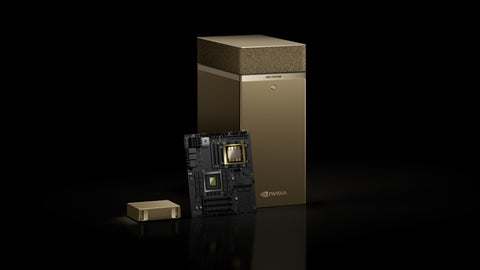
For edge development and deployment, the NVIDIA Jetson Orin Nano Super 8GB Developer Kit (S$696), the Jetson AGX Orin 64GB Developer Kit (S$5,871.60) and, for robotics and multi-sensor work, the Jetson AGX Thor 128GB Developer Kit (S$9,075.60). For an on-premises language model server, the NVIDIA DGX Spark 4TB (S$9,450) (listed 11 Nov 2026; prices change; ask for a current quotation). To start, use Request for Quotation on the product page, call (65) 6978 3502, email Sales@sourceit.com.sg or use our contact page.
Frequently asked questions
What is the difference between edge AI and cloud AI? Edge AI runs the model on a device near where data is produced, giving fast responses and offline operation. Cloud AI sends data to a remote data centre, giving access to larger models without owning hardware.
Why is edge AI faster? Because the data does not travel over the internet. The response time is just the model's processing time, which is consistent, with no network round trip added.
Does edge AI work without internet? Yes. Inference runs locally, so decisions continue during an outage. A connection is needed only for reporting, remote management and updates.
Is edge AI cheaper than cloud AI? It depends on volume. Edge hardware is an up-front cost with low running costs, so it tends to be cheaper for continuous, high-volume workloads. Cloud is usually cheaper for occasional use.