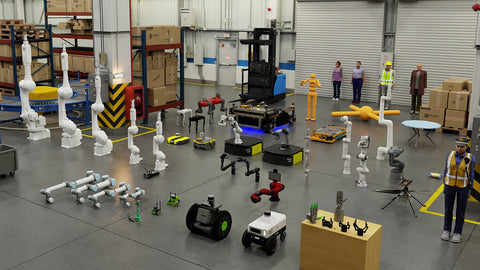
Multimodal AI is AI that can take in, and sometimes produce, more than one type of data: text, images, audio, video, and increasingly sensor readings and actions. A vision-language model (VLM) is the most common type. You give it a photo, a scanned invoice or a screenshot along with a question, and it answers in text. Speech models add hearing, and video models add time. When people say an AI can "see, hear and understand", they mean a multimodal model is joining those inputs into one answer.
For businesses, this matters because most of the information that slows work down isn't clean text. It is PDFs with tables, photos from site visits, whiteboard snapshots, CCTV clips and recorded meetings. Multimodal AI can read all of them.
How does a multimodal model work?
A language model works on tokens, which are small chunks of text. A multimodal model adds encoders that convert other data into tokens the same model can reason over.
- Images are cut into small patches. A vision encoder turns each patch into a token, so one image can become hundreds or thousands of tokens depending on its resolution and the model.
- Audio is converted into tokens by a speech encoder, or transcribed to text first by a separate speech-recognition model.
- Video is treated as a sequence of frames, usually sampled, plus audio. It is by far the heaviest input.
Once everything is a token, the model reasons over the mixture just as it would over a long document. That has a hardware cost: image and video tokens fill the model's context window and its KV cache much faster than text does.
What types of multimodal AI are there?
| Type | Input | Output | Business example |
|---|---|---|---|
| Vision-language model (VLM) | Image + text | Text | Extract line items from a supplier invoice photo |
| Document AI | Scanned PDFs, forms | Structured data | Read delivery orders and match them to purchase orders |
| Speech AI | Audio | Text or audio | Transcribe and summarise a meeting |
| Video understanding | Video + text | Text, timestamps | Find when a pallet was left in a fire lane on CCTV |
| Any-to-any ("omni") models | Several | Several | A voice assistant that also looks at what the user's camera sees |
| Vision-language-action model | Camera + instruction | Robot movement | A robot arm told to "pick the damaged carton" |
The last row is where multimodal AI meets physical AI. NVIDIA's Cosmos 3, launched in June 2026, is one example of a model that handles text, images, video, sound and robot actions together.
What can a Singapore business do with multimodal AI?
- Finance and procurement. Read invoices, delivery orders and receipts, including handwritten notes and stamps, and push the data into the accounting system for checking.
- Field service and facilities. Technicians photograph a fault and the model suggests the part number, or flags a missing safety label.
- Quality inspection. Describe a defect in plain language rather than training a separate model for every type. Our computer vision quality inspection guide covers when a dedicated vision model is still better.
- Meetings. Combine the transcript with what was on the shared screen and whiteboard. We tested transcription in transcribing 100 hours of meetings on GB10.
- Customer service. Customers send a photo of a product label or error screen, and the assistant identifies the model and the fix.
Most company knowledge is trapped in images: scans, photos, screenshots and slides. Multimodal AI is the first kind of AI that can read them without someone typing them out first.
Should multimodal AI run in the cloud or locally?
Cloud models are the easiest way to start and are usually the most capable. The case for running locally is strongest when the images themselves are sensitive: identity documents, medical images, CCTV of staff and customers, or engineering drawings. Under Singapore's PDPA, a photo that identifies a person is personal data, so sending it to an outside service needs the same care as sending a spreadsheet of names. Running open vision-language models on your own hardware keeps those images inside your network. Our sovereign AI guide covers that decision in more detail.
What hardware does multimodal AI need?
| Workload | What matters most | Typical fit |
|---|---|---|
| A few documents or photos at a time, one user | Enough memory for model + images | RTX Spark laptop or 24 GB+ workstation GPU |
| Document processing for a team, private | Memory capacity, steady throughput | 128 GB GB10 desktop |
| Video analysis, many cameras or large VLMs | GPU compute, VRAM, video decoding | RTX PRO 6000 Blackwell or several GPUs |
| Vision at the edge (shop, factory, robot) | Power, camera inputs, latency | Jetson Orin or Jetson Thor |
Two practical points often get missed. Higher image resolution usually means more tokens, which means more memory and slower answers, so resize images to what the task actually needs. And video work needs fast storage and hardware video decoding, not just a big GPU.
Buying in Singapore
For individual users, the MSI Prestige N16 Flip AI+ with RTX Spark, 32GB (S$4,974.08) runs smaller vision models on a laptop, and the NVIDIA RTX PRO 4000 Blackwell (S$5,640) suits a desktop workstation. For a team's private document AI, the NVIDIA DGX Spark 4TB (S$9,450) and HP ZGX Nano G1n 4TB (S$11,499) offer 128 GB of memory. For video analysis, the RTX PRO 6000 Blackwell Workstation Edition (S$29,100). For vision at the edge, the Jetson AGX Orin 64GB (S$5,871.60) and Jetson AGX Thor 128GB (S$9,075.60) developer kits (listed 11 Nov 2026; prices change; ask for a current quotation). To start, use Request for Quotation on the product page, call (65) 6978 3502, email Sales@sourceit.com.sg or use our contact page.
Frequently asked questions
What is multimodal AI? Multimodal AI is AI that can process more than one type of data, such as text, images, audio and video, and combine them into one answer. A vision-language model that answers questions about a photo is a common example.
What is a vision-language model? A vision-language model (VLM) takes an image plus a text prompt and responds in text. It uses a vision encoder to turn the image into tokens that a language model can reason over.
What are business uses of multimodal AI? Common uses include reading invoices and delivery orders, analysing site or product photos, summarising meetings with what was on screen, reviewing CCTV footage and answering customer questions from photos.
Why does multimodal AI need more memory than text AI? Each image or video frame becomes many tokens, so it fills the model's context window and KV cache much faster than text. Higher resolution and longer videos increase memory use and slow responses.
Can I run multimodal AI locally? Yes. Open vision-language models run on workstations, 128 GB GB10 desktops and Jetson edge devices, which keeps sensitive images such as ID documents or CCTV inside your own network.

SourceIT Approved
Researched and verified by the SourceIT team for Singapore buyers.