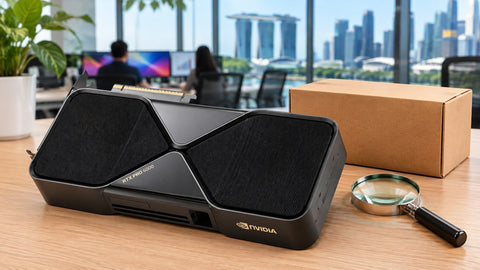
For most businesses, yes: one RTX PRO 6000 Blackwell is the simpler and more practical replacement for four gaming GPUs, but not always the faster one. Four GeForce RTX 5090s have 128 GB of memory in total and more raw compute. But that memory comes as four separate 32 GB pools, the cards draw about 2,300 W between them, and they need a high-end platform with 64 PCIe lanes. They also need software that splits every large model across them. One RTX PRO 6000 puts 96 GB behind a single GPU at 600 W. In published tests, four 5090s beat one PRO 6000 on throughput for some models, but the single card was cheaper per token and far easier to run.
How do one RTX PRO 6000 and four RTX 5090s compare?
| Factor | 1x RTX PRO 6000 Workstation Edition | 4x GeForce RTX 5090 |
|---|---|---|
| GPU memory | 96 GB in one pool | 128 GB as four separate 32 GB pools |
| Largest model without splitting | About 89 GB (83 GiB) of weights | About 27 GB (26 GiB) of weights per card |
| GPU power | 600 W | 2,300 W (4 x 575 W) |
| PCIe lanes for full x16 | 16 | 64 (Threadripper PRO or Xeon workstation class) |
| GPU-to-GPU peer-to-peer | Not applicable with one card | Not supported on GeForce RTX 50-series (NVIDIA forum moderator) |
| GLM-4.5-Air AWQ, vLLM (CloudRift) | 3,169 tok/s, US$0.113 per M tokens | 4,622 tok/s, US$0.156 per M tokens |
| Llama 3.3 70B AWQ, vLLM (CloudRift) | 1,031 tok/s (one card) | 1,230 tok/s with two 5090s |
| US price reference (2026) | US$13,250–16,000 (NVIDIA marketplace, Jun–Aug) | US$17,200–26,000 at US$4,300–6,500 street per card |
Source: NVIDIA product pages (memory, power); CloudRift vLLM benchmarks, 9 Oct 2025 (pipeline parallelism on the 5090s, 400 concurrent requests); NVIDIA developer forum, Mar 2025; Tom's Hardware and LetsDataScience pricing; street prices Sep–Nov 2026 per Tom's Hardware reporting. Usable weight space is a practitioner rule of thumb after engine overhead.
GamersNexus remarked in 2025 that "you could also technically buy four 5090s for the price of one RTX PRO 6000". At 2026 US street prices that no longer holds: four 5090s now cost more than one PRO 6000 at NVIDIA's marketplace price.
Does 4 x 32 GB equal 128 GB?
Not in the way most people hope. Each GPU can only work directly on what's in its own memory. To run a model bigger than 32 GB on four 5090s, software such as vLLM has to split it: either by layer (pipeline parallelism, where each card holds a slice of the model and passes activations along) or within each layer (tensor parallelism, where all cards work on every layer and exchange partial results). Both work, but every split adds traffic over PCIe, plus settings to tune and new ways to fail.
For GPU rendering the split usually isn't possible at all. Maxon says Redshift "does not combine the VRAM when using multiple GPUs", so a 50 GB scene won't render on four 32 GB cards. Four cards speed up a scene that already fits on one, but they don't make a bigger scene fit.
Four gaming GPUs give you more total memory. One RTX PRO 6000 gives you more memory in the place that matters: next to a single GPU.
Is four GPUs faster?
Sometimes. CloudRift's 9 Oct 2025 tests are the clearest public data. With models split by layer, four 5090s ran GLM-4.5-Air at 4,622 tokens per second against 3,169 on one PRO 6000, about 46% more. Two 5090s ran Llama 3.3 70B (4-bit) at 1,230 against 1,031, about 19% more. On Qwen3-Coder-30B, four 5090s running as separate copies of the model reached 12,744 tokens per second against 8,425. But going from two to four 5090s added only 40%, which shows how quickly the benefit tails off.
The single PRO card still came out cheaper per million tokens in the same tests, and it ran each model without splitting it. If your workload is many small, independent jobs, such as several users each running a 7–14B model, four cheaper cards can make sense. For one big model, one card with enough memory is simpler and usually more efficient.
What does four GPUs mean for power and cooling?
Four 575 W cards draw about 2,300 W on their own. Add a 350 W workstation CPU and around 250 W for the rest of the system, and our estimate is about 2,900 W at the components. At 94% power-supply efficiency that's about 3,085 W, or 13.4 A from a 230 V supply. That exceeds a single 13 A socket's rating by our arithmetic, so you'd need a dedicated circuit and a licensed electrician. The same estimate for one RTX PRO 6000 system is about 1,280 W, or 5.6 A.
Cooling is just as hard. RTX 5090 cards are open-air designs; NVIDIA's own setup guide asks for three-slot clearance, and partner cards are often thicker. Stacking four in one tower usually means risers, water cooling or a specialist chassis. We cover power, connectors and chassis in is your PC ready for 600 W?
What about the platform and software?
- PCIe lanes: four cards at x16 need 64 PCIe 5.0 lanes. Consumer desktop CPUs don't have that many. You'd need an AMD Threadripper PRO (128 Gen5 lanes) or an Intel Xeon 600 workstation platform, which raises the cost of the rest of the machine.
- Peer-to-peer: an NVIDIA forum moderator has said GPU-to-GPU P2P is "not supported" on GeForce RTX 50-series cards, so data between 5090s goes through system memory. A community driver patch exists; one tester measured only a 2.7% average gain from it on two 5090s.
- Licensing: NVIDIA's GeForce driver licence (25 Feb 2025, section 2.8) says the software "is not licensed for datacenter deployment". That matters if the multi-GPU box ends up in a server room.
- Tuning: splitting choices change results a lot. On one eight-card RTX PRO 6000 server, Helix measured a 7.8x throughput difference just from changing the inference engine.
If you do need more than 96 GB, a multi-card RTX PRO build is the more practical route. The 300 W RTX PRO 6000 Max-Q is designed for up to four per system, and user reports show P2P working between PRO cards after some tuning. See our four RTX PRO 6000, 384 GB workstation post and how multi-GPU works without NVLink.
So which should you choose?
- One RTX PRO 6000: one large model (33–90 GB), large scenes or meshes, certified drivers, a normal office power socket, minimal tuning.
- Several gaming GPUs: many independent small jobs, a personal lab where you're happy to tune, and a budget where the platform, power and cooling costs still work out.
- Neither: if your model is several hundred gigabytes, look at a DGX Station GB300.
For the card-to-card comparison, see RTX PRO 6000 vs RTX 5090. For the overall verdict, see brilliant or overkill?
Buying in Singapore
SourceIT lists the RTX PRO 6000 Blackwell Workstation Edition at S$29,100 here and the multi-GPU-friendly 300 W Max-Q at S$29,100 here (both listed 6 Nov 2026). The wider range is in our NVIDIA graphics cards collection, and multi-GPU workstation and server configurations are in AI workstations and AI servers. RTX 5090 cards are not in stock at the time of writing; ask us about availability. Prices change, so ask for a current quotation. Use Request for Quotation on the product page, call (65) 6978 3502, email Sales@sourceit.com.sg or use our contact page.
Frequently asked questions
Do four RTX 5090s give 128 GB of usable VRAM? Only if the software splits the model across them. Each card has its own 32 GB, and the split adds communication over PCIe. GPU renderers such as Redshift do not combine VRAM across cards.
Are four RTX 5090s faster than one RTX PRO 6000? For some AI models, yes. CloudRift measured about 46% more throughput on GLM-4.5-Air. The single PRO 6000 was cheaper per million tokens in the same tests and needed no model splitting.
Can a normal office socket power four RTX 5090s? By our estimate, a full four-card system draws around 3,000 W from the wall, above a single 13 A, 230 V socket's rating. Have a licensed electrician assess a dedicated circuit.
Do RTX 5090 cards support peer-to-peer transfers? An NVIDIA forum moderator has said GPU-to-GPU P2P is not supported on GeForce RTX 50-series cards. Data moves between them through system memory instead.
What is the better multi-GPU option? For businesses that need more than 96 GB, several 300 W RTX PRO 6000 Max-Q cards, which NVIDIA designs for up to four per system. Each card still has its own 96 GB, but you get fewer cards, lower power and professional drivers.