Not on purpose, as far as anyone can show, but 2026 has made building your own PC noticeably harder. Flagship graphics cards draw more power, take up more space and are much harder to buy than they were two years ago, and the memory shortage has pushed up the price of almost every other part in the box. No GPU maker has announced a policy against do-it-yourself builders. What has changed is that a high-end DIY build now asks more of your power supply, your case and your wallet, and the parts are less reliably on the shelf.
What has changed since the RTX 4090?
| Card | Rated board power | NVIDIA required system power | Size (L × H) | Thickness | US launch price |
|---|---|---|---|---|---|
| RTX 4090 Founders Edition | 450 W | 850 W | 304 × 137 mm | 3-slot | US$1,599 |
| RTX 5080 Founders Edition | 360 W | 850 W | 304 × 137 mm | 2-slot | US$999 |
| RTX 5090 Founders Edition | 575 W | 1,000 W | 304 × 137 mm | 2-slot | US$1,999 |
| ASUS ROG Astral RTX 5090 (air) | 575 W class; ASUS lists a 1,000 W PSU | 1,000 W | 357.6 × 149.3 mm | 3.8-slot (76 mm) | Partner card |
Source: NVIDIA RTX 50 and RTX 40 product pages; ASUS ROG Astral RTX 5090 specification (fetched 6 Nov 2026). NVIDIA's required-system-power figures assume a Ryzen 9 9950X system for RTX 50 and a Ryzen 9 5900X for RTX 40.
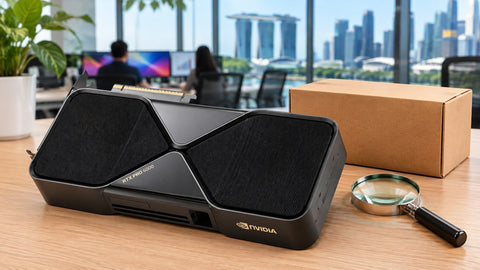
The Founders Edition is the exception that proves the rule: NVIDIA squeezed a 575 W card into two slots. Many partner cards went the other way, with bigger coolers to keep that heat quiet. And the launch prices in the table are now mostly theoretical, as the sections below show.
Are graphics cards now too power-hungry for a normal PC?
A flagship card now draws about as much as an entire high-end PC did a few years ago. KitGuru measured an average of 463 W across 12 games at 1440p, and 546 W across eight ray-traced games at 4K. Igor's Lab recorded excursions of about 901 W lasting under a millisecond. Modern ATX 3.1 power supplies are designed to ride through spikes like that: the standard allows 200% for up to 1 ms on the 600 W connector. Older supplies built to earlier rules can trip their protection instead.
That is why NVIDIA asks for a 1,000 W system and recommends a PCIe CEM 5.1 compliant supply. Seasonic suggests 1,200 W for comfortable headroom and 1,300–1,600 W for long AI or rendering runs. That is vendor guidance, but it reflects how much of the budget the GPU now takes. Our 575 W power and running-cost guide covers the sums. Our 1,000 W power supply myth post explains why a bigger PSU alone doesn't add performance.
The connector has also changed. The 12V-2x6 standard altered the socket on the card and the power supply, not the cable. The sense pins are recessed so that they disconnect first, and a plug with both sense pins open now allows 0 W instead of 150 W. That makes a badly seated plug fail safe. Melted-connector reports have continued in 2026, and our 12V-2x6 connector guide sets out the dated incidents and good practice.
Why don't graphics cards fit like they used to?
NVIDIA's own SFF-Ready guideline for small cases caps a card at 304 mm long, 50 mm (2.5 slots) thick and 151 mm high, and the height limit includes the bend radius of the power cable. By our arithmetic, the air-cooled ROG Astral 5090 is 53.6 mm longer than that limit and about 1.3 slots thicker. NVIDIA's current list does include the 5090 Founders Edition and two ASUS ProArt 5090 cards as SFF-Ready, so small builds are possible, but only with a short list of cards.
Weight and clearance matter too. A 3.8-slot card covers the slots below it, and a power cable that must not be bent tightly near the plug needs space beside the side panel. Our RTX 5090 size and case fit guide has a measuring checklist.
The parts haven't become impossible to build with. They've become less forgiving: less room for a marginal power supply, a tight case or a guess about stock.
Is it harder to buy the parts?
For the top card, clearly yes. NVIDIA's US launch price for the RTX 5090 is still US$1,999, but Tom's Hardware found it at about US$8,500 on Amazon and about US$7,300 on Newegg on 17 October 2026, and the eBay average was about US$6,542 in early November. Micro Center marked its 5090 listings "Not Carried" in October, and earlier required photo ID and a signed no-export declaration to buy one. NVIDIA's US store removed the 5090 in mid-October and the 5080 around 30 October, without giving a reason. Our guide to the RTX 5090 discontinuation rumours separates those observations from the leaks.
The rest of the build has moved too. Tom's Hardware tracked a 32 GB DDR5-6000 kit from US$90 in July 2025 to US$459 in July 2026. In Singapore, a Straits Times check at Sim Lim Square (13 Sep 2026) found a 32 GB DDR5 kit up from S$195 to S$763, a 1 TB SSD from S$149 to S$328 and RTX 5060-series cards from S$572 to S$824 year on year. Micron confirmed in December 2025 that it was leaving the Crucial consumer business to prioritise its larger customers. Our post on how AI demand is eating the world's RAM explains the memory side, and our look at whether AI is taking graphics cards from gamers covers the GPU side.
Is anyone deliberately squeezing out DIY builders?
There is no evidence of a stated policy. The signs people point to are indirect:
- Founders Edition cards inside prebuilts. In September 2026, CyberPowerPC systems sold through Walmart shipped with RTX 50 Founders Edition cards. The 5090 version was about US$2,400 cheaper than a standalone card at the time, according to Tom's Hardware.
- How memory is allocated. Gigabyte's CEO said in January 2026 that NVIDIA could weigh the revenue each segment earns per gigabyte of memory. That describes a possible strategy, not a confirmed one.
- OEM purchasing power. Dell's COO said the company's priority is "first secure supply, next price". That is a large buyer's advantage, not a rule against small ones.
Demand for add-in cards hasn't collapsed either. Jon Peddie Research counted about 12.5 million AIB shipments in Q2 2026, up 10% on the previous quarter. Jon Peddie's theory was that buyers rushed in before prices rose further. Building is still popular. It just costs more and needs more care. Why system builders can still ship complete PCs is covered in our post on system builders' advantage in the shortage.
What should enthusiasts do now?
- Measure first. Check the card's length, thickness and height against the case, and leave room for the power cable bend.
- Size the power supply for the GPU you'll buy, not the one you have. For a 5090, use at least NVIDIA's 1,000 W figure, an ATX 3.1 / PCIe CEM 5.1 unit, and a native 12V-2x6 cable or four separate 8-pin leads on the adapter.
- Price the whole build. With DDR5 and SSD prices where they are, a complete system can come close to a parts list. Our post on when a complete RTX 5090 PC costs less than the card shows how that comparison has moved, and buying the whole PC instead sets out the trade-offs.
- Consider the step down. An RTX 5080 needs 850 W of system power and fits in two slots, and its 16 GB handles most games at 4K, although a few path-traced titles with frame generation push just past it.
Buying in Singapore
SourceIT has no GeForce add-in cards in stock at the moment. Every RTX 5090 card listing is out of stock, and we don't list power supplies, cases or cables. Ask us for current card availability and a quotation, or for a complete system. If you want 5090-class gaming in a compact box today, the ASUS ROG NUC 16 Edition 20 (RTX 5090 Laptop GPU, 24 GB) is S$11,888.40 and the MSI Raider 16 Max HX (RTX 5090 Laptop GPU) is S$7,268.80. The laptop GPU is a smaller chip than the desktop card, at roughly half its speed. For a DIY build, the AMD Ryzen 7 9800X3D is S$756.38, and the APC Back-UPS Pro Gaming 2200VA is S$645.00 (all listed 6 Nov 2026). Prices change; ask for a current quotation. Use Request for Quotation on the product page, call (65) 6978 3502, email Sales@sourceit.com.sg or use our contact page.
Frequently asked questions
Are GPU makers trying to stop people building their own PCs? There is no evidence of that. No GPU maker has stated such a policy. Higher power, bigger coolers, tight supply and expensive memory have made DIY builds harder and costlier, but add-in card shipments rose in Q2 2026.
What power supply does an RTX 5090 need? NVIDIA specifies 1,000 W of system power and recommends a PCIe CEM 5.1 compliant supply. Seasonic suggests 1,200 W for headroom and more for sustained AI or rendering.
Will an RTX 5090 fit in a small case? Only some will. NVIDIA's SFF-Ready limits are 304 mm long, 2.5 slots thick and 151 mm high including the cable bend. The 5090 Founders Edition and two ASUS ProArt cards qualify; large partner cards such as the ROG Astral do not.
Why are other PC parts more expensive in 2026? Memory makers have shifted capacity towards AI data centres. DDR5 and SSD prices rose sharply between 2025 and 2026, both in the US and at Sim Lim Square.
Is it still worth building your own PC? Yes, if you value choosing every part and are prepared to plan power, cooling and fit carefully. Compare the full parts cost with a complete system first, because in 2026 the savings are smaller and less reliable than they used to be.