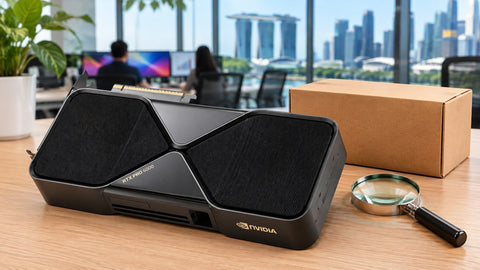
For most gamers, the money stops making sense after the RTX 5070 Ti. In Tom's Hardware's June 2026 tests the RTX 5080 was only about 10% faster at 1440p and 13% faster at 4K, for about a third more money at launch prices and nearly 40% more at late-2026 US street prices. Both have 16 GB. The RTX 5090 is in a different class: about 43% faster than the 5080 at 4K and the only one of the three with 32 GB. At MSRP it was a reasonable flagship. At 2026 US street prices it costs roughly two and a half to four times as much per 4K frame as the 16 GB cards, so it only makes sense when you need what nothing else offers.
What does each card cost per frame?
| Measure | RTX 5070 Ti | RTX 5080 | RTX 5090 |
|---|---|---|---|
| Memory / bandwidth | 16 GB / 896 GB/s | 16 GB / 960 GB/s | 32 GB / 1,792 GB/s |
| TGP | 300 W | 360 W | 575 W |
| 1080p Ultra / 1440p Ultra / 4K Ultra (fps, native) | 155.4 / 116.8 / 68.6 | 166.9 / 128.3 / 77.4 | 203.8 / 167.3 / 110.8 |
| 4K ray tracing (fps, native) | 36.7 | 42.1 | 64.1 |
| US launch MSRP | US$749 | US$999 | US$1,999 |
| US$ per 1440p frame at MSRP | 6.42 | 7.79 | 11.95 |
| US$ per 4K frame at MSRP | 10.93 | 12.92 | 18.05 |
| US street price, Tom's tracker (26 Oct 2026) | US$1,229 | US$1,699 | US$8,477 |
| US$ per 1440p frame at that street price | 10.52 | 13.24 | 50.67 |
| US$ per 4K frame at that street price | 17.92 | 21.95 | 76.51 |
Source: Tom's Hardware GPU Benchmarks Hierarchy (updated 24 Jun 2026; Ryzen 7 9800X3D, native resolution, no DLSS or frame generation) and Tom's Hardware lowest-price tracker (26 Oct 2026); specs from NVIDIA and Tom's review spec tables. Cost per frame is our arithmetic. Street prices change weekly and differ by country.
A second price source tells the same story. eBay asking prices in November 2026 averaged about US$1,322 for a 5070 Ti, US$1,865 for a 5080 and US$6,542 for a 5090. On those numbers a 4K frame costs about US$19, US$24 and US$59 respectively.
Where does the RTX 5080 fit?
It's the hardest card of the three to recommend on value. The 5080 and 5070 Ti use the same GB203 chip and the same 16 GB, and the 5080's extra cores and slightly faster memory buy a single-digit to low-teens percentage gain: about 7% at 1080p, 10% at 1440p, 13% at 4K and 15% in 4K ray tracing. That costs 33% more at MSRP and 38–41% more at the street prices above. Hardware Unboxed reached a similar conclusion at launch prices, finding the 5070 about 20% better value per frame than the 5080 and the 5070 Ti in between.
The 5080 makes sense if you want the most a 16 GB card can do, or if you find one close to its MSRP. Otherwise, the 5070 Ti gives you nearly the same experience, and both cards get DLSS 4 Multi Frame Generation and the DLSS 4.5 5x and 6x modes.
How does resolution change the answer?
- 1080p: all three cards are partly held back by the CPU. Even with a Ryzen 7 9800X3D, the 5090 is only about 22% ahead of the 5080 here. A 5090 at 1080p is mostly unused capacity. A 5070 Ti, or a cheaper card, is enough for high-refresh 1080p.
- 1440p: the 5070 Ti averages about 117 fps at native Ultra settings in Tom's suite, which suits a 144–180 Hz monitor without frame generation. The 5090's 30% lead over the 5080 is real but expensive. See our 1080p vs 1440p monitor guide.
- 4K: this is where the 5090 earns its place. It averages about 111 fps natively in Tom's raster suite against 69–77 fps for the 16 GB cards. With DLSS Super Resolution, the 5070 Ti and 5080 can also play well at 4K, but their 16 GB is borderline in a few path-traced games.
- 4K at 240 Hz: no card renders demanding games at 240 fps natively. Getting there means DLSS upscaling plus frame generation on any of the three. Our 4K 240 Hz post shows what the 5090 actually delivers.
Below the RTX 5090, you're buying frames. With the RTX 5090, you're buying 32 GB and the top of the chart, and at 2026 prices you pay several times more for each extra frame.
Does the value ladder change for creative and AI work?
Partly. In Blender, the 5090 scales better than in games: its Open Data median on Blender 5.2.0 is 16,080, against 9,148 for the 5080 and 7,739 for the 5070 Ti (fetched 6 Nov 2026). At MSRP that's about 10.3, 9.1 and 8.0 points per US dollar for the 5070 Ti, 5080 and 5090. At the Tom's street prices it's about 6.3, 5.4 and 1.9. The 5070 Ti stays the value pick until a scene outgrows 16 GB.
In local AI, bandwidth matters more than core count. On gpt-oss-20b in hardware-corner's llama.cpp tests, the 5070 Ti generated 133 tokens per second, the 5080 141 and the 5090 249. The 5080 is only about 6% faster than the 5070 Ti here, because their memory bandwidth is almost the same. The 5090's real advantage is capacity: 24B–32B models at 4-bit and 32B QLoRA fine-tuning fit in 32 GB, but not in 16 GB. For budget AI options, see RTX 5090 vs RTX 5060 Ti 16GB.
So where does the money stop making sense?
- Stop at the RTX 5070 Ti for 1080p and 1440p gaming, 4K gaming with DLSS, and creative or AI work that fits in 16 GB.
- Consider the RTX 5080 only if you find it near MSRP or want the fastest 16 GB card regardless of value.
- Go to the RTX 5090 for native 4K at high refresh rates, or when your work needs more than 16 GB of VRAM. Compare it with the 5080 in our RTX 5090 vs RTX 5080 post, and read our overall is the RTX 5090 worth it verdict.
Power is part of the cost, too. The three cards are rated at 300 W, 360 W and 575 W, and NVIDIA asks for 750 W, 850 W and 1,000 W power supplies respectively.
Buying in Singapore
RTX 5070 Ti, 5080 and 5090 desktop cards are not in stock at SourceIT at the time of writing; ask us about availability and a quotation. If you'd rather buy a complete compact system, the ASUS ROG NUC 16 with an RTX 5070 Ti Laptop GPU is S$4,773.15 and the RTX 5080 Laptop GPU version is S$5,650.03 (listed 6 Nov 2026). These laptop GPUs are slower than the desktop cards and have less memory in the 5070 Ti's case (12 GB). For a 4K 240 Hz monitor that also runs 1080p at 480 Hz, the Philips Evnia 27M2N5800P is S$764.40. Prices change, so ask for a current quotation. Use Request for Quotation on the product page, call (65) 6978 3502, email Sales@sourceit.com.sg or use our contact page.
Frequently asked questions
Is the RTX 5080 worth it over the RTX 5070 Ti? Rarely on value. It's about 10–13% faster at 1440p and 4K in Tom's tests, with the same 16 GB, for about a third more money at MSRP and more at 2026 street prices.
Which is the best value RTX 50 card for 1440p? Of these three, the RTX 5070 Ti. It averages about 117 fps at native 1440p Ultra in Tom's suite and costs the least per frame at both MSRP and street prices.
Is the RTX 5090 good value? At its US$1,999 MSRP it cost about 40% more per 4K frame than a 5080. At late-2026 US street prices it costs roughly two and a half to three and a half times as much per 4K frame as a 5080, so it's only good value if you need its 32 GB or its top-end 4K speed.
Do all three cards support DLSS 4 Multi Frame Generation? Yes. Multi Frame Generation and the DLSS 4.5 5x and 6x modes are available on all RTX 50 cards.
Why are RTX 50 cards selling above MSRP? NVIDIA hasn't changed its MSRPs, but it has said memory supply is constrained. Street prices rose through 2026, and AI demand has added pressure on the 5090 in particular.

SourceIT Approved
Researched and verified by the SourceIT team for Singapore buyers.