It comes down to utilisation. On the illustrative model below, a DGX Station costs about S$162,000 to own over three years, before staff time. The closest single-GPU cloud rental, one NVIDIA B300 at US$8.99 an hour on RunPod (as listed on 5 Nov 2026), would cost the same if you used it for about 54% of all hours over those three years: roughly 13 hours a day, every day. Against higher-priced options such as an AWS B300 Capacity Block at about US$16.15 per GPU-hour, owning breaks even at about 30% utilisation. If your workload is a few hours a day, or comes in bursts, renting usually wins. If the GPU would be busy most of the day and night, ownership usually wins, especially once the data-location and availability benefits are counted. The DGX Station systems themselves, such as the Supermicro ARS-511GD-NB-LCC or GIGABYTE W775-V10-L01, are price on request at SourceIT. We assume S$150,000.
What does each option cost over three years?
| Option | Rate (as listed on 5 Nov 2026) | 3 years at 24/7 (26,280 h) | Utilisation needed to equal ownership (S$162,354) |
|---|---|---|---|
| Own a DGX Station GB300 (illustrative) | S$150,000 hardware + UPS + electricity | about S$162,354 | — |
| RunPod, 1× B300 | US$8.99/h (S$11.48) | about S$301,795 | about 54% |
| Nebius, B300 | US$9.50/h (S$12.14) | about S$318,916 | about 51% |
| AWS p6-b300 Capacity Block, per GPU | about US$16.15/h (S$20.63) | about S$542,022 | about 30% |
| CoreWeave HGX B200, per GPU | US$8.60/h (S$10.99) | about S$288,703 | about 56% |
| Lambda, 1× B200 | US$6.69/h (S$8.55) | about S$224,584 | about 72% |
| Azure ND H200 v5, Southeast Asia, per GPU | US$13.78/h (S$17.60) | about S$462,596 | about 35% |
Source: RunPod, Nebius, CoreWeave and Lambda pricing pages; AWS EC2 Capacity Blocks pricing (p6-b300, US East, S$ per GPU derived from the 8-GPU rate); AzureSpeed for the Azure Southeast Asia rate. All as listed on 5 Nov 2026, converted at USD/SGD 1.2774 (Trading Economics). Lambda's page notes that new prices take effect on 16 Nov 2026. The ownership figure is illustrative. It is S$150,000 for the system (the ballpark used in this series; public US pricing of roughly US$93,000–125,000 for most OEMs is about S$119,000–160,000 before GST), an APC Smart-UPS SRT 3000VA at S$4,165 (listed 5 Nov 2026) and electricity at a 1 kW average, 24/7, at SP Group's Q4 2026 tariff of 31.16¢/kWh with GST. It excludes staff time. Cloud prices exclude GST, storage, data transfer and any reserved-capacity discounts.
Are these like-for-like comparisons?
Not exactly, and the differences cut both ways. A cloud B300 has 288 GB of HBM3e; the DGX Station's GB300 has 252 GB of HBM3e plus 496 GB of LPDDR5X attached to its 72-core Grace CPU, all coherent over NVLink-C2C. B200 and H200 rentals have less GPU memory than either. Cloud instances, on the other hand, can scale out to eight or more GPUs for a training job, which a single Station cannot. H200 rows are included mainly because Azure's H200 is the only like-for-like Singapore-region GPU price we found: US$13.78 per GPU-hour in Southeast Asia, against US$10.60 in East US 2, a 30% premium. Most of the cheapest B200 and B300 offers listed above don't publish a Singapore price.
The question isn't whether owning is cheaper than renting. It is whether you will keep the GPU busy enough for ownership to win.
How does the answer change with utilisation?
| Average utilisation over 3 years | GPU-hours | RunPod B300 (S$) | AWS B300 Capacity Block (S$) | Own (S$, excl. staff) |
|---|---|---|---|---|
| 25% (about 6 hours a day) | 6,570 | 75,449 | 135,506 | 162,354 |
| Office hours only (8 h × 261 days a year) | 6,264 | 71,935 | 129,194 | 162,354 |
| 50% | 13,140 | 150,897 | 271,011 | 162,354 |
| 75% | 19,710 | 226,346 | 406,517 | 162,354 |
| 100% (24/7) | 26,280 | 301,795 | 542,022 | 162,354 |
Add staff time and the ownership line moves. With S$20,000 a year for a fifth of an engineer, ownership comes to about S$222,354, and break-even against RunPod's B300 rises to about 74% utilisation (about 41% against AWS). Cloud GPUs need some engineering effort too, so the true difference in staffing is usually smaller than the full S$20,000. Our post Now Who's Going to Manage It? covers what owning involves.
Own or rent: GPU utilisation calculator
Defaults reproduce this article's illustrative model. Change the rental rate, how busy the GPU will be and your ownership costs.
Cloud rental
Owning a DGX Station
Bar: green is the utilisation you entered; the black mark is where owning and renting cost the same. Cloud cost = rate × hours used. Owned cost = hardware and one-off costs, plus electricity around the clock. Cloud prices as listed on 5 Nov 2026, before GST, storage, data transfer and reserved-capacity discounts. Rental GPUs are not identical to a DGX Station's GB300: cloud B300s have more HBM, the Station adds 496 GB of LPDDR5X and a 72-core Grace CPU. S$150,000 is a planning assumption; SourceIT quotes DGX Station systems on request. Illustrative estimate, not a quotation.
What else belongs in the comparison besides the hourly rate?
- Elasticity. The cloud lets you rent eight GPUs for a weekend and none the following month. A Station is a fixed amount of capacity.
- Availability. Popular GPUs on lower-cost clouds can be sold out or preempted, and capacity blocks must be booked. A Station you own is available whenever you are.
- Data location. Renting means your data and model weights sit on someone else's infrastructure, often outside Singapore. See Data Residency vs Data Sovereignty.
- Price changes. Cloud rates move both ways. AWS cut H100 (P5) on-demand prices by 44% in June 2025, and Lambda has a price change scheduled for 16 Nov 2026. A purchase price is fixed once paid.
- Warranty and lifecycle. SourceIT's HP ZGX Fury and Supermicro listings state 3-year onsite warranty terms; MSI, ASUS and GIGABYTE confirm terms at quotation. After year three, plan for support extension or replacement. We haven't assumed any resale value.
- Electricity. At the full 1.6 kW around the clock, three years at the Q4 2026 tariff would cost about S$13,102, against S$8,189 in our 1 kW base case. A difference of a few thousand dollars doesn't change the conclusion.
Is there a middle path?
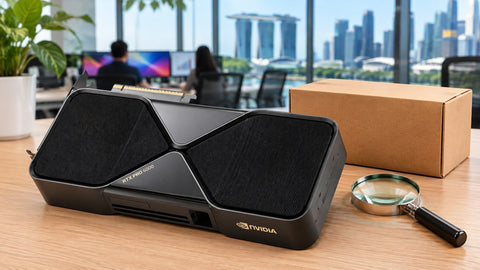
Two are worth considering. The first is a workstation GPU rather than a full Station. RunPod lists the RTX PRO 6000 at US$2.49 an hour, and SourceIT sells the NVIDIA RTX PRO 6000 Blackwell Workstation Edition at S$29,100 (listed 5 Nov 2026). The card alone equals about 9,149 hours of that rental, roughly 381 days of continuous use, before you count the host workstation it needs. Our post NVIDIA GB10 vs RTX PRO 6000 Blackwell compares that tier.
The second is hybrid capacity. Own enough to cover your steady daily load, and rent cloud GPUs for training runs or peaks. Running the steady load around the clock, including overnight batch work as described in The 24/7 AI Factory, is what pushes owned utilisation high enough to beat renting.
For related comparisons, see NVIDIA DGX Station vs Traditional GPU Servers, How Much Productivity Must It Generate to Justify the Investment? and our earlier Local AI vs Cloud API cost model, which compares owned hardware against per-token APIs rather than rented GPUs.
Buying in Singapore
SourceIT lists the Supermicro ARS-511GD-NB-LCC, GIGABYTE W775-V10-L01, HP ZGX Fury G1n, MSI XpertStation WS300 and ASUS ExpertCenter Pro ET900N G3, all price on request, in the NVIDIA DGX Spark & DGX Station collection. Share your current monthly GPU-hours and cloud invoices, and we will quote a system so you can replace our S$150,000 assumption with a real number. For a quotation, use Request for Quotation on the product page, call (65) 6978 3502, email Sales@sourceit.com.sg or use our contact page.
Frequently asked questions
What is the closest cloud rental to a DGX Station? A single NVIDIA B300 GPU, listed at US$8.99 an hour on RunPod and US$9.50 on Nebius on 5 Nov 2026. A cloud B300 has 288 GB of HBM3e against the Station's 252 GB, but the Station adds 496 GB of LPDDR5X and a 72-core Grace CPU.
At what utilisation does owning beat renting? On this article's illustrative assumptions, about 54% against RunPod's B300 and about 30% against an AWS B300 Capacity Block, excluding staff time. Including S$20,000 a year of staff time, about 74% and 41%.
Are cloud GPUs more expensive in Singapore? The only like-for-like Singapore figure we found was Azure's H200: US$13.78 per GPU-hour in Southeast Asia against US$10.60 in East US 2, about 30% higher, as listed on 5 Nov 2026.
How much does electricity add to owning? About S$8,189 over three years at a 1 kW average, or about S$13,102 at the full 1.6 kW around the clock, at SP Group's Q4 2026 tariff of 31.16¢/kWh with GST.
Should I count resale value? We don't, because there is no established resale market for DGX Station GB300 systems yet. Any resale value would improve the ownership case.