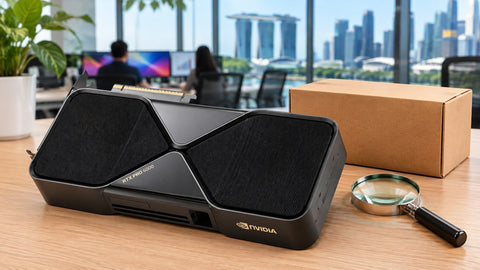
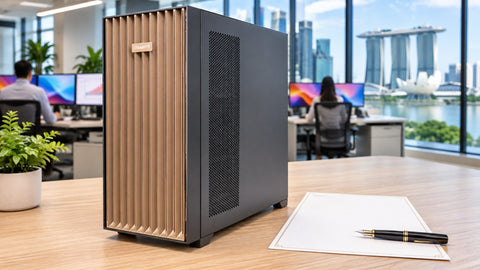
Buy now if the ASUS ProArt GR1X already runs the models and apps you need, and waiting would cost you more in delay than you would save. Wait if you are buying for software that isn't ready on Windows on Arm yet, for many simultaneous users, or for models larger than 128 GB can hold. NVIDIA's next RTX Spark generation, based on Vera Rubin, sits on its roadmap for around 2027–28, with no firm date or specifications. Memory prices are also more likely to stay high than to fall soon, so waiting is not a reliable way to pay less.
What do we actually know about the next NVIDIA chip?
| Item | What's public | Status |
|---|---|---|
| Current chip | RTX Spark N1X (Grace Blackwell), 20-core CPU, 6,144-core GPU, up to 128 GB LPDDR5X at about 300 GB/s | Shipping in laptops; desktops such as the GR1X launching now |
| Next generation | Vera Rubin-based RTX Spark, moving to LPDDR6 | On NVIDIA's Computex 2026 roadmap for around 2027–28 |
| Generation after | Feynman-based RTX Spark | Roadmap window around 2029–30 |
| Named successors | Jensen Huang: "N2X and N3X are already planned" | No specs, prices or dates |
| "N2 in Q3 2027" | Reported by VideoCardz | Rumour; reports disagree on the year |
| Smaller, cheaper chip | Leaked "N1": 12 CPU cores, 2,560 shaders, 128-bit memory | Unverified leak |
| Software support lifecycle | No NVIDIA or Microsoft commitment published | Unknown |
Source: NVIDIA Computex 2026 roadmap as reported by heise and PC Gamer (1 Jun 2026); HWCooling (16 Jun 2026); Jensen Huang via Tom's Guide and tbreak (4 Aug 2026); VideoCardz headlines (page not retrievable); ASUS ProArt GR1X page (8 Nov 2026). Roadmap years differ between reports, so treat them as windows, not dates.
Will waiting get you a cheaper GR1X?
Probably not in the next year. The GR1X uses soldered LPDDR5X, and memory has driven much of the 2026 rise in PC and AI hardware prices. TrendForce reported contract DRAM prices up 90–95% in the first quarter of 2026, and, according to a summary of Micron's September 2026 earnings call, its chief executive expects fiscal 2027–28 to be "much tighter" than 2026. NVIDIA's own DGX Spark rose to US$6,950 from its launch price. None of that guarantees higher GR1X prices, but it makes a quick drop unlikely.
ASUS had not published a GR1X price at the time of writing. SourceIT estimates about S$6,200–7,200 for the 64 GB model and S$9,000–12,000 for 128 GB, based on comparable RTX Spark devices. This is not an official ASUS price. Our is the GR1X overpriced post breaks down what that money buys.
Will the software get better on the hardware you buy now?
Very likely, and that is an argument for buying sooner rather than waiting. Most of the GR1X's current limits are software, not silicon:
- CUDA on Windows on Arm launched as a developer preview.
- vLLM and TensorRT-LLM have no native Windows support; a community Arm64 port of vLLM exists for one model.
- ComfyUI's native Arm64 installer was still an open pull request in November 2026.
- Some games don't run yet; Microsoft has committed to Call of Duty on RTX Spark in 2027.
These improve with driver and app updates on today's chip. What updates cannot change is the 128 GB ceiling and the roughly 300 GB/s of bandwidth. If your needs are within those limits, a later chip mainly buys speed. Our obsolescence post looks at how quickly that ceiling might start to bite.
Waiting for the next chip makes sense when today's chip can't do the job. It rarely makes sense when the job is ready and only the price might change.
Who should buy now?
- Single users running models up to the 120B mixture-of-experts class. gpt-oss-120b ran at about 63 tokens per second on a 128 GB RTX Spark laptop in Techtesters' test (16 Oct 2026). The practical ceiling for local models in mid-2026 was around this size at 4-bit, according to one analysis (openclawdc, 29 Jul 2026).
- Windows creators who want Adobe, ComfyUI and local image and video generation on a compact machine.
- Teams with a privacy need today, where every month of sending sensitive work to cloud services is a cost or a risk.
- Buyers who would otherwise wait for an RTX 5090 desktop. Those cards have been scarce in 2026 and were out of stock at SourceIT at the time of writing. Our GR1X vs RTX 5090 post compares the two.
Who should wait, or buy something else?
- Developers who need Linux and the full CUDA stack now. A GB10 system such as the ASUS Ascent GX10 or DGX Spark has it today. See GR1X vs DGX Spark: Windows or Linux.
- Teams serving many users. Bandwidth and the lack of native serving tools limit a GR1X. A GPU workstation is the better buy now; a future chip won't fix this soon.
- Anyone who needs more than 128 GB. Frontier open models are growing past what any single 128 GB box can hold. A next-generation RTX Spark might raise the ceiling, but nothing has been announced.
- Buyers whose key app doesn't run on Windows on Arm. Check our Windows on Arm compatibility guide first. If it's missing, wait and recheck rather than buy on a promise.
Our three-year ageing comparison covers what each RTX Spark desktop offers for upgrades over its life, such as the GR1X's second SSD slot.
A simple way to decide
- List the three models and three apps you will use most in the next 12 months.
- Check that each runs on Windows on Arm today, not "coming soon".
- Check that the largest model fits in 64 GB or 128 GB with the context you need.
- If all three checks pass, buy now; a later chip would mainly make it faster.
- If any check fails, buy the tool that passes today (a GB10, a GPU workstation or cloud) or wait and recheck.
Buying in Singapore
The ASUS ProArt GR1X is price on request at SourceIT; ask us for current pricing and availability. Available now on the same RTX Spark chip, the ASUS ProArt P16 128 GB laptop is S$10,773.20. For Linux and the full CUDA stack, the ASUS Ascent GX10 64 GB / 1 TB is S$6,670 and the 128 GB / 1 TB is S$10,350 (all listed 8 Nov 2026). Prices change; ask for a current quotation. Use Request for Quotation on the product page, call (65) 6978 3502, email Sales@sourceit.com.sg or use our contact page.
Frequently asked questions
When is NVIDIA's next RTX Spark chip coming? NVIDIA's roadmap shows a Vera Rubin-based RTX Spark for around 2027–28, with Feynman after it. NVIDIA has given no firm date, specifications or prices, and reports disagree on the year.
Will the GR1X get cheaper if I wait? Not reliably. Memory prices rose sharply in 2026 and Micron expects supply to be tighter in fiscal 2027–28. ASUS had not published a GR1X price at the time of writing.
Can I upgrade the GR1X's memory later? No. The LPDDR5X memory is soldered, so choose 64 GB or 128 GB at purchase. Storage is the upgradable part: ASUS lists two SSD slots.
Will software support improve on the current GR1X? Very likely. CUDA on Windows on Arm, serving tools and app support are still maturing as of November 2026, and those improvements arrive through updates. NVIDIA hasn't published a support lifecycle, though.
Should I buy a DGX Spark instead of waiting? If you need Linux, the full CUDA stack or two-unit clustering now, a GB10 system such as the DGX Spark or ASUS Ascent GX10 does that today. It isn't faster at generating tokens than the GR1X.

SourceIT Approved
Researched and verified by the SourceIT team for Singapore buyers.