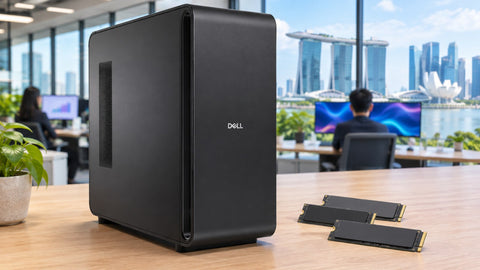
Buying NVIDIA DGX GB300 in Singapore? Why Choosing the Right Supplier Matters More Than Price

Because on a GB300 order, price is the smallest risk. A DGX Station GB300 is a single-GPU deskside system with 748 GB of coherent memory, and most public US prices for it sit around US$93,000–100,000, within a few per cent of each other. The real costs come from wrong configurations, missed allocations, a warranty the manufacturer won't honour locally, or an order that stalls because the end-user paperwork doesn't line up. This guide gives you a scorecard for judging suppliers on those points, so you compare more than the bottom line.
A note on names: most Singapore buyers asking about a "DGX GB300" mean the DGX Station GB300, which ASUS, Dell, HP, MSI, GIGABYTE and Supermicro build. NVIDIA's own DGX GB300 is a different product, a 72-GPU GB300 NVL72 rack for data centres. The scorecard works for both, but the stakes are far higher for the rack.
Why can't you just compare prices?
Three things make GB300 different from buying servers or laptops.
There is no public price to compare against. NVIDIA publishes no list price for DGX GB300 or HGX systems, and sends buyers to partners. All six DGX Station GB300 listings on our store are price on request. That is a supplier condition, not a SourceIT choice. Each quote is built for a specific configuration (storage, keyboard and monitor options, support term), so two "GB300 quotes" are often not like for like.
Supply is allocated. NVIDIA told investors in August 2026 that it expects memory supply to stay tight through fiscal 2028, and Supermicro reported a US$13 billion Blackwell Ultra backlog in February 2026. No manufacturer publishes a lead time in weeks for GB300 systems. A supplier who promises a date without checking allocation is guessing.
The seller's channel decides your support. NVIDIA has said that data centres "require service and support, which we provide only to authorized NVIDIA products" (July 2025). Hardware warranty on GB300 systems comes from the OEM, and some OEM terms apply only to the original purchaser.
What should a GB300 supplier scorecard include?
| Criterion | Why it matters for GB300 | What to ask for | Red flag |
|---|---|---|---|
| Channel | Warranty and NVIDIA support depend on an authorised OEM or distributor chain | Which OEM or distributor the unit comes from, in writing | "Can't say where it's from" or a price far below everyone else's |
| Configuration check | Storage, OS, networking and support term change both price and fit | A quote that lists the exact OEM part numbers | A quote that just says "GB300 workstation" |
| Local warranty | OEM terms vary (e.g. Dell's default onsite cover follows remote diagnosis; Supermicro GPU systems carry 3 years' labour but 1 year's parts) | The Singapore warranty term and how a fault is logged | Warranty described only as "manufacturer warranty" |
| Allocation and timing | Supply is tight and quotes can expire quickly | Quote validity and what the delivery estimate depends on | A fixed delivery date with no conditions |
| Site check and commissioning | A Station draws 1,600 W; a rack needs liquid cooling | Who checks the site and who powers it on | "Delivery to kerb" only |
| Documentation support | Manufacturers and distributors typically ask for end-user and site details | A list of what will be needed, before you order | No questions asked about who will use it |
| Payment terms | Large deposits tie up cash if the order stalls | Deposit, balance and what happens if allocation slips | Full prepayment to an unfamiliar seller |
Source: NVIDIA DGX GB300 and HGX pages (fetched 9 Nov 2026); NVIDIA statement reported 25 Jul 2025; CIO Dive (27 Aug 2026); Futurum (5 Feb 2026); Dell and Supermicro warranty pages (fetched 9 Nov 2026). Facts as of 9 Nov 2026. The scorecard is SourceIT's suggested framework, not an industry standard.
How much does price really vary?
Not much, for the same box. Public US figures for DGX Station GB300 systems cluster tightly: Supermicro sold its ARS-511GD direct at US$92,887.47 (TechRadar, 1 Sep 2026), Exxact listed one at US$94,930, and the ASUS ExpertCenter Pro ET900N G3 appeared at US$99,999 at a US retailer in June 2026 (Notebookcheck). Larger Dell configurations have been reported at about US$182,000. Those are US prices before local taxes and they move, but the pattern holds: on the same configuration, the spread between honest quotes is small next to what a stalled or unsupported order costs.
So when one quote is much cheaper, ask why. It may be a smaller storage option, a shorter support term or a different OEM. Or it may be stock whose origin the seller can't document, which is the risk we cover in the risks of buying high-end NVIDIA GPUs from unverified suppliers. Our HP ZGX Fury vs MSI quotation comparison shows how to line two real quotes up, and why the cheapest quotation isn't always the best deal covers the general method.
On a six-figure GB300 order, a 2% price gap matters far less than whether the system arrives configured correctly, on a date you were told honestly, with a warranty the manufacturer will honour in Singapore.
What does "legitimate sourcing" look like in practice?
A legitimate supplier can tell you, in writing, which manufacturer or distributor the system comes from, and the paperwork follows the hardware: OEM part numbers on the quote, a serial number you can register with the OEM, and an invoice chain the OEM would recognise. It also asks you questions. For high-end AI systems, manufacturers and distributors typically want to know who the end user is, where the system will be installed and what it will be used for. A seller who asks nothing is not doing you a favour. In a US case reported in March 2026, NVIDIA reviewed a large server order, could not verify the ultimate buyer, and the purchase did not go ahead.
We explain what those questions are, and why each one is asked, in GB300 KYC and EUC requirements explained. For the supplier's side of compliance, see why your AI infrastructure supplier should understand export compliance. The rules themselves are summarised in our earlier post on export controls and AI hardware in Singapore. This article is general information, not legal advice; confirm requirements for your situation with your legal or trade-compliance adviser.
What should transparent procurement include?
Transparency is mostly about telling you what you are getting, and what could change, before you commit:
- A line-item quote with OEM part numbers, support term and what is excluded (installation, UPS, networking).
- Stated assumptions on delivery: what the estimate depends on, and what happens if allocation moves.
- A documentation list up front, so the order isn't held later for information you could have supplied on day one. Our post on documentation mistakes that hold up GB300 orders lists the common ones.
- A named route for faults: who you call, and whether the OEM's onsite service covers your address.
- Total cost, not just the box: the support term, a suitable online UPS, and any networking or storage the workload needs.
The step-by-step version of this, from quote to handover, is in from quotation to delivery. For what goes wrong on larger projects, see why experienced AI hardware suppliers matter.
Buying in Singapore
SourceIT lists DGX Station GB300 systems from six manufacturers, each supplied through that OEM's channel: the ASUS ExpertCenter Pro ET900N G3, Dell Pro Max with GB300, HP ZGX Fury G1n, MSI XpertStation WS300, GIGABYTE W775-V10-L01 and Supermicro ARS-511GD-NB-LCC. All are price on request. We prepare a line-item quotation for your configuration, check it against your workload, help you prepare the KYC and end-user information suppliers ask for, coordinate with the manufacturer, and arrange delivery and handover. Our DGX Station GB300 buyer's guide compares the models. SourceIT does not list GB300 NVL72 racks. For data-centre projects, ask us to source through our partners; we will confirm availability, lead time and facility requirements rather than assume stock. To start, use Request for Quotation on the product page, call (65) 6978 3502, email Sales@sourceit.com.sg or use our contact page.
Frequently asked questions
Why don't GB300 systems show a price online? NVIDIA publishes no list price for these systems, and the suppliers behind the six DGX Station GB300 models on our store don't allow a storefront price. Each quote is built for a specific configuration and support term.
Is the cheapest GB300 quote a bad sign? Not always, but ask why it's cheaper. It may be a smaller storage option or shorter support term. If the seller can't say which OEM or distributor the unit comes from, treat that as a warning.
Does buying from an unauthorised seller void the warranty? It can leave you without cover. GB300 hardware warranty comes from the OEM, some OEM terms apply only to the original purchaser, and NVIDIA says it supports only authorised NVIDIA products. Confirm the Singapore warranty in writing before you pay.
Can a supplier guarantee a delivery date for GB300? Be wary if one does. Supply is allocated, no manufacturer publishes GB300 lead times in weeks, and quotes can expire quickly. A good supplier explains what the estimate depends on.
Is a DGX GB300 the same as a DGX Station GB300? No. The DGX Station GB300 is a single-GPU deskside system from OEMs such as ASUS, Dell and HP. NVIDIA's DGX GB300 is a 72-GPU GB300 NVL72 rack for data centres, sold through select partners.

SourceIT Approved
Researched and verified by the SourceIT team for Singapore buyers.