NVIDIA GB300 Procurement Delayed? 7 Documentation Mistakes That Could Hold Up Your Order

A GB300 order can stall on paperwork as easily as on hardware supply. When the supplier, distributor or manufacturer finds a gap or a contradiction in the buyer's information, it has to stop and ask. Seven avoidable problems are behind much of that back-and-forth: names that don't match across documents; an undisclosed parent company; a vague end use; an installation site marked "TBC"; unmentioned plans to resell, move or share the system; declarations that are unsigned, out of date or altered; and procurement and IT giving different answers. Each one maps to a red flag in US export-control guidance, which is why nobody in the chain can simply wave it through. All seven are easy to fix before you submit. This post assumes you know what a KYC check and an end-user certificate are. If not, start with our GB300 KYC and EUC explainer.
Why do small inconsistencies stop a GB300 order?
US "Know Your Customer" guidance (Supplement 3 to Part 732 of the Export Administration Regulations) tells sellers: if there are red flags, inquire, and "do not self-blind". The Bureau of Industry and Security's 13 May 2025 guidance on advanced computing chips adds specific red flags, including an unknown installation address, an unknown or refused headquarters for the customer or its parent, and inconsistencies in the information provided. It also says a refusal to give attestations is itself a red flag. So when a supplier spots a mismatch, the safe course is to pause and resolve it. That pause, repeated at each party in the chain, can turn a quick question into a delay of weeks.
Which seven mistakes hold up orders, and how do you fix them?
| # | Mistake | What the supplier sees | Fix before you submit |
|---|---|---|---|
| 1 | Names don't match | PO, ACRA record, invoice address and end-user form show different entities or spellings | Use the exact ACRA name everywhere; explain any buyer/end-user difference in writing |
| 2 | Parent company not disclosed | "N/A" for ultimate parent, or a group structure that doesn't match public records | Give the ultimate parent and its headquarters country, with a simple structure chart |
| 3 | Vague end use | "AI", "research" or "data processing" | Two or three specific sentences: workload, users, internal or external service |
| 4 | Installation site "TBC" | No address, a registered office instead of the real site, or a data centre that hasn't confirmed capacity | Give the actual address and facility; get the data centre's written confirmation |
| 5 | Undisclosed onward plans | Later mention of reselling, relocating or providing compute to other companies | State any such plans up front, even if tentative |
| 6 | Declarations unsigned, outdated or altered | Missing signature or stamp, an old form, or edits after signing | Use the supplier's current form, signed by an authorised officer; re-sign if facts change |
| 7 | Procurement and IT disagree | Different answers on site, configuration or users in emails and forms | Nominate one owner who checks every answer before it goes out |
Source: BIS Supplement 3 to Part 732 (KYC red flags); BIS "Industry Guidance to Prevent Diversion of Advanced Computing Integrated Circuits" (13 May 2025); 15 CFR §748.11 on signed statements. These are practical issues, not measured frequencies. Facts as of 9 Nov 2026.
1. Why do mismatched company names matter so much?
The legal entity on the purchase order is the anchor for every screening check. If the PO says one name, the ACRA profile another and the end-user form a third (a trading name, an abbreviation, a sister company), the supplier can't tell whether these are one party or several. Fix it by using the exact registered name and UEN on every document. If a different group company will use the system, say so on the form rather than leaving the supplier to infer it.
2. What if we don't think the parent company is relevant?
It is relevant. BIS guidance of 31 May 2026 says a US licence is required where the buyer or its ultimate parent is headquartered in a Country Group D:5 country or Macau, wherever the buyer itself is located. A Singapore subsidiary of an overseas group should expect this question and answer it fully. Our post on hidden compliance challenges works through the ownership scenarios.
3. How specific does the end use need to be?
Specific enough that a stranger could check it fits your business. "AI" describes almost anything. "Fine-tuning and serving internal language models for our customer-service team, used by about 40 staff in Singapore" tells the supplier what the system does, who uses it and that it is internal. If the system will provide compute to other companies, say so: providing infrastructure as a service is a category BIS asks sellers to identify.
4. Why can't the installation site wait until delivery?
Because the declaration is about a place as well as a company. BIS lists an unknown installation address as a red flag, and a data centre that cannot confirm it has the power, cooling or space for the equipment as another. For a data-centre deployment, get the facility's written confirmation before you submit. Site questions get their own guide: why suppliers need to know where your AI server will be installed.
5. Do tentative plans to move or share the system count?
Yes. US rules follow US-origin items after export, so reselling a system, moving it to another country or renting out its compute can create new obligations. A plan mentioned for the first time after the forms are signed looks far worse than one disclosed at the start, even if it is only a possibility.
6. What makes a declaration "incomplete"?
Missing signatures, missing company stamps, blank fields, an outdated version of the supplier's form, or edits made after signing. BIS's own rules for its statement say a signed form cannot be altered and a new one is needed if facts change. Treat supplier forms the same way.
7. How do internal disagreements cause delays?
A procurement officer fills in the form; an engineer emails the supplier about the configuration; a manager mentions a second site on a call. If those answers differ, the supplier has to reconcile them. Give one person ownership of the whole pack and route every answer through them.
Every mistake on this list is cheaper to fix before you submit than after a supplier has had to stop and ask.
What else commonly slows a GB300 order?
Paperwork is not the only cause. Supply is tight: NVIDIA expects memory constraints to last through fiscal 2028 (CIO Dive, 27 August 2026), and configurations are built to order. A clean pack doesn't create stock, but it means your order is ready the moment allocation is. Import paperwork matters too: Singapore Customs charges 9% GST at import, paid by the importer named on the TradeNet permit, and naming the wrong importer means a replacement permit (IRAS GST Guide on Imports, 30 January 2026). Public-sector buyers face their own steps; see why government IT procurement can fail before the equipment arrives. For wider supply effects, read who gets hardware first in a chip shortage and our general RFQ checklist. If you're preparing for a data-centre deployment, use the full pre-quote document pack.
This article is general information, not legal advice; confirm requirements for your situation with your legal or trade-compliance adviser.
Buying in Singapore
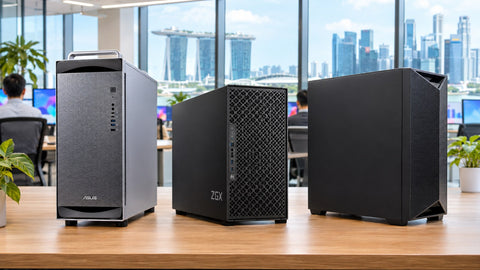
SourceIT checks your end-user pack for these seven problems before it goes to the manufacturer or distributor, and coordinates any follow-up questions. We can't guarantee approval or a delivery date; those decisions sit with the manufacturer, the distributor and, where relevant, regulators. We list DGX Station GB300 systems from ASUS, Dell, HP, MSI, GIGABYTE and Supermicro, each supplied through the OEM's channel and all price on request. SourceIT does not list GB300 NVL72 racks. For data-centre projects, ask us to source through our partners; we will confirm availability, lead time and facility requirements rather than assume stock. Use Request for Quotation on the product page, call (65) 6978 3502, email Sales@sourceit.com.sg or use our contact page.
Frequently asked questions
How long does end-user verification take for a GB300 order? No manufacturer publishes a fixed time, and it varies by order and supplier. A complete, consistent pack avoids the repeated questions that cause most delays.
Can we submit the end-user form after the purchase order? You can, but the order generally won't progress until it's accepted. Preparing it alongside the quotation saves time.
Our parent company is overseas. Will that block the order? Not necessarily. It depends on where the parent is headquartered and other factors. It must be disclosed, and your trade-compliance adviser should confirm what applies.
What if we don't know the final data centre yet? Say so and give the shortlist, then confirm before submission. Suppliers generally need an actual address before an order proceeds.
Does a mistake mean the order is cancelled? Usually it means a pause while the supplier asks for clarification. Repeated gaps, refusals or contradictions are what lead suppliers to decline orders.

SourceIT Approved
Researched and verified by the SourceIT team for Singapore buyers.