Probably not, if our estimate holds. ASUS hadn't announced a ProArt GR1X price when we wrote this. Our estimate, based on comparable RTX Spark devices and not an official ASUS price, is about S$6,200–7,200 for 64 GB/1 TB, S$9,000–10,800 for 128 GB/2 TB and S$10,000–12,000 for 128 GB/4 TB. That puts it at or below ASUS's own same-chip ProArt P16 laptop, and level with NVIDIA's GB10 desktops per gigabyte of memory. It's clearly dearer than AMD Strix Halo mini PCs, which give you 128 GB for less but with slower memory and a non-CUDA software stack. Whether it's overpriced for you depends on whether you need an NVIDIA GPU, Windows and the creator extras.
How does the estimated price compare?
| System (memory/storage) | Price (S$, incl. GST) | S$ per GB of memory | Memory bandwidth | Platform |
|---|---|---|---|---|
| ASUS ProArt GR1X 128GB/2TB (estimate) | ~9,000–10,800 | ~70–84 | Up to 300 GB/s | Windows 11, NVIDIA RTX Spark |
| ASUS ProArt GR1X 64GB/1TB (estimate) | ~6,200–7,200 | ~97–113 | Up to 300 GB/s | Windows 11, NVIDIA RTX Spark |
| ASUS ProArt P16 laptop 128GB/1TB, same chip (SourceIT) | 10,773.20 | ~84 | ~300 GB/s | Windows 11, laptop with 4K OLED |
| NVIDIA DGX Spark 128GB/4TB (SourceIT) | 9,300 | ~73 | 273 GB/s | DGX OS Linux, ConnectX-7 |
| ASUS Ascent GX10 128GB/1TB (SourceIT) | 10,350 | ~81 | 273 GB/s | DGX OS Linux, ConnectX-7 |
| ASUS Ascent GX10 64GB/1TB (SourceIT) | 6,670 | ~104 | 273 GB/s | DGX OS Linux |
| GMKtec EVO-X2, Ryzen AI Max+ 395 128GB/2TB (SourceIT) | 5,844.54 | ~46 | ~256 GB/s | Windows 11, AMD (ROCm/Vulkan) |
| HP Z2 Mini G1a, Ryzen AI Max+ PRO 395 128GB/4TB (SourceIT) | 13,528 | ~106 | ~256 GB/s | Windows 11 workstation, AMD |
| Apple Mac Studio M5 Max 64GB/1TB (Apple Singapore list price) | 5,449 | ~85 | 614 GB/s | macOS, MLX |
Source: SourceIT prices listed 8 Nov 2026 (prices change; ask for a current quotation). Apple price from Apple Singapore's published configuration pricing; check apple.com/sg for the current figure. GR1X: SourceIT estimate, derived mainly from the ProArt P16's Singapore SRPs (S$7,499 for 64 GB, S$11,099 for 128 GB), Microsoft's US$5,999.99 Surface RTX Spark Dev Box, and typical 64 GB-to-128 GB price steps. Bandwidth from ASUS, NVIDIA, AMD and Apple spec pages; the N1X figure is ASUS's "up to" number.
What are you actually paying for?
Broadly, five things:
- An NVIDIA Blackwell GPU with CUDA: 6,144 CUDA cores and NVIDIA's "up to 1 petaflop" FP4 rating, a peak figure (the same number is footnoted as sparse on NVIDIA's DGX Spark page). CUDA support matters for most AI tools, even if on Windows on Arm it's still a developer preview.
- Up to 128 GB of unified memory that the GPU can use, though by default only part of it is assigned to the GPU in Windows.
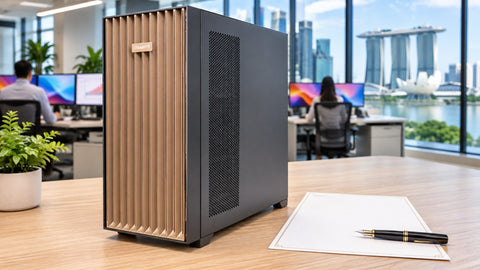
- A small desktop's extras: two M.2 SSD slots, 10 GbE, Wi-Fi 7, HDMI 2.1 and three USB-C ports with DisplayPort for up to four displays, in a 1.1-litre case.
- ASUS's creator software: ProArt Creator Hub, StoryCube, MuseTree for local FLUX and WAN image generation, the Zenni Claw assistant, and three months of Adobe Creative Cloud.
- Windows 11 and ASUS's warranty and support. Singapore terms weren't published at the time of writing; ask before you buy.
What you're not paying for: a screen, keyboard and battery (the ProArt P16 includes those), or ConnectX networking (the DGX Spark and GX10 include that).
At the estimated price, the GR1X costs about what NVIDIA's own GB10 boxes cost per gigabyte. You're choosing Windows and creator tools over Linux and clustering, not paying a large premium for either.
Is it overpriced against the ProArt P16 laptop?
No, if ASUS prices it in our range. The P16 128 GB has a Singapore SRP of S$11,099, and our 128 GB/2 TB GR1X estimate tops out at S$10,800, so roughly S$300–2,100 less for the same chip and memory without the 4K OLED screen and battery. At 64 GB the P16's SRP is S$7,499, against our S$6,200–7,200 estimate. A desktop also runs at 140 W sustained rather than a laptop's 45–80 W, which may help sustained image generation and rendering. That's untested on the GR1X. If ASUS prices the desktop at or above the laptop, the case weakens. Microsoft priced its RTX Spark Dev Box at about the same as its top Surface Laptop Ultra, so that's possible.
Is it overpriced against AMD and Apple?
AMD Strix Halo is the budget route to 128 GB. The GMKtec EVO-X2 is S$5,844.54 on our shelf, roughly S$3,000–5,000 less than our GR1X 128 GB estimate. Its memory is a little slower (about 256 GB/s) and its AI software runs on ROCm or Vulkan rather than CUDA. If you only chat with models in LM Studio or llama.cpp, that may not matter. If your tools assume CUDA, it does.
Apple's Mac Studio gives you more bandwidth: Apple lists 614 GB/s on the M5 Max with the 40-core GPU and 1.2 TB/s on the M5 Ultra. The M5 Max 64 GB/1 TB is S$5,449 at Apple Singapore's list price, less than our GR1X 64 GB estimate and with twice the bandwidth. HardwareZone found an M5 Max MacBook Pro generated text about twice as fast as the ProArt P16 (6 Nov 2026). The trade-off is macOS and Apple's MLX framework instead of CUDA and Windows. Our GR1X vs Mac Studio post compares the ecosystems.
So who is it good value for?
- Good value: Windows-based creators who want local AI image and video generation, Adobe and a CUDA GPU in a tiny box, without a separate Linux machine.
- Fair value: anyone choosing between it and a GB10 box who prefers Windows to Linux. The hardware cost is similar.
- Poor value: buyers who only need to chat with local models (Strix Halo or a Mac costs less or runs faster), and developers who need vLLM, clustering or Linux (a GB10 box fits better). Our wrong choice for serious AI developers post covers those workloads.
Before deciding on the configuration, check our 64 GB vs 128 GB guide. On a 64 GB N1X, Windows exposed at most 55.4 GB to the GPU in XDA's testing, which rules out gpt-oss-120b. The published hidden costs of owning an AI workstation post covers running costs beyond the purchase price.
Buying in Singapore
The ProArt GR1X is listed at SourceIT as price on request in the ASUS ProArt GR1X collection. Our estimate will be replaced once ASUS publishes official pricing. For comparison, we stock the ASUS ProArt P16 RTX Spark 128GB at S$10,773.20, the NVIDIA DGX Spark 4TB at S$9,300, the ASUS Ascent GX10 128GB/1TB at S$10,350 and the GMKtec EVO-X2 128GB/2TB at S$5,844.54 (listed 8 Nov 2026). Mac Studio configurations are available on request. Prices change, so ask for a current quotation. To get a quote, use Request for Quotation on the product page, call (65) 6978 3502, email Sales@sourceit.com.sg or use our contact page.
Frequently asked questions
How much does the ASUS ProArt GR1X cost in Singapore? ASUS hadn't announced a price when we wrote this. Our estimate, based on comparable RTX Spark devices and not an official ASUS price, is about S$6,200–7,200 for 64 GB/1 TB, S$9,000–10,800 for 128 GB/2 TB and S$10,000–12,000 for 128 GB/4 TB.
Is the GR1X cheaper than the ASUS ProArt P16 with the same chip? On our estimate, slightly. The P16's Singapore SRP is S$7,499 for 64 GB and S$11,099 for 128 GB, and the GR1X drops the laptop's screen and battery. Official GR1X pricing could change that.
Why not buy an AMD Strix Halo mini PC with 128 GB instead? It's much cheaper, around S$5,845 for the GMKtec EVO-X2 on our shelf. It has slightly lower memory bandwidth and uses ROCm or Vulkan rather than CUDA. It suits users who mainly chat with models; CUDA-dependent tools favour the GR1X.
Is the GR1X better value than a DGX Spark? The hardware cost per gigabyte is similar. The DGX Spark gives you Linux, vLLM and ConnectX-7 clustering; the GR1X gives you Windows, creator apps and two SSD slots. Choose on software, not price.
What extras come with the GR1X? ASUS lists ProArt Creator Hub, StoryCube, MuseTree, the Zenni Claw assistant and a three-month Adobe Creative Cloud subscription, plus 10 GbE, Wi-Fi 7 and support for up to four displays.