
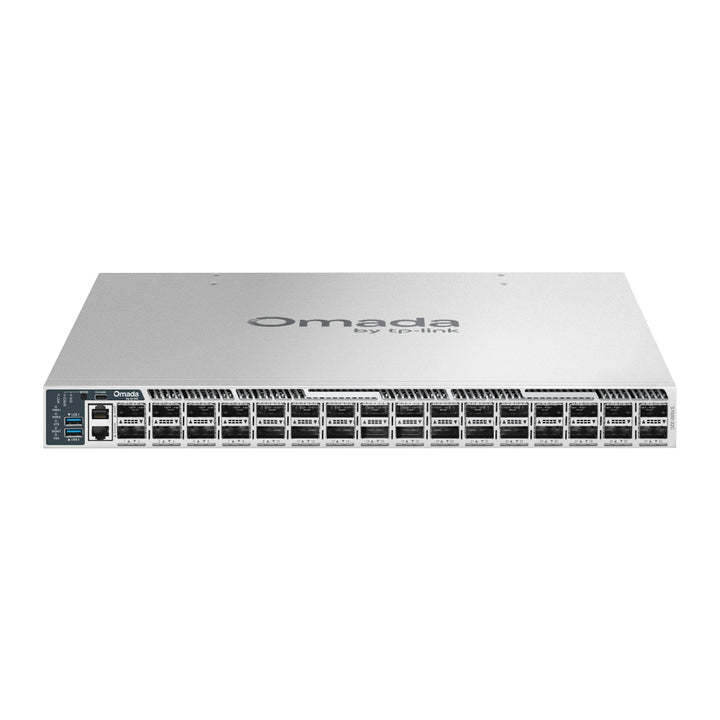


TP-Link Omada Campus 32-Port 100G Stackable L3 Managed Core Switch
Email sales@sourceit.com.sg or use Request for Quotation below and our team will confirm the latest price, availability and lead time.
PRODUCT DESCRIPTION
TP-Link Omada Campus 32-Port 100G Stackable L3 Managed Core Switch (S7500-32C) - 5 Years Local Warranty
The S7500-32C is the core switch at the top of TP-Link's Omada campus range: a 1U chassis with 32× 40/100G QSFP28 slots, 6.4 Tbps of switching capacity and the full Layer 3 routing stack — OSPF, BGP, IS-IS, VRF and PIM multicast — needed to sit at the centre of a multi-building network and terminate the 100G uplinks from S7500 aggregation switches below it.
32× 100G QSFP28 and 6.4 Tbps in One Rack Unit
Every one of the 32 ports is a 40/100G QSFP28 slot, giving the S7500-32C 6.4 Tbps of switching capacity and a 2.8 Bpps packet forwarding rate per unit. A 24 MB packet buffer absorbs the bursts that build up where many aggregation links converge, and the MAC address table holds up to 256 K entries. Management is out-of-band through a dedicated RJ45 management port, with RJ45 and USB Type-C console ports and two USB 3.0 ports alongside.
Stack Up to 12 Units Over 100G
Any QSFP28 slot can be used as a stacking port. In standalone mode up to 12 units stack into one logical switch (4 in controller mode), and with all 32 slots set as stacking ports the stacking bandwidth reaches 6.4 Tbps. TP-Link notes that stacking runs only over 100G DAC or 100G QSFP28 modules, not 40G DAC or 40G QSFP — worth planning into the optics order.
Full Layer 3 Routing for the Campus Core
The S7500-32C routes with OSPFv2/v3, BGPv4, IS-ISv4/v6, RIPv1/v2 and RIPng, segments tenants or departments with VRF, and steers traffic with PBR and ECMP while uRPF drops spoofed sources. Route capacity is sized for a large campus: up to 516,096 IPv4 network routes (shared with IPv6), 22,528 host routes, 4,094 L3 interfaces and 45,056 dynamic ARP entries. PIM-SM/DM/SSM and 2,048 IGMP groups carry multicast video and IPTV across routed boundaries.
High Availability From Power Supply to Uplink
Two field-replaceable, hot-swappable power supply bays and five field-replaceable, hot-swappable fans keep the core serviceable without downtime — note the switch ships with one PSM550-AC and the redundant second module is bought separately. M-LAG (with dual-active detection and a peer-link LAG) lets two core switches present one logical uplink to the layer below, while VRRPv2/v3 provides gateway redundancy, ERPS recovers ring topologies quickly and BFD detects link failure in under a second.
Campus Security and Precision Timing
Access control spans 802.1X with RADIUS, RADSEC, MAB and guest VLAN, plus TACACS+ AAA. Dynamic ARP inspection, IP and IPv6 source guard, RA guard, DoS defend, DHCP filtering and IP/IPv6-MAC-port binding (1,024 entries each) protect the control plane, and Secure Boot verifies firmware at start-up. IEEE 1588v2 PTP and 802.1AS support time-sensitive applications that need synchronised clocks across the network.
Centralized Management Through Omada Pro
TP-Link positions the S7500-32C for its Omada Pro platform: the switch is managed centrally from the Omada Pro Cloud-Based, Hardware or Software Controller, with the Omada App and cloud access working through that controller. Zero-Touch Provisioning lets a replacement or new unit be pre-configured in the Omada Pro Cloud-Based Controller and pull its configuration on first boot, so a site does not need an engineer on hand with a console cable. Where a controller is not wanted, the switch is fully manageable on its own through the web GUI, CLI (console or telnet) and SNMPv1/v2c/v3.
Ideal For
Universities, hospitals, large enterprise and government campuses that need a 100G core to collapse multiple S7500 or S6500 aggregation and access stacks, with dual-core M-LAG designs and redundant power. Supplied by SourceIT with local Singapore warranty, GST invoice and project pricing on request.
S7500-32C Datasheet — Technical Specifications
General
| Model | S7500-32C |
| Official Product Name | Omada Campus 32-Port 100G Stackable L3 Managed Core Switch |
| Brand | TP-Link Omada |
| Product Line | S7500 Series campus switch (Omada Pro managed) |
| Warranty | 5 Years Local Warranty (Singapore) |
Hardware Features
| Interface | 32× 40/100G QSFP28 Slots; 2× USB 3.0 Ports; 1× RJ45 Console Port; 1× USB Type-C Console Port; 1× RJ45 Management Port |
| Fan Quantity | Five Field-replaceable and Hot-swappable Fans |
| Power Supply | Two Field-replaceable and Hot-swappable Power Supply Modules* (100–240 VAC, 50/60 Hz) |
| Dimensions (W x D x H) | 17.3 × 16.5 × 1.7 in (440 × 420 × 44 mm) |
| Mounting | Rackmountable |
| Max. Power Consumption | 311.2 W max @ 220V/50Hz 25 °C; 316.7 W max @ 110V/60Hz 25 °C |
| Max. Heat Dissipation | 1061.16 BTU/hr @ 220V/50Hz 25 °C; 1080.02 BTU/hr @ 110V/60Hz 25 °C |
Performance
| Packet Buffer Memory | 24 MB |
| Jumbo Frame | 9 KB |
| Stacking | Stacking Number: 12 in standalone mode, 4 in controller mode; Stacking Port: 100G QSFP28 Slot (all uplink ports can be used as stacking ports); Stacking Bandwidth: 6.4 Tbps (All 32 QSFP28 slots set as stacking ports) |
| Switching Capacity | 6.4 Tbps |
| Packet Forwarding Rate | 2.8 Bpps |
| MAC Address Table | Max 256 K |
Layer 3 Features
| L3 Interface | 4,094 (IPv4, IPv6) |
| Static Route | 2,048 IPv4, 1,024 IPv6 |
| Host Route Table | Max 22,528 entries |
| IPv4 Network Router Entries | Max 516,096 (shared with IPv6 Network Router entries) |
| IPv6 Network Router Entries | Max 258,048 (shared with IPv4 Network Router entries) |
| ECMP | Supported |
| Dynamic ARP / ND | 45,056 / 45,056 |
| DHCPv4 Server | Max 512 IP pool |
| DHCPv4/v6 Relay | Supported |
| Routing Protocols | OSPFv2/v3, RIPv1/v2, RIPng, IS-ISv4/v6, BGPv4 |
| VRRP | VRRPv2/v3 |
| VRF | Supported |
| Multicast Routing | PIM-SM/PIM-DM/PIM-SSM; IGMPv1/v2/v3, 2,048 IGMP groups |
| BFD | 16 template numbers, 32 session numbers |
| PBR / uRPF | Supported / Supported |
Layer 2, VLAN & Quality of Service
| L2 / L2+ Features | LACP / Static LAG; STP / RSTP / MSTP / STP Security; ERPS; Port Isolation; Loopback Detection; Port Security; Sticky MAC; 802.3x Flow Control; Port Mirror; RSPAN; LLDP; LLDP-MED |
| Multicast | IGMP Snooping; MLD Snooping; Multicast VLAN Registration (MVR); Max Multicast Table 1K (IPv4, IPv6); Fast Leave; IGMP/MLD Snooping Querier; Multicast Filtering; Unknown Multicast Discard |
| M-LAG | M-LAG domain configuration; DAD (Dual-Active Detection); Peer-link-port LAG |
| PTP | IEEE 1588v2 (PTPv2), IEEE 802.1AS; Clock-type: oc, bc, e2etc, p2ptc |
| 802.1Q VLAN | 4K VLANs |
| MAC VLAN | 200 entries |
| Protocol VLAN (IEEE 802.1v) | 16 Protocol VLAN Templates, 12 Protocol VLAN Groups |
| QinQ (VLAN VPN) | 256 entries |
| Private VLAN / GVRP | Supported / Supported |
| Quality of Service | 8 priority queues; Port Priority; IEEE 802.1p Priority; DSCP/ToS Priority; SP/WRR per queue with queue weight config; Rate Limit; Storm Control; Voice VLAN; WRED |
| Advanced / ISP Features | Automatic Device Discovery‡; Batch Configuration‡; Batch Firmware Upgrading‡; Intelligent Network Monitoring‡; Abnormal Event Warnings‡; Unified Configuration‡; Reboot Schedule‡; 802.3ah Ethernet Link OAM; L2PT (Layer 2 Protocol Tunneling); Device Link Detect Protocol (DLDP); DDM; sFlow |
Security
| IP-MAC-Port Binding | 1,024 Entries; ARP Scanning; Manual Binding; DHCP Snooping |
| IPv6-MAC-Port Binding | 1,024 Entries; DHCPv6 Snooping; Manual Binding; ND Snooping |
| ARP Inspection / ND Detection | Dynamic ARP Inspection / ND Detection |
| Source Guard | IP Source Guard; IPv6 Source Guard |
| RA Guard | 30 entries |
| Other Protection | DoS Defend; DHCP Filter; ACL; Secure boot |
| 802.1X | Radius Authentication; Radius Accounting; Radius Server Load Balancing; RADSEC; Guest VLAN; VLAN Assignment; MAB |
| AAA | AAA (including TACACS+) |
Management
| Omada App | Yes, through Omada Pro Controller |
| Centralized Management | Omada Pro Cloud-Based Controller, Omada Pro Hardware Controller, Omada Pro Software Controller |
| Cloud Access | Yes, through Omada Pro Controller |
| Zero-Touch Provisioning | Yes. Requiring the use of Omada Pro Cloud-Based Controller. |
| Management Features | Web-based GUI; Command Line Interface (CLI) through console port, telnet; SNMPv1/v2c/v3 (Trap/Inform, RMON 1, 2, 3, 9 groups); SDM Template; DHCP/BOOTP Client; 802.1ab LLDP/LLDP-MED; DHCP Auto Install; Dual Image, Dual Configuration; CPU Monitoring; Password Recovery; SNTP; System Log |
Environment
| Operating Temperature | -5 °C to 45 °C (23 °F to 113 °F) @ 300 meters; -5 °C to 40 °C (23 °F to 104 °F) @ 2,000 meters; -5 °C to 35 °C (23 °F to 95 °F) @ 3,000 meters |
| Storage Temperature | -40 °C to 70 °C (-40 °F to 158 °F) |
| Operating Humidity | 10–90% RH non-condensing |
| Storage Humidity | 5–90% RH non-condensing |
TP-Link Footnotes
*Ships with one PSM550-AC module by default, and another field-replaceable redundant power supply requires a separate purchase.
‡These functions require the use of the Omada Pro SDN Controller. Zero-Touch Provisioning requires the use of the Omada Pro Cloud-Based Controller.
Supports 12 units of physical stacking in standalone mode.
The 100G QSFP28 slots support stacking only through 100G DAC/100G QSFP28 modules rather than 40G DAC/40G QSFP modules.
Compatibility & Software Support
The S7500-32C is an Omada Pro campus switch. TP-Link lists the Omada Pro controllers — not the standard Omada SDN controller — as its centralized-management platform, so plan the controller with the switch.
| Omada Pro SDN Controller | Supported — centralized management through the Omada Pro Cloud-Based Controller, Omada Pro Hardware Controller or Omada Pro Software Controller |
| Omada App | Supported — through an Omada Pro Controller |
| Cloud Access | Supported — through an Omada Pro Controller |
| Zero-Touch Provisioning | Supported — requires the Omada Pro Cloud-Based Controller |
| Standalone Management | Supported — web-based GUI, CLI (console port, telnet) and SNMPv1/v2c/v3 |
| Stacking Mode Limit | 12 units in standalone mode; 4 units in controller mode |
| Transceivers & Cabling | 40/100G QSFP28 slots. Stacking only through 100G DAC/100G QSFP28 modules rather than 40G DAC/40G QSFP modules. |
TP-Link's note: these functions require the use of the Omada Pro SDN Controller. Zero-Touch Provisioning requires the use of the Omada Pro Cloud-Based Controller.
Package Contents & Ordering Information
What’s in the Box
| Package Contents | S7500-32C Switch, Power Cord, RJ45 Console Cable, Locking Strap, Rackmount Kit, Rubber Feet, Quick Installation Guide |
Ordering Information
| Model | S7500-32C |
| Recommended Retail Price (incl. GST) | S$53,999.00 |
| Power Supply Shipped | 1× PSM550-AC (550 W AC Power Supply Module), installed by default |
| Redundant Power Supply | PSM550-AC — second module sold separately |
Datasheet & Downloads
Frequently Asked Questions — S7500-32C
Does the S7500-32C need an Omada controller?
No. The S7500-32C can be run standalone through its web-based GUI or the CLI (console port or telnet). TP-Link lists the Omada Pro Cloud-Based, Hardware and Software Controllers for centralized management; the Omada App and cloud access work through an Omada Pro Controller, and Zero-Touch Provisioning requires the Omada Pro Cloud-Based Controller. Tell SourceIT which controller your site already runs and we will confirm the fit before you order.
Does the S7500-32C ship with redundant power supplies?
Not as standard. The S7500-32C has two field-replaceable, hot-swappable power supply bays (100–240 VAC, 50/60 Hz), but TP-Link ships it with one PSM550-AC module by default. The second, redundant module is a separate purchase — add a PSM550-AC to the order if the switch must keep running through a power-supply failure. SourceIT can supply it with the switch.
What warranty does SourceIT provide?
Five years local Singapore warranty. Every S7500-32C sold by SourceIT comes with a GST invoice.
Is stock held locally?
Campus-class switches such as the S7500-32C are typically brought in on indent rather than held on the shelf. Ask SourceIT for the current lead time before committing to a project date.
Can SourceIT quote this for a project or tender?
Yes. Send the bill of materials and we will quote the whole build — core and aggregation switching, access switches, power supply modules, transceivers and DAC cables — with local warranty and support.
Is this model available for project orders?
Yes. TP-Link supplies this model for project deployments; contact SourceIT with your bill of materials for pricing and lead time.


