
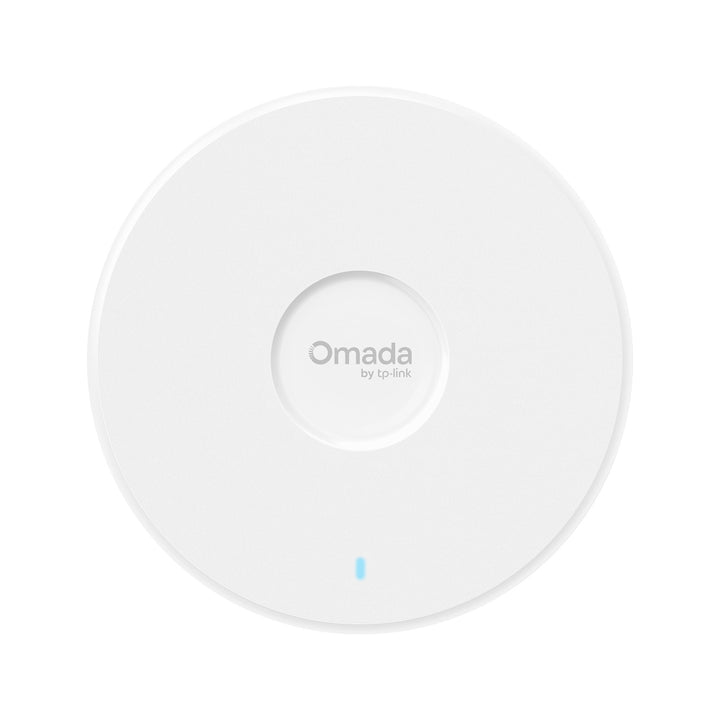


TP-Link Omada BE15000 Ceiling Mount Tri-Band Wi-Fi 7 Access Point
Email sales@sourceit.com.sg or use Request for Quotation below and our team will confirm the latest price, availability and lead time.
PRODUCT DESCRIPTION
TP-Link Omada BE15000 Ceiling Mount Tri-Band Wi-Fi 7 Access Point (EAP787) - 5 Years Local Warranty
The EAP787 is Omada's BE15000 tri-band Wi-Fi 7 ceiling access point, sitting at the top of the ceiling-mount range. Beyond the 6 GHz radio and 8-stream capacity that separate it from dual-band models like the EAP723, it adds a dedicated RF scanning radio and a 10G 802.3bt PoE++ uplink, so the wired port is not the bottleneck the airtime improvements would otherwise expose.
15 Gbps of Tri-Band Wi-Fi 7 Capacity Across Three Radios
The EAP787 is a BE15000 class access point: 8648 Mbps on 5 GHz, 5765 Mbps on 6 GHz and 688 Mbps on 2.4 GHz, for 15.0 Gbps of combined capacity across eight spatial streams. The 6 GHz radio is the important addition over dual-band Wi-Fi 7 models, because it opens spectrum that legacy clients cannot occupy and supports 320 MHz channels. In a dense office or lecture theatre that combination means far more aggregate airtime for modern clients while the 2.4 GHz radio continues to carry older and IoT devices.
Multi-Link Operation Lets Clients Use Three Bands at Once
Multi-Link Operation is the Wi-Fi 7 feature that changes behaviour rather than just raw speed. Instead of a client associating to one band and staying there, MLO coordinates simultaneous transmissions across the 6 GHz, 5 GHz and 2.4 GHz radios. Traffic can be spread across links or moved off a link that has become congested, which cuts latency and reduces the jitter that hurts voice, video conferencing and interactive applications. For a buyer this is the difference between headline throughput and consistently responsive connections under load.
4096-QAM Packs Roughly 20% More Data Into Every Symbol
Wi-Fi 7 raises the modulation ceiling to 4096-QAM, encoding 12 bits per symbol where Wi-Fi 6 managed 10. Omada puts the practical gain at approximately 20% more data transmitted for the same airtime. The benefit is largest for clients with a strong, clean signal — devices close to the ceiling AP in an office or classroom — and it compounds with the other Wi-Fi 7 scheduling features the EAP787 supports, including Multi-RUs, OFDMA and BSS Colouring, all of which are about fitting more clients into the same spectrum.
A Dedicated Scanning Radio That Never Interrupts Traffic
The EAP787 carries a dedicated RF scanning capability that performs real-time tri-band spectral analysis and over-the-air packet capture. Because scanning runs continuously on its own path, it does not pull the serving radios off-channel, so troubleshooting never comes at the cost of client throughput. That lets an administrator identify an interference source — a rogue transmitter, a microwave, a neighbouring network — while the AP is in production, rather than scheduling a maintenance window or carrying a spectrum analyser to site.
10G PoE++ Uplink So the Wire Is Not the Bottleneck
A 15 Gbps radio budget is wasted behind a Gigabit port, so the EAP787 uses a single 10G/2.5G Ethernet port with 802.3bt PoE++ support. One cable carries both the multi-gigabit uplink and the power, and the AP draws 29 W over PoE (24.5 W on DC). It is also backward compatible with 802.3at, though a bt-capable switch port is what lets the access point run at full capability. Omada rates the AP for 510+ concurrent clients over roughly 190 m² (2050 ft²).
Guest Access, WPA3 and Rogue AP Detection Under Omada SDN
Security and management come from the Omada SDN platform, which manages APs, switches and gateways from one place via Omada Central cloud, a hardware controller or a software controller. The EAP787 supports up to 24 SSIDs for segmented guest networks, SMS login for captive portal onboarding, WPA3 to protect otherwise-open public networks, and rogue AP detection to flag unauthorised transmitters. Omada mesh and 802.11k/v/r seamless roaming are supported with a controller, so clients hand off between APs without dropping calls.
Ideal For
Singapore businesses, schools, hotels and managed-service providers building on Omada, and IT teams that want access points they can adopt, monitor and update centrally rather than box by box. Supplied by SourceIT with local Singapore warranty, GST invoice and project pricing on request.
EAP787 Datasheet — Technical Specifications
General
| Model | EAP787 |
| Official Product Name | Omada BE15000 Ceiling Mount Tri-Band Wi-Fi 7 Access Point |
| EAN | 1210002600569 |
| Brand | TP-Link Omada |
| Warranty | 5 Years Local Warranty (Singapore) |
Specifications
| Standards | IEEE 802.11 a/b/g/n/ac/ax/be |
| Signal Rate 2.4 GHz | 688 Mbps |
| Signal Rate 5 GHz | 8648 Mbps |
| Signal Rate 6 GHz | 5765 Mbps |
| Interface | 1x 10G/2.5G Ethernet Port |
| Button | Reset |
| Antennas | 2x 4.0 dBi (2.4 GHz), 4x 5.0 dBi (5 GHz), 2x 5.0 dBi (6 GHz) |
| Bluetooth | 1x 5 dBi internal antenna |
| Power Supply | 802.3bt/at PoE or 12V/2.5A DC |
| Max Power Consumption | 29 W (PoE), 24.5 W (DC) |
| Dimensions | 8.7 x 8.7 x 1.5 inches (220 x 220 x 38.8 mm) |
| Coverage | 2050 ft2 (190 m2) |
| Concurrent Clients | 510+ |
| Wireless Functions | 320 MHz Bandwidth, MLO, 4K-QAM, Multi-RUs, Multi-SSID (24 total), MU-MIMO, Mesh, BSS Coloring, OFDMA, seamless roaming, load balancing, band steering, beamforming, airtime fairness, dedicated RF scanning, AFC |
| Wireless Security | WPA3-Personal/Enterprise, MAC filtering, VLAN, captive portal, rogue AP detection, wireless isolation |
| Management | Omada App; centralized management via Cloud-Based, Hardware and Software Controllers; cloud access; email alerts; LED control; MAC access control; SNMP v1/v2c/v3; local/remote syslog; web-based management |
| Operating Temperature | 0 C-40 C |
| Storage Temperature | -40 C-70 C |
| Operating Humidity | 10%-90% non-condensing |
| Storage Humidity | 5%-90% non-condensing |
| Certification | Wi-Fi 7 (R1), Wi-Fi 6 (R2), Wi-Fi 6E, WPA3-R3, WPA3-Suite B, Enhanced Open Security; FCC/CE/NCC/VCCI/JRF/BSMI |
| Package Contents | EAP787, Installation Guide, Ceiling/Wall/Junction Box Mounting Kit (power adapter not included) |
Compatibility & Software Support
The EAP787 is part of the Omada ecosystem: gateways, switches and access points are managed together from one controller, under one set of policies, with one view of the network. Cloud and app features listed below require the device to be adopted into an Omada Controller.
| Omada SDN Controller | Supported — adopt and manage centrally from the Omada Software Controller, Hardware Controller or Cloud-Based Controller |
| Omada App | Supported — remote management from iOS and Android |
| Omada Cloud Access | Supported — no licence fee for cloud management |
| Standalone Mode | Supported — the device can also be configured on its own via its web interface |
Package Contents & Ordering Information
What’s in the Box
| Package Contents | EAP787, Installation Guide, Ceiling/Wall/Junction Box Mounting Kit (power adapter not included) |
Ordering Information
| Model | EAP787 |
| Recommended Retail Price (incl. GST) | S$499.00 |
| Carton Pack Size | 6PCS |
| EAN | 1210002600569 |
Datasheet & Downloads
Frequently Asked Questions — EAP787
Does the EAP787 need an Omada Controller?
No. The EAP787 runs standalone through its own web interface. Adopting it into an Omada Software, Hardware or Cloud-Based Controller is what unlocks central configuration, monitoring, firmware management and cloud/app access across every Omada device on site — at no licence cost.
What warranty does SourceIT provide?
Five years local Singapore warranty. Every EAP787 sold by SourceIT comes with a GST invoice.
Is stock held locally?
SourceIT holds fast-moving Omada lines in Singapore. Anything not in local stock is brought in on indent — ask us for the current lead time before committing to a project date.
Can SourceIT quote this for a project or tender?
Yes. Send the bill of materials and we will quote the whole Omada build — controller, gateway, switching, access points and optics — with local warranty and support.
Product Video
We Also Recommend


