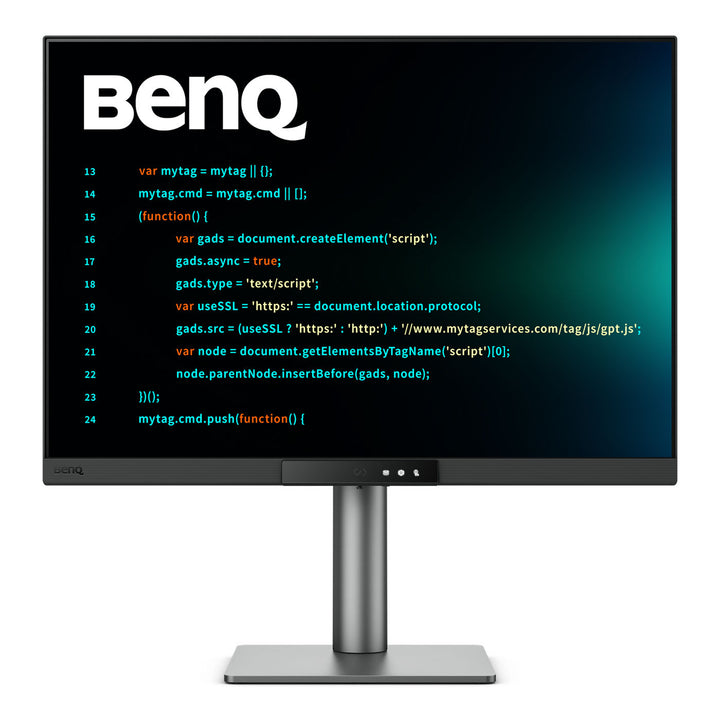


BenQ RD280UG 28" 4K+ 120Hz Programming Monitor with MoonHalo
PRODUCT DESCRIPTION
BenQ RD280UG 28" 4K+ 120Hz Programming Monitor with MoonHalo (RD280UG) - 3 Year Local Warranty
The Flagship 3:2 Coding Panel — 4K+ at 120Hz
The RD280UG is the top of BenQ's programmer range: the same 28.2-inch 3840 x 2560 3:2 panel as the RD280U, but running at 120Hz instead of 60Hz, with native contrast lifted to 2000:1. The 3:2 shape is the point — 2560 pixels of vertical space against the 2160 a 4K 16:9 screen gives you, so more lines of a file, a taller terminal and a longer stack trace stay in view. At 164 PPI, monospaced text renders with laptop-class sharpness across a screen more than twice the size.
120Hz Makes Scrolling Through Code Legible
Refresh rate is usually sold as a gaming specification, but on a developer's screen it does something more mundane and more useful: text stays readable while it moves. Scrolling a long file, a diff or a build log at 120Hz produces far less motion smear than at 60Hz, so you can actually read while scrolling rather than stopping to let the screen settle. FreeSync Premium and HDMI 2.1 support the mode, and the 2000:1 contrast gives dark-theme editors deeper backgrounds than the 1200:1 of the 60Hz RD280U.
MoonHalo, Nano Matte and Night Hours Protection
MoonHalo is a light ring on the rear of the chassis that washes the wall behind the monitor. In a dark room a bright screen forces constant pupil adaptation between display and surroundings, and lifting the ambient level behind the panel closes that gap — a deliberate answer to late sessions rather than a decorative flourish. Night Hours Protection takes brightness below a normal monitor's floor for very dim rooms, Visual Optimizer keeps text edges sharp there, and the Nano Matte coating carries a TÜV Reflection Free certification for daytime glare.
KVM, Auto Pivot, PIP/PBP and 90 W USB-C
The RD280UG is built for a two-machine desk. Its KVM switch hands one keyboard and mouse between two connected computers with the video source, PIP/PBP puts both on screen at once, and DualView Plus splits the panel into two colour-independent halves. Auto Pivot rotates the image automatically when you turn the screen on its 90° pivot. USB-C carries video, data and 90 W of Power Delivery for a 16-inch laptop under load, with USB-C out for daisy chaining and USB 3.2 Gen 2 downstream ports at 10 Gbps.
BenQ RD280UG Datasheet — Technical Specifications
General
| Product | BenQ RD280UG 28" 4K+ 120Hz Programming Monitor with MoonHalo |
| Part Number (SKU) | RD280UG |
| Screen Size | 28.2 inch |
| Panel Type | IPS, LED backlight |
| Aspect Ratio | 3:2 |
| Manufacturer Warranty | 3 Year Local Warranty (BenQ Singapore) |
| Local Warranty (Singapore) | Supplied by SourceIT with GST invoice |
Display
| Resolution (max.) | 3840 x 2560 (4K+) |
| Pixel Density | 164 PPI |
| Brightness (typ.) | 350 nits |
| Brightness (peak, HDR) | 400 nits |
| HDR | HDR10, VESA DisplayHDR 400 |
| Native Contrast | 2000:1 |
| Colour Gamut | 95% DCI-P3 |
| Display Colours | 1.07 billion |
| Viewing Angle (L/R) | 178° / 178° |
| Response Time (GtG) | 5 ms |
| Refresh Rate | 120 Hz |
| Panel Coating | Nano Matte |
| Gamma | 1.8 - 2.6 |
| HDCP | 2.3 |
| Colour Modes | Coding - Paper Color, Coding - Dark Theme, Coding - Light Theme, sRGB, HDR, M-book, User, Game, ePaper, Cinema |
| Colour Temperature | Bluish, Normal, Reddish, User Define |
| FreeSync Premium | Yes |
| AMA (overdrive) | Yes |
Audio
| Built-in Speakers | 3 W x 2 |
| Headphone Jack | Yes |
Connectivity
| USB-C | 1 (Power Delivery 90 W, DisplayPort Alt Mode, Data) |
| HDMI (v2.1) | 1 |
| DisplayPort (v1.4) | 1 |
| Daisy Chain | USB-C out (MST) |
| USB Type-B Upstream | 1 (USB 3.2 Gen 1, 5 Gbps, data only) |
| USB Type-A Downstream | 2 (USB 3.2 Gen 2, 10 Gbps, 4.5 W charging) |
| USB Type-C Downstream | 1 at 15 W and 1 at 7.5 W (USB 3.2 Gen 2, 10 Gbps) |
| Supplied Signal Cables | HDMI (v2.1), USB 3.2, USB-C (may vary by region) |
Coding, Eye Care & Professional Features
| MoonHalo Rear Backlight | Yes |
| Coding Modes | Dark Theme, Light Theme, Paper Color |
| KVM Switch | Yes |
| DualView Plus | Yes |
| PIP / PBP | Yes |
| Auto Pivot | Yes |
| Night Hours Protection | Yes |
| Visual Optimizer | Yes |
| Flicker-free Technology | Yes |
| Low Blue Light | Yes |
| Colour Weakness Mode | Yes |
| ePaper Mode | Yes |
| Eye Reminder | Yes |
| TÜV Certificate | Eye Comfort 2.0, EyeSafe 2.0, Flicker-free, Low Blue Light (Hardware and Software Solution), Reflection Free |
| Display Pilot 2 | Yes |
| Display QuicKit | Yes |
| Firmware Update by USB | Yes |
Physical & Environmental
| Height Adjustment | 150 mm |
| Tilt (down/up) | -5° to 20° |
| Swivel (left/right) | 15° / 15° |
| Pivot | 90° (with Auto Pivot) |
| VESA Wall Mount | 100 x 100 mm |
| Dimensions with Stand (HxWxD) | 465.2 - 615.2 x 610.4 x 233.3 mm |
| Dimensions in Portrait (HxWxD) | 611.1 - 714.5 x 432.8 x 233.3 mm |
| Dimensions without Stand (HxWxD) | 432.8 x 610.4 x 91.5 mm |
| Net Weight | 10.1 kg |
| Net Weight (without stand) | 7.8 kg |
| Energy Star | 8.0 |
| EPEAT | Bronze |
Power
| Voltage Rating | 100 - 240 V |
| Power Supply | Built-in |
| USB-C Power Delivery | 90 W |
| Power Consumption (normal) | 30 W |
| Power Consumption (max) | 250 W |
| Power Consumption (sleep mode) | < 0.5 W |
Specifications are taken from BenQ's published product data for this model. Where BenQ does not publish a figure for this exact model it has been left out rather than estimated.
Compatibility & Installation
Mounting and orientation
The stand gives 150 mm of height travel — the most in the RD range — with -5° to 20° tilt, 15° swivel each way and a full 90° pivot. Auto Pivot rotates the image automatically as you turn the panel, so portrait needs no driver setting. In portrait the unit stands up to 714.5 mm tall, so check overhead clearance. For an arm, the monitor uses the standard 100 x 100 mm VESA pattern at 7.8 kg without the base; confirm your arm is rated for that weight.
Driving it at 4K+ 120Hz
3840 x 2560 at 120Hz is a demanding mode. HDMI 2.1 carries it, as does DisplayPort 1.4 and USB-C DisplayPort Alt Mode depending on the host's available bandwidth and any display stream compression it supports — confirm the output capability of your graphics card or laptop before assuming 120Hz at full resolution over every input. At 164 PPI, plan to run operating system display scaling rather than 100%, which both macOS and current Windows builds handle cleanly.
Two machines: KVM, PIP/PBP and DualView Plus
The KVM switch passes one keyboard and mouse between two connected computers along with the video source — connect one over USB-C and the other over HDMI or DisplayPort with the USB Type-B upstream cable. PIP/PBP puts both machines on screen simultaneously, useful when watching a build on one and editing on the other. DualView Plus splits the panel into two halves with independent colour modes, so you can run a coding mode beside a colour-accurate preview.
USB-C power, daisy chain and peripherals
USB-C delivers 90 W, enough for a 16-inch developer laptop or mobile workstation under genuine load, over the same cable as video and data. USB-C out with MST daisy chains a second display from this monitor rather than the host; MST behaviour depends on the graphics driver, so verify it before relying on it. Downstream ports run USB 3.2 Gen 2 at 10 Gbps — two Type-A plus two Type-C, one of which supplies 15 W.
Package Contents & BenQ RD Programmer Range
In the box
- BenQ RD280UG monitor with ergonomic stand
- HDMI (v2.1) signal cable (may vary by region)
- USB 3.2 cable (may vary by region)
- USB-C cable (may vary by region)
- Quick Start Guide
- Warranty card
- Safety instruction sheet
Package contents follow BenQ's product data for this model; items not listed by BenQ are not claimed here.
BenQ RD programming range
| Model | Size, Resolution & Refresh |
| RD270Q | 27", 2560 x 1440 QHD 16:9, 144 Hz |
| RD280U | 28.2", 3840 x 2560 4K+ 3:2, 60 Hz |
| RD280UG (this listing) | 28.2", 3840 x 2560 4K+ 3:2, 120 Hz |
| RD320U | 31.5", 3840 x 2160 4K 16:9, 60 Hz |
Datasheet & Downloads
SourceIT can email the current BenQ data sheet revision for the RD280UG on request with a quotation.
Frequently Asked Questions — BenQ RD280UG
How do the four RD models differ — RD270Q, RD280U, RD280UG and RD320U?
The RD270Q is 27 inches, 2560 x 1440 QHD in 16:9 at 109 PPI and 144Hz — the entry model, and the only one without MoonHalo. The RD280U and this RD280UG share the 28.2-inch 3840 x 2560 3:2 panel at 164 PPI; the RD280U is 60Hz with 1200:1 contrast, HDMI 2.0 and no pivot, while the RD280UG is 120Hz with 2000:1 contrast, HDMI 2.1, FreeSync Premium, a 90° Auto Pivot, PIP/PBP and 10 Gbps USB. The RD320U is 31.5 inches, 3840 x 2160 4K in 16:9 at 140 PPI and 60Hz, with a wider 98% P3 gamut.
What does the "G" in RD280UG add over the RD280U?
The headline differences are refresh rate and contrast: 120Hz against 60Hz, and 2000:1 native contrast against 1200:1. It also adds HDMI 2.1, FreeSync Premium, a 90° pivot with Auto Pivot, PIP/PBP, DualView Plus, 150 mm of height travel instead of 110 mm, 3 W speakers instead of 2 W, and 10 Gbps USB downstream ports instead of 5 Gbps.
Does refresh rate actually matter for writing code?
More than most developers expect. At 120Hz, text stays legible while it scrolls, so you can read a long file or build log as it moves rather than stopping for the screen to settle. It is not a gaming argument at this level — it is a readability one.
Why a 3:2 panel instead of 16:9?
Code runs vertically. 3840 x 2560 gives 2560 pixels of height where a 4K 16:9 panel gives 2160 — roughly 18% more vertical space on a comparable diagonal. That means more lines of a file, a taller terminal and less scrolling. It is the main reason developers pick the 280-series over a conventional 4K monitor.
What is MoonHalo for?
It is a backlight ring on the rear of the chassis that lights the wall behind the monitor. In a dark room your eyes constantly re-adapt between a bright screen and black surroundings, which is a major source of fatigue; raising the ambient level behind the panel narrows that gap. BenQ fits MoonHalo to the RD280U, RD280UG and RD320U.
Can I run two computers from it?
Yes. The KVM switch hands one keyboard and mouse to whichever machine is the active video source — connect one over USB-C and the other over HDMI or DisplayPort plus the USB Type-B upstream cable. PIP/PBP shows both at once, and DualView Plus splits the screen into two halves with independent colour modes.
Will the 90 W USB-C port power my laptop?
90 W covers a 16-inch developer laptop or mobile workstation under real working load, not just at idle, while carrying video and data on the same cable. A machine with a high-power discrete GPU may still draw more during sustained rendering or compilation.
Does it come with a Singapore warranty and a GST invoice?
Yes. Every BenQ RD280UG sold by SourceIT comes with the BenQ Singapore 3 Year Local Warranty and a GST invoice.