Some can, but most SMEs should start with cloud AI and bring only specific workloads in-house. Sovereign AI for a small business means keeping the most sensitive or most repetitive AI work on hardware you control. Client files, customer records and bulk processing jobs are examples. Everything else stays on subscription services that cost little per user. The numbers show why. Ten ChatGPT Business seats cost about S$3,066 a year at list price. A light API workload can cost a few hundred dollars a year. A full NVIDIA DGX Station GB300 is a six-figure investment that only makes sense for heavy, shared use. For most SMEs that do need local AI, a smaller GB10 system such as the NVIDIA DGX Spark, at S$9,300, is the realistic entry point.
Why is this a question for SMEs now?
Adoption is already widespread. Singapore had 369,500 SMEs in 2025, according to SingStat. In September 2026, Senior Minister of State Low Yen Ling cited an SCCCI survey finding that "77% of our SMEs have adopted AI", with 45% starting from off-the-shelf tools. Most of that use runs on cloud services. That is fine for general work. It becomes a question when staff start pasting client contracts, payroll data or customer lists into tools the company has not vetted. Our post on employees using ChatGPT with company data covers that risk.
Where does cloud AI remain more economical for an SME?
In most everyday cases. The table compares typical spending levels with local hardware. Prices are list prices as published on 5 Nov 2026, converted at USD/SGD 1.2774 where shown, before GST. The usage scenarios are illustrative.
| Option | Cost basis | Approx. annual cost | Notes |
|---|---|---|---|
| ChatGPT Business, 10 users | US$20 per user per month, annual billing | About S$3,066 | No training on workspace data; SSO and admin console |
| Google Workspace Business Standard (Gemini included), 10 users | S$18.80 per user per month, annual plan | S$2,256 | Also includes email, storage and office apps |
| Microsoft 365 Copilot Business add-on, 10 users | US$18 per user per month (first-year promotion; normally US$21) | About S$2,759 (S$3,219 at US$21) | On top of a Microsoft 365 business plan |
| Light API use: Claude Sonnet 5.5 | 5M input + 1M output tokens a month at US$2/US$10 per million | About S$307 | Illustrative workload, e.g. an internal summarising tool |
| Heavy API use: Claude Sonnet 5.5 | 200M input + 40M output tokens a month | About S$12,263 | Illustrative; at this level local hardware starts to compare |
| NVIDIA DGX Spark 4TB (local) | One-off S$9,300 (listed 5 Nov 2026) | Hardware only; add power, setup and support | Runs mid-sized open-weight models for a small team |
| NVIDIA DGX Station GB300 (local) | Price on request; public US pricing of about US$93,000 to US$125,000 is roughly S$119,000 to S$160,000 before GST | Plus up to about S$4,367 a year in electricity at full 1.6 kW, 24/7 | For large models and many concurrent users |
Sources: OpenAI ChatGPT Business help page; Google Workspace Singapore pricing; Microsoft Singapore Copilot Business page; Anthropic pricing docs; SourceIT listings; SP Group Q4 2026 tariff (31.16 cents/kWh with GST). Electricity is an upper bound; real draw is lower. All accessed 5 Nov 2026. Prices change; check vendor pages.
The cloud options also include things a local box does not: frontier-quality models, built-in collaboration, mobile apps and no maintenance. On the Artificial Analysis Intelligence Index, accessed 5 Nov 2026, the best open-weights model scored 33 against 55 to 60 for the leading closed models. If your staff mainly draft emails, summarise meetings and research public topics, a subscription is the economical choice.
For most SMEs, sovereign AI is a carve-out, not a migration: keep the sensitive or repetitive work close, and rent the rest.
When does local AI make sense for a smaller business?
There are four situations where it can pay off:
- Client confidentiality. Law firms, accounting practices and corporate service providers often have engagement terms restricting where client documents go. A local model lets staff summarise and search those files without sending them to a third party.
- Repetitive bulk work. Transcribing recordings, extracting fields from invoices or classifying thousands of support emails generates heavy token volumes. Local hardware turns a variable bill into a fixed cost.
- Predictable budgets. Cloud prices move. Google's pricing page shows Gemini 4 Argon doubling to US$4/US$20 per million tokens on 1 Dec 2026. A paid-off local system is insulated from that, though not from power and support costs. See AI token inflation.
- Working offline or on restricted networks. Sites with limited connectivity, or clients who forbid internet-connected AI tools, need something on premises.
Does an SME need a DGX Station?
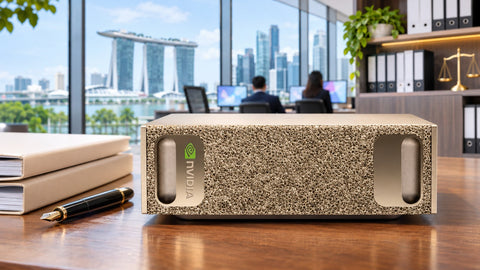
Rarely as the first step. A DGX Station GB300 has 748GB of coherent memory and was measured by StorageReview at 9,280 output tokens per second with gpt-oss-120b at 128 concurrent requests. That is capacity for a department or a whole mid-sized company. A small team running one mid-sized open-weight model for document work is usually better served by a GB10 system with 128GB of unified memory. Our GB10 private AI assistant post covers what one can handle. A DGX Station makes sense for an SME when several teams share heavy workloads, or when larger models are essential and volumes justify the cost. Our DGX Station vs 100 AI subscriptions analysis looks at that crossover.
Either way, someone has to run it. Patching, backups and access control do not disappear because the business is small. See the hidden costs of owning an AI workstation.
Are there grants for SME AI hardware?
Possibly, but confirm before buying. The Productivity Solutions Grant closed on 29 Sep 2026. Its replacement, EDGE, launched on 30 Sep 2026 with up to 70% support for SMEs, capped at S$100,000 a year. EnterpriseSG does not state whether on-premises AI servers qualify. The Enterprise Compute Initiative covers cloud credits and consultancy rather than hardware, and requires at least 10 Singapore staff and a technical team. The Budget 2026 enhancement to EIS gives a 400% tax deduction on qualifying AI spend up to S$50,000 a year for YA2027 and YA2028. Secondary sources say hardware is excluded, so check with IRAS. Our post on running AI locally in Singapore covers the regulatory side.
A sensible path for SMEs
- Standardise on one business-tier cloud AI service with no-training terms, and ban personal accounts for company data.
- List the workloads involving confidential client data or large repetitive volumes.
- Pilot those on a GB10 system with an open-weight model, and measure quality against the cloud tool.
- Scale up only if usage justifies it: a second GB10, or a DGX Station shared across departments.
The concepts behind this are in Sovereign AI: Why Should Your Company's Intelligence Live on Someone Else's Server? and data residency vs data sovereignty.
Buying in Singapore
For an SME pilot, SourceIT lists the NVIDIA DGX Spark 4TB at S$9,300 and the HP ZGX Nano G1n 4TB at S$11,499 (both listed 5 Nov 2026). Larger deployments can use DGX Station GB300 systems from HP, MSI, ASUS, GIGABYTE and Supermicro, all price on request. Browse the DGX Spark and DGX Station collection. For a quotation, use Request for Quotation on the product page, call (65) 6978 3502, email Sales@sourceit.com.sg or use our contact page.
Frequently asked questions
Is sovereign AI only for governments? No. The term started with national strategies, but any organisation can apply the idea by keeping specific AI workloads on infrastructure it controls. Gartner's definition explicitly covers organisations.
Is cloud AI cheaper than local AI for a small business? Usually, at low or irregular volumes. Ten ChatGPT Business seats cost about S$3,066 a year at list price, while a GB10 system costs S$9,300 up front plus running costs. Local AI starts to compete at heavy, steady volumes.
What is the cheapest way for an SME to run AI locally? A GB10 system such as the NVIDIA DGX Spark (S$9,300 on SourceIT's 5 Nov 2026 listing) can run mid-sized open-weight models for a small team. A DGX Station is designed for much larger models and many users.
Can SMEs get grants for AI hardware in Singapore? The PSG closed on 29 Sep 2026 and EDGE replaced it. EnterpriseSG has not said whether on-premises AI servers qualify, so confirm in writing before relying on support.
Will local AI match ChatGPT or Claude? Not at the top end. Open-weight models trail the leading closed models on most benchmarks, but they can be good enough for summarising, searching and classifying company documents. Test with your own work first.