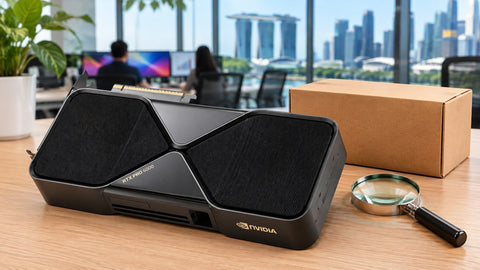
For most buyers, no. The GeForce RTX 5090 is the fastest gaming card NVIDIA sells. Published reviews put it about 25–35% ahead of the RTX 4090 at native 4K, and about 43% ahead of the RTX 5080 in Tom's Hardware's June 2026 averages. But US street prices in late 2026 have run at roughly three to four times its US$1,999 MSRP, it draws up to 575 W, and below 4K a fast CPU often caps it anyway. It earns its price for three groups: 4K high-refresh gamers who want path tracing, 3D artists who render on the GPU, and AI developers who need 32 GB and 1,792 GB/s of memory bandwidth on one card. Everyone else gets more for their money a step down.
What does the RTX 5090 actually deliver?
| GPU | 1440p Ultra, fps | 4K Ultra raster, fps | 4K ray tracing, fps | US MSRP | US street, 26 Oct 2026 | US$ per 4K frame at street (CALC) |
|---|---|---|---|---|---|---|
| RTX 5090 | 167.3 | 110.8 | 64.1 | US$1,999 | US$8,477 | 76.51 |
| RTX 4090 | 143.4 | 89.1 | 52.2 | US$1,599 | US$4,450 | 49.94 |
| RTX 5080 | 128.3 | 77.4 | 42.1 | US$999 | US$1,699 | 21.95 |
| RTX 5070 Ti | 116.8 | 68.6 | 36.7 | US$749 | US$1,229 | 17.92 |
Source: Tom's Hardware GPU Benchmarks Hierarchy (updated 24 Jun 2026; Ryzen 7 9800X3D, native resolution, no DLSS or frame generation) and Tom's Hardware lowest-GPU-price tracker (26 Oct 2026). Cost per frame is our arithmetic. Street prices change weekly; eBay's lowest listings averaged about US$6,542 for a 5090 in November 2026.
The fps columns tell the story. At 4K the 5090 is clearly the fastest card, with a 24% lead over the 4090 in this dataset and up to 35% in TechPowerUp's launch review. At 1440p the gap narrows, and at 1080p the CPU becomes the limit even with a Ryzen 7 9800X3D. If you don't play at 4K, much of what you'd pay for goes unused.
What are you really paying for?
At launch prices the 5090 was roughly as good value per frame as the 4090. Hardware Unboxed found only a 1.5% improvement in value per frame at MSRP. That changed in 2026. NVIDIA has not changed the US$1,999 MSRP, but it said in January 2026 that "memory supply is constrained", and its CFO said in February that supply would be "very tight" for a couple of quarters. By September, Tom's Hardware reported that first-party 5090 stock in the US had "almost completely evaporated", with third-party listings from US$6,500 to US$9,500.
At the October street prices in the table, a 4K frame on a 5090 costs about 3.5 times as much as one on a 5080. That is the premium: the last 43% of performance costs several times more per frame. It can still make sense if the card saves you working hours or does a job nothing cheaper can, but it is rarely a rational purchase for gaming alone.
Where does the RTX 5090 earn its price?
- 4K high-refresh gaming with path tracing. Natively, Cyberpunk 2077 with path tracing runs at about 28 fps on a 5090 (Tom's Hardware). DLSS upscaling and Multi Frame Generation lift that past 200 fps, though responsiveness still follows the base frame rate. Hardware Unboxed recommends a base of 70–80 fps and a 240 Hz-class monitor for 4x frame generation. See 4K gaming at 240 Hz on the RTX 5090.
- GPU rendering. On Blender Open Data (Blender 5.2.0, fetched 6 Nov 2026) the 5090's median score is 16,080, against 11,553 for the 4090 and 9,148 for the 5080. That is 1.76 times a 5080. For an artist billing render time, that gap is money. See RTX 5090 for Blender.
- Local AI on one card. The 5090's 32 GB holds models that 16 GB cards can't load, such as Qwen3-32B at 4-bit, and its bandwidth makes it fast on them: llama.cpp's own guide measured 282.5 tokens per second generating with gpt-oss-20b, against 204.9 on a 5080. See why 32 GB still frustrates AI developers.
Who doesn't need one?
- 1080p and 1440p players, especially in esports titles. With a 5090, a Ryzen 7 9800X3D beat a Ryzen 5 7600X by 37% at 1080p Medium (TechSpot/Hardware Unboxed). At those settings you are paying for GPU headroom your CPU can't feed.
- Most 4K players who are happy to use DLSS. An RTX 5080 or 5070 Ti with upscaling covers most games at far lower cost. We compare them in where your money stops making sense.
- AI users whose models are bigger than 32 GB. A 70B model at 4-bit is about 42.5 GB, and gpt-oss-120b is about 65 GB. Those need a 96 GB RTX PRO 6000 or a 128 GB GB10 system, not a gaming card.
The RTX 5090 is worth it when it does a job nothing cheaper can, or does a paid job measurably faster. As a pure gaming purchase at 2026 street prices, it is a luxury.
What does it cost to run?
NVIDIA rates the card at 575 W and asks for a 1,000 W system power supply. Measured gaming averages are lower: KitGuru recorded 463 W at 1440p, and 4K ray-traced games averaged about 546 W. At SP Group's Q4 2026 tariff of 31.16 cents per kWh including GST, running the card at a full 575 W for four hours a day comes to about 840 kWh, or roughly S$262 a year (our arithmetic). That heat, about 1,962 BTU per hour at full power, has to leave the case and the room. We cover electricity, heat and power supplies in 575 watts for one graphics card, and the connector debate in the RTX 5090 power connector controversy.
Which alternative fits you better?
- RTX 5080 (16 GB): about 70% of a 5090's 4K frame rate for about a fifth of the October US street price. See RTX 5090 vs RTX 5080.
- RTX 4090 (24 GB): still second-fastest. Used-market listings averaged about US$3,515 on eBay in November 2026, roughly 1.75 times its 2022 launch price, so it isn't a bargain either.
- An RTX 5090 Laptop GPU system: despite the name, it's a different chip (GB203, 24 GB, up to 175 W) at roughly half the desktop card's speed. It suits compact or portable setups, not desktop-5090 expectations.
- RTX PRO 6000 Blackwell or a GB10 system: for AI work that doesn't fit in 32 GB. Our RTX PRO 6000 vs RTX 5090 post compares the two cards directly.
Buying in Singapore
RTX 5090 graphics cards are not in stock at SourceIT at the time of writing; ask us about RTX 5090 card availability and a quotation. If you want an RTX 50 system now, the ASUS ROG NUC 16 Edition 20 with the RTX 5090 Laptop GPU (24 GB) is S$11,888.40, and the MSI Raider 16 Max HX laptop with the RTX 5090 Laptop GPU is S$7,268.80. For a 4K 240 Hz display, the MSI MPG 322URX QD-OLED with DisplayPort 2.1 UHBR20 is S$1,485.60, and the AMD Ryzen 7 9800X3D is S$756.38 (all listed 6 Nov 2026). Prices change; ask for a current quotation. Use Request for Quotation on the product page, call (65) 6978 3502, email Sales@sourceit.com.sg or use our contact page.
Frequently asked questions
How much faster is the RTX 5090 than the RTX 4090? About 25–35% at native 4K across launch reviews, roughly 30% on average. At 1440p and 1080p the gap shrinks to roughly 12–20% because the CPU becomes the limit.
Has NVIDIA raised the RTX 5090's price? No official change has been announced; the US MSRP is still US$1,999. Retail and marketplace prices rose sharply in 2026 as memory supply tightened, and they change weekly.
Is the RTX 5090 good for 1440p gaming? It works, but it's overkill for most players. At 1440p and below, a fast CPU such as a Ryzen 7 9800X3D often becomes the limit, and an RTX 5080 or 5070 Ti delivers most of the experience for much less.
Is the RTX 5090 a good AI card? For models that fit in 32 GB it is one of the fastest single cards available, because of its 1,792 GB/s bandwidth. Larger models such as 70B at 4-bit or gpt-oss-120b don't fit without offloading to system memory, which slows them sharply.
Is the RTX 5090 Laptop GPU the same as the desktop card? No. It uses the smaller GB203 chip with 24 GB at up to 175 W and runs at roughly half the desktop RTX 5090's speed.