Can a Mini AI Supercomputer Replace an Entire Server?

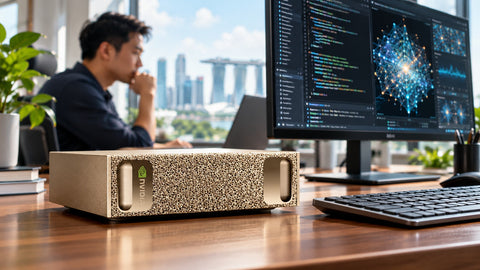
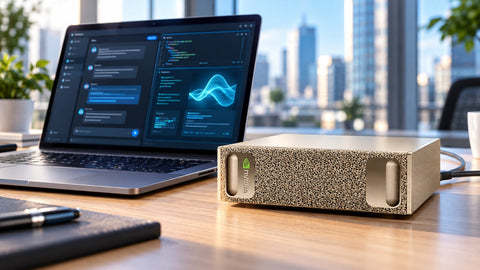
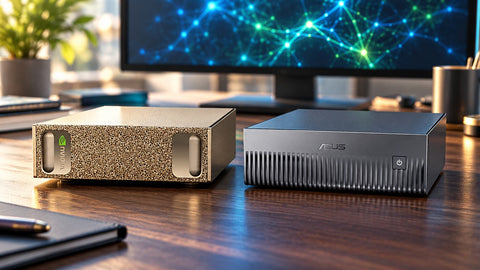
A GB10 mini AI supercomputer can replace one kind of server: the single-purpose inference box that serves a model to a developer or a small team. It cannot replace a server that must stay up when hardware fails, serve a department at once, or live in a rack under remote management. The ASUS Ascent GX10 (from S$7,200) and the NVIDIA DGX Spark (S$8,600) put 128 GB of unified memory and 1 petaFLOP of FP4 compute in a 150 mm box on a 240 W adapter, which is remarkable, but a server is defined by availability, management and concurrency as much as by memory. This post sets out what a GB10 unit can serve, what it cannot, and when a GB300 tower or a rack server is the right answer. The wider range sits in our ASUS Agent Computer guide.
Server duties compared: GB10 desk unit, GB300 tower, rack server
| Requirement | GB10 desk unit (GX10, DGX Spark) | GB300 tower (ET900N G3 class) | Rack AI server |
|---|---|---|---|
| Memory for models | 128 GB unified at 273 GB/s | 748 GB coherent (252 GB HBM3e at 7.1 TB/s) | Depends on GPU configuration |
| Concurrent users | One developer or a small team on a mid-size model | Team or department; StorageReview ran 128 streams | Scales with GPU count and nodes |
| Out-of-band management | No BMC | BMC with Redfish and IPMI | BMC as standard |
| Power redundancy | Single external 240 W adapter | Single 1,600 W PSU on a dedicated circuit | Redundant hot-swap PSUs are common |
| Failover / high availability | None built in; clustering pools memory, not uptime | Up to two Stations linked; no automatic failover implied | Designed for clustering and failover with the right software |
| Placement | Any desk | Office floor, dedicated circuit | Rack, server room or datacentre |
| SourceIT price | S$7,200 to S$9,850 (GX10); S$8,600 (DGX Spark) | Price on request | Price on request |
What a GB10 box can serve well
NVIDIA describes the DGX Spark's audience as developers, researchers, data scientists and students "working independently or as part of an enterprise fleet". That is the realistic frame for every GB10 unit. Used as a server, one box does these jobs well:
- A private model endpoint for a developer or a small project team, running a model up to the roughly 200B-parameter ceiling at FP4 that the GB10 class is quoted for.
- An internal retrieval assistant over documents that must stay in the office under the PDPA, used by a handful of colleagues.
- Always-on agents (OpenClaw, NemoClaw or Hermes on the GX10) that poll systems and draft work for human review, where a few minutes of downtime is tolerable.
- A staging box that mirrors what will later run on a GB300 tower or in a datacentre, since the software stack is shared.
Our post on local AI agents on your desk covers the agent use case, and why 128 GB of unified memory matters explains which models fit.
Concurrency: why "how many users" has no single answer
Neither NVIDIA nor the OEMs publish a user count for GB10 units, and any figure you see is workload-specific. The physics can be stated. For one stream, memory bandwidth divided by model size sets the ceiling: a 70B model at FP4 is about 35 GB, so 273 GB/s caps a single stream at roughly 7.8 tokens per second before overheads. Serving software batches several users together, which raises total throughput, but every user's conversation also holds a KV cache in the same 128 GB, so long contexts and many simultaneous sessions compete with the model for memory.
In practice that means a GB10 unit is comfortable when a few people use a mid-size model intermittently, and responses slow as more requests arrive together, particularly with long documents. The one comparative figure we can cite runs the other way: in StorageReview's 23 September 2026 review, the ASUS ET900N G3 served GPT-OSS-120B at about 9,300 output tokens per second at full concurrency, which the review put at 18 times a DGX Spark on the same workload, with 128 concurrent streams tested. If the plan is to put a model in front of a whole department, that gap is the answer.
What a GB10 box cannot do: HA, redundancy and rack management
A server earns its price in the parts that keep it running. A GB10 desk unit has a single external power adapter and no BMC, so there is no out-of-band console to reach it when the operating system hangs and no hot-swap power or drive bays to service it while it runs. If the unit fails, the service stops until it is repaired or replaced. If your policy requires specific memory error correction or storage redundancy, confirm those specifications for the exact SKU with us before treating it as production infrastructure.
Clustering does not fix this. Two GX10 units connect directly over QSFP, and up to four through a 200 GbE switch, but the purpose is to pool memory so a larger model can be split across them; with the model divided between units, losing either one stops it. Our guide to clustering two GX10 units shows the setup. For redundancy you would instead run two independent units each holding a full copy of the model behind a load balancer, which doubles cost and still lacks a BMC. There is also no rack form factor: the boxes sit on desks or shelves, outside your server room's power, cooling and access controls.
When a GB300 tower is the answer
A GB300 tower sits between a desk unit and a rack. The ASUS ExpertCenter Pro ET900N G3, the HP ZGX Fury G1n and the MSI XpertStation WS300 add the server features a GB10 box lacks: an ASPEED AST2600 BMC with Redfish and IPMI on the ASUS, Multi-Instance GPU partitioning into up to seven isolated instances, 748 GB of coherent memory and the concurrency figures above. They remain single-PSU deskside machines on a dedicated circuit, so they are not a high-availability design either, but for a team endpoint, multi-model agent stacks or fine-tuning they replace what used to need a multi-GPU server. Our posts on what you can run on a DGX Station GB300 and DGX Station GB300 vs DGX Spark GB10 work through the sizing; the office installation checklist covers the circuit and placement.
When you need a rack server
Choose rack infrastructure when the service has an uptime commitment, when many users or applications hit it all day, when it must sit inside a managed server room or datacentre, or when your auditors expect redundant power, out-of-band management and documented failover. Those are properties of the platform and the operations around it, not of the chip. Browse AI workstations and AI servers or ask us to specify one. Many organisations end up with both: GB10 units for developers to build and test on, and a GB300 tower or rack server to serve the result. The running costs of each are set out in the hidden costs of owning an AI workstation, and whether you need local hardware at all is the subject of do you need an AI supercomputer. The full GB10 field is in our GB10 buyer's guide.
Buying a GB10 unit or GB300 tower in Singapore
SourceIT Pte Ltd is an authorised ASUS reseller. Use Request for Quotation on the Ascent GX10 4 TB page or the ET900N G3 product page, call (65) 6978 3502 or email Sales@sourceit.com.sg. Tell us how many users, which models and what uptime you need, and we will say which class fits. We commission units updated, networked and serving models, and we are GeBIZ and Vendors@Gov registered for government buyers.
Frequently asked questions
Can an ASUS GX10 or DGX Spark replace a server? It can replace a single-purpose inference server for a developer or small team. It cannot replace a server that needs high availability, redundant power, out-of-band management or rack mounting.
How many users can a GB10 unit serve? NVIDIA publishes no user count. It suits a few people using a mid-size model intermittently; responses slow as simultaneous requests and context lengths grow.
Does clustering two GX10 units give me redundancy? No. Clustering pools memory to run a larger model split across the units, so losing either unit stops that model.
Does a GB10 unit have a BMC? No. GB300 towers such as the ASUS ET900N G3 have a BMC with Redfish and IPMI.
When should I choose a GB300 tower instead? When a model must serve a team or department, run several models at once, or support fine-tuning. StorageReview measured the ET900N G3 at about 18 times a DGX Spark on GPT-OSS-120B at full concurrency.
How much do these systems cost at SourceIT? The ASUS GX10 is S$7,200, S$8,050 or S$9,850 by storage, and the NVIDIA DGX Spark 4 TB is S$8,600. GB300 towers and rack servers are price on request.