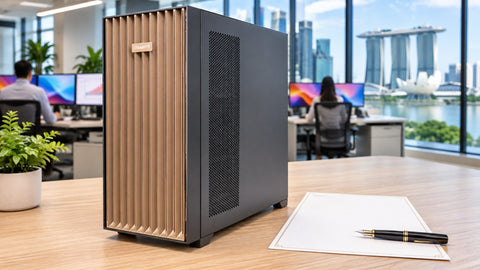
The ASUS ProArt GR1X packs NVIDIA's RTX Spark N1X chip and up to 128 GB of unified memory into a 1.1-litre box. It has seven limitations worth knowing before you buy. Its AI software on Windows is still maturing. Not all memory goes to the GPU by default. Memory bandwidth caps text speed. The memory can't be upgraded. It has no high-speed clustering port. Some Windows apps and games don't run. And no independent GR1X test or Singapore price had been published at the time of writing. None of these is a reason to avoid it, but each rules out certain jobs.
What are the seven limitations at a glance?
| # | Limitation | Who it affects | What to do |
|---|---|---|---|
| 1 | AI tooling on Windows on Arm is preview-grade | Developers using vLLM, TensorRT-LLM, Docker | Check each tool; consider a Linux GB10 box |
| 2 | GPU memory split, not the full 128 GB | Anyone sizing a big model | Plan on ~64 GB by default, ~96 GB if adjustable |
| 3 | ~300 GB/s memory bandwidth | Users of large dense models | Prefer mixture-of-experts models |
| 4 | Soldered memory; only SSDs serviceable | Anyone planning to grow later | Buy the memory you'll need for 3 years |
| 5 | No ConnectX, Thunderbolt or USB-A | Teams wanting to cluster or attach legacy devices | Use 10 GbE, a USB-C hub, or a GB10 cluster |
| 6 | App and game compatibility gaps | Users of anti-cheat games, kernel drivers, some plug-ins | Check our compatibility guide first |
| 7 | No GR1X benchmarks, price or local warranty terms yet | Every buyer | Ask for a quotation and terms before committing |
Source: ASUS GR1X product and tech-spec pages (8 Nov 2026); XDA RTX Spark laptop hands-on (26 Oct 2026); PCWorld ASUS ProArt P16 review (29 Oct 2026); Notebookcheck RTX Spark game tests (16–18 Oct 2026); vLLM documentation. Status as of November 2026.
1. Is the AI software ready on Windows on Arm?
Partly. NVIDIA brought CUDA to Windows on Arm with RTX Spark, but as a developer preview, and it has warned that some PyTorch workflows can trigger GPU timeouts. Ollama and LM Studio work. vLLM has no native Windows support, so it runs through WSL2 or a community port that supported one model when we checked. TensorRT-LLM's install guide is Linux-only, Docker GPU support on these machines hadn't been publicly validated, and the native Arm64 ComfyUI installer was still an unmerged pull request. XDA also found Windows' Smart App Control blocking unsigned llama.cpp builds. If your workflow is a Python stack built for Linux CUDA, read our Windows on Arm developer guide first.
2. Do you get all 128 GB for AI models?
No. Windows splits unified memory between the CPU and GPU. PCWorld found the ProArt P16 128 GB defaulted to about half for the GPU, adjustable to about 96 GB in MyASUS. ASUS hadn't documented that control for the GR1X at the time of writing. On 64 GB machines XDA found Windows exposed at most 55.4 GB to the GPU. That means gpt-oss-120b, at about 65 GB, won't load on a 64 GB unit.
3. Why is text generation slower than the memory size suggests?
Because generating each token means reading the model's active weights from memory, and the GR1X's memory runs at "up to 300 GB/s" by ASUS's figure. A dense 70B model at 4-bit has a theoretical single-user ceiling of only about 7 tokens per second. Mixture-of-experts models are far kinder: RTX Spark laptops measured around 59–63 tokens per second on gpt-oss-120b. Our 128 GB memory trap post works through the maths.
Most GR1X limitations aren't hardware faults. They're the cost of putting a new chip, a new operating-system port and a lot of memory into a very small box.
4. Can you upgrade it later?
Only the storage. The LPDDR5X memory is soldered, so a 64 GB GR1X stays 64 GB for life. ASUS lists two M.2 NVMe slots with "up to 4TB". It's not clear yet whether that means 4 TB per slot or in total, or how easy the slots are to reach. The GPU is part of the chip, so there's no graphics-card upgrade path either. That's the main reason our 64 GB vs 128 GB guide leans towards 128 GB for anyone running models above about 30B.
5. Can you cluster it or plug in older devices?
The rear panel has one USB-C power input, three 20 Gbps USB-C ports with DisplayPort output, HDMI 2.1 and 10 GbE. There's no USB-A, no Thunderbolt or USB4, and no ConnectX port. A DGX Spark or ASUS Ascent GX10 has ConnectX-7 at 200 Gb/s, and NVIDIA's tools link two to four of them to run larger models. The GR1X has no supported equivalent, and we found no published results for clustering RTX Spark PCs over 10 GbE. Budget for a USB-C hub if you use USB-A peripherals.
6. Will all your software and games run?
Most Windows apps do, as Arm-native builds or through Microsoft's Prism emulation. Prism doesn't cover kernel drivers, so anti-cheat systems and some hardware utilities fail. Notebookcheck found Call of Duty, F1 25 and Battlefield 6 wouldn't run on RTX Spark laptops, and Microsoft has said Call of Duty support will come in 2027. That contradicts NVIDIA CEO Jensen Huang's claim that RTX Spark runs everything. Check our Windows on Arm app compatibility guide for your specific apps and plug-ins.
7. What don't we know yet?
- Performance: no independent GR1X benchmark had been published at the time of writing. Every figure above comes from RTX Spark laptops running at 45–80 W, while the GR1X is rated at 140 W sustained. That may help image generation and rendering more than text generation, but it's untested.
- Price: ASUS hadn't announced one. Our estimate, based on comparable RTX Spark devices and not an official ASUS price, is about S$6,200–7,200 for 64 GB/1 TB and S$9,000–10,800 for 128 GB/2 TB.
- Warranty and support in Singapore: not yet published. One European retailer lists 24 months carry-in, but that's not confirmed for Singapore.
- Software lifecycle: NVIDIA hasn't published how long RTX Spark drivers will be supported. We look at that in whether the GR1X will age faster than a GPU workstation.
Buying in Singapore
The ProArt GR1X is listed at SourceIT as price on request in the ASUS ProArt GR1X collection. If limitation 1 or 5 rules it out for you, the ASUS Ascent GX10 128GB/1TB (S$10,350) and NVIDIA DGX Spark 4TB (S$9,300) run Linux with ConnectX-7 clustering (listed 8 Nov 2026). Prices change, so ask for a current quotation. Send us your app list and we'll check it against what's known to run. To get a quote, use Request for Quotation on the product page, call (65) 6978 3502, email Sales@sourceit.com.sg or use our contact page.
Frequently asked questions
Can I upgrade the GR1X's memory later? No. The LPDDR5X memory is soldered. Only the two M.2 SSD slots are expandable, so choose 64 GB or 128 GB carefully at purchase.
Does vLLM run on the ASUS ProArt GR1X? Not natively on Windows. You can run it inside WSL2 or try an unofficial Windows Arm64 port. Ollama and LM Studio work natively on RTX Spark.
Does the GR1X have Thunderbolt or USB-A? No. ASUS lists three 20 Gbps USB-C ports with DisplayPort, one USB-C power input, HDMI 2.1 and 10 GbE. Use a USB-C hub for USB-A devices.
Will my games run on the GR1X? Many will, but titles with anti-cheat that needs kernel drivers may not. Call of Duty, F1 25 and Battlefield 6 didn't run on RTX Spark laptops in October 2026 tests.
Are there any GR1X benchmarks? Not at the time of writing. Published RTX Spark figures come from laptops using the same N1X chip at lower power, so treat them as a guide rather than GR1X results.

SourceIT Approved
Researched and verified by the SourceIT team for Singapore buyers.