
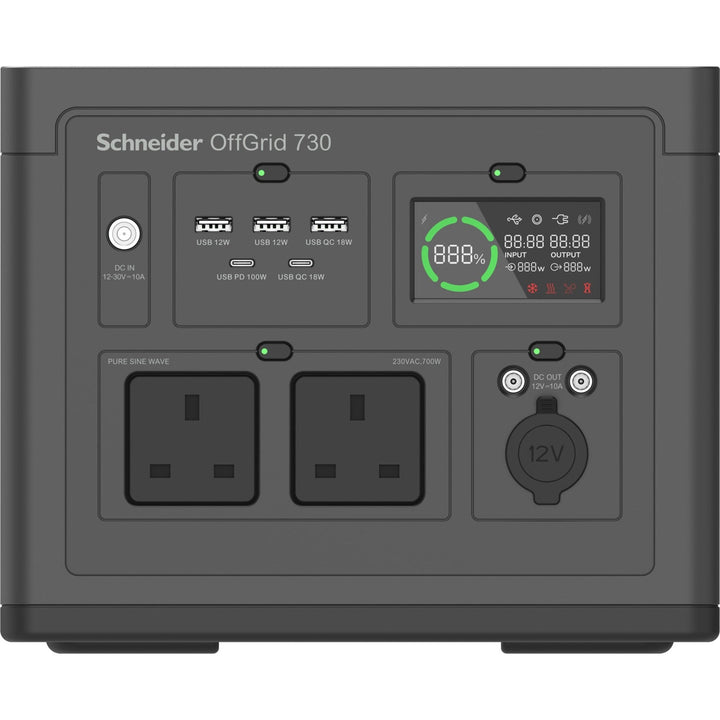


Schneider OffGrid Portable Power Station 730
PRODUCT DESCRIPTION
Schneider OffGrid Portable Power Station 730 (PPS730-UK) - 2 Years Local Warranty
Schneider OffGrid Portable Power Station 730 — 738 Wh, 700 W, 100 W USB-C
The Schneider OffGrid 730 is the largest of the three: a 738 Wh lithium-ion pack delivering 700 W of continuous 230 V, 50 Hz sine wave AC through two BS 1363 outlets, in a 6.4 kg case. Its headline feature is a 100 W USB-C Power Delivery port — enough to charge a large laptop or a mobile workstation over a single cable, without going near the inverter.
This is a Schneider-branded product rather than an APC one, documented and supported under the Schneider OffGrid range name.
Rated 700 W, Not 730 W
As with its siblings, the number in the name is watt-hours rather than watts. Schneider rates the continuous AC output at 700 W, and its own product name reads “730, 700W”. The previous version of this listing gave around 730 W, which is a small overstatement but the wrong side of the line if you are checking a 720 W appliance. Schneider publishes no surge or peak output figure for this range. Numbers of that kind do circulate in third-party catalogues, but the catalogue entry they come from also lists this -UK model with Schuko sockets, which it does not have, so we treat the whole record as unreliable. Size by the continuous rating.
The 100 W USB-C Port Is the Reason to Choose This Model
Most portable power stations treat USB-C as a phone charger. At 100 W this one will run a 16-inch laptop or a mobile workstation at full charging rate over the same cable the machine came with. That is both more convenient and materially more efficient than plugging the laptop’s own AC adapter into the inverter, because it skips the DC-to-AC-to-DC round trip entirely — so the same battery lasts longer.
For a working day away from mains, or for a site visit where a laptop and a couple of smaller devices need to stay alive, that single port changes the arithmetic more than the extra 221 Wh of capacity does.
Buying the OffGrid 730 in Singapore
The two BS 1363 outlets are Singapore’s own socket standard, so local plugs fit directly — the “-UK” suffix is a description of the socket type, not a warning. The AC input accepts 190 to 265 V at 50 or 60 Hz, which covers our supply comfortably.
SourceIT supplies the OffGrid 730 with a GST invoice and local Singapore warranty support. Schneider states two years from the date of purchase, with a note to register the product within ten days.
Schneider OffGrid 730 Datasheet — Technical Specifications
General
| Part Number (SKU) | PPS730-UK |
| Range | Schneider OffGrid |
| Product Type | Portable power station with lithium-ion battery and sine wave inverter |
| Brand | Schneider Electric |
| Manufacturer Warranty | 2-Year Manufacturer Warranty (Schneider Electric) |
| Warranty Coverage | Local Warranty (Singapore) |
Battery
| Battery Capacity | 738 Wh (14.76 V x 50 Ah) |
| Battery Chemistry | Lithium-ion, non-removable — not lithium iron phosphate |
| Cycle Life | 500 or more cycles retaining 80 percent or more of capacity |
AC Output
| Rated Continuous Output | 700 W |
| Surge / Peak Output | Not published by Schneider |
| Output Voltage and Frequency | 230 V AC, 50 Hz |
| Waveform | Sine wave — Schneider’s product-name string reads “Sinewave” |
| AC Sockets | 2 x BS 1363, the Singapore and United Kingdom three-pin standard |
DC and USB Outputs
| USB-A | 3 ports; two at 5 V and 2.4 A, one supporting Quick Charge 3 at up to 18 W |
| USB-C | 2 ports; one is USB Power Delivery at 100 W maximum (adding 20 V at 5 A), the other Quick Charge 3 at up to 18 W |
| Car Socket | 1 x 12 V at 10 A (120 W) |
| DC5521 Barrel Outputs | 2 x 12 V at 5 A, sharing a 60 W budget |
| Wireless Charging Pad | 15 W maximum |
Input and Charging
| AC Input | 190 to 265 V, 50 or 60 Hz, 0.7 A maximum |
| Solar / DC Input | 12 to 30 V, 10 A, 200 W maximum |
| Recommended Solar Panels | Schneider OffGrid PSP100 or PSP200 |
| Solar Connector Type | Not published by Schneider |
| MPPT | Not stated by Schneider — no claim made |
| Pass-through Operation | Supported; switchover time not published |
| AC Recharge Time | Not published by Schneider |
Physical & Environmental
| Dimensions | 204 x 200 x 250 mm |
| Weight | 6.4 kg |
| Display | LCD with status readout and alphanumeric error codes |
| Light | LED work light, three modes: low, high and SOS signal |
| Operating Temperature, Charging | 0 to 40 °C |
| Operating Temperature, Discharging | -10 to 40 °C |
| Storage Temperature | -20 to 70 °C |
Compatibility & Runtime
Sockets and plugs in Singapore
Two BS 1363 outlets, which is our own domestic standard, so Singapore plugs fit with nothing in between. The AC input window of 190 to 265 V at 50 or 60 Hz covers the local 230 V, 50 Hz supply, so the supplied charging cable works here unmodified.
Which devices will negotiate the full 100 W
Any device that implements USB Power Delivery at 20 V and 5 A — most 15-inch and 16-inch laptops and mobile workstations do. Smaller machines will negotiate a lower profile and charge at their own rate. The efficiency argument is in the description above.
What the AC output will run
Seven hundred watts continuous covers a full desk — workstation, monitor, networking — or a projector-and-audio setup, or camera and lighting kit, or light bench equipment without a motor — a soldering station, a test meter, a work light. It does not cover kettles, hair dryers, heaters, microwaves or fridges, and a compressor’s start-up surge will trip it even where its running draw looks acceptable.
Estimating runtime
Divide 738 Wh by the load in watts and allow for conversion losses on the AC side. A laptop drawing 100 W over USB-C runs for around seven hours — and most laptops draw that only while charging, so in practice a good deal longer. A 300 W desk load gives you a little over two hours. Small loads on the USB and DC outputs are efficient enough that the practical limit is usually patience rather than capacity.
Solar charging
The DC input takes 12 to 30 V at up to 10 A, capped at 200 W. Schneider names both the PSP100 and the larger PSP200 for this model, so it can use either. Pairing it with a panel turns a day-long capacity into an indefinite one for modest loads in good light.
Charging while in use
Pass-through is supported, so connected equipment keeps running while the station charges. Schneider publishes no switchover time, so it should not be relied on as an uninterruptible supply for equipment that cannot tolerate a break.
Where it sits in the range
This is the top of the three. Against the OffGrid 500, which shares its case and footprint, it adds 221 Wh, 200 W of output and the 100 W USB-C port for 0.9 kg more weight. The OffGrid 330 is a different proposition entirely — roughly half the weight and less than half the energy.
Package Contents & Schneider OffGrid Ordering Information
In the box
- Schneider OffGrid Portable Power Station 730
- AC charging cable
- Car charging cable
- Safety guide
- Quick installation guide
The Schneider OffGrid range at SourceIT
| PPS730-UK (this listing) | 738 Wh, 700 W, 6.4 kg — 2 x BS 1363, USB-C Power Delivery at 100 W, 200 W solar input |
| PPS500-UK | 517 Wh, 500 W, 5.5 kg — same case, USB-C PD at 60 W |
| PPS330-MS | 332 Wh, 300 W, 3.31 kg — the compact unit, 100 W solar input |
| PSP100 | 100 W foldable monocrystalline solar panel — works with all three stations |
Accessories worth adding
A panel is what turns a finite capacity into a sustainable one. Schneider lists the PSP100 and the 200 W PSP200 for this model; the 200 W input ceiling means either will work, and the larger panel will halve the daylight needed for a given amount of charge.
Schneider specifies lithium-ion cells here, not lithium iron phosphate, and rates the pack at 500 or more cycles to 80 percent of its original capacity. That is worth knowing if you are comparing against a LiFePO4 unit, which will typically quote a much higher cycle count for the same money and weigh more for the same energy.
Datasheet & Downloads
- Schneider Electric product page for the OffGrid Portable Power Station 730
- Schneider OffGrid range page
- Schneider user manual covering the OffGrid 500 and 730 (SPD_SOF_UM-TME44186_EN)
- Schneider FAQ on which solar panels work with which OffGrid power stations (FAQ000270882)
Every specification on this page was read out of the documents above, and where a figure was not published we say so in the row instead of filling it with a plausible number. We do not link Schneider’s own download host directly: it redirects across domains and has repeatedly returned a different model’s document. If you need a data sheet or manual emailed as a PDF for a tender, ask us and we will send it.
Frequently Asked Questions — Schneider OffGrid 730
Is it 730 W or 700 W?
700 W continuous. Schneider’s own product name reads “730, 700W” — the 730 refers to the 738 Wh battery. The previous version of this listing gave around 730 W, which is only a small overstatement but is on the wrong side of the line for anything drawing between 700 and 730 W.
Does the -UK build need an adapter in Singapore?
No. BS 1363 is Singapore’s own three-pin standard, so local plugs fit these sockets directly, and the 190 to 265 V input covers our mains. The -UK designation names the socket standard, and it happens to be ours as well.
What can the 100 W USB-C port charge?
A large laptop or a mobile workstation at its full charging rate, over the cable the machine already came with. It is also the efficient way to do it: drawing DC straight from the pack avoids the conversion losses of running the laptop’s AC adapter off the inverter, so you get more working time from the same charge.
What is the surge or peak rating?
Schneider does not publish one, so we do not quote one. A peak figure circulates in third-party catalogues, but the record it comes from also describes this -UK model as having Schuko sockets, which it does not, so we treat that entry as unreliable throughout. Size against the 700 W continuous rating.
Will it run a fridge or a kettle?
No. Both are beyond its continuous rating, and a fridge compressor draws several times its running figure at start-up. This class of product is for electronics and lighting, not for heating or refrigeration.
Should I buy this or the OffGrid 500?
If your load list has comfortable headroom under 500 W and nothing needs fast USB-C charging, the OffGrid 500 saves money and 0.9 kg in the same case. Take the 730 if you are close to 500 W, if you want the extra 221 Wh, or if the 100 W USB-C port earns its keep — for a laptop-centred kit list, that last point often decides it.
Does it come with a local Singapore warranty?
Yes. Every Schneider OffGrid Portable Power Station 730 sold by SourceIT comes with local Singapore warranty and a GST invoice; Schneider backs the OffGrid Portable Power Station 730 with a 2-year manufacturer warranty. Schneider’s own documentation states two years from the date of purchase with no regional split, so the same term applies here.


