


Schneider OffGrid Portable Power Station 330
PRODUCT DESCRIPTION
Schneider OffGrid Portable Power Station 330 (PPS330-MS) - 2 Years Local Warranty
Schneider OffGrid Portable Power Station 330 — 332 Wh, 300 W Sine Wave Output
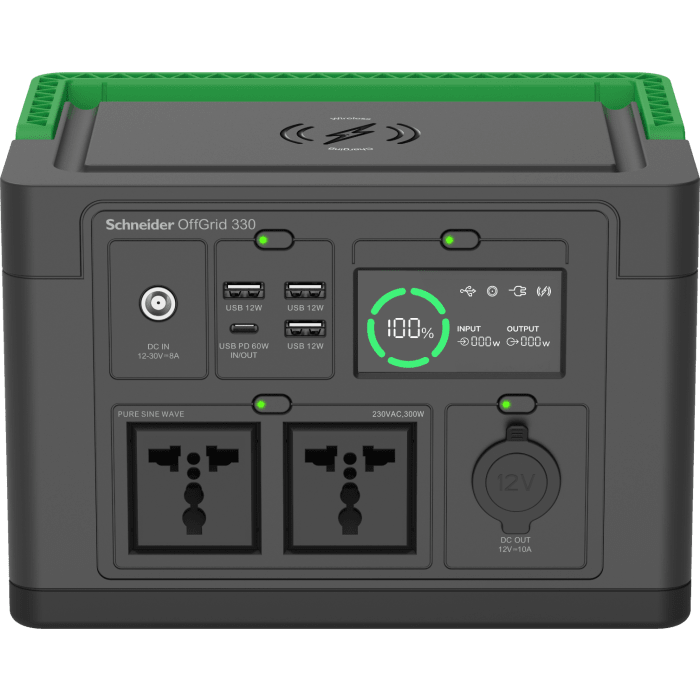
The Schneider OffGrid 330 is the entry point of Schneider’s portable power range: a 332 Wh lithium-ion pack delivering 300 W of continuous 230 V, 50 Hz AC through a sine wave inverter, in a 3.31 kg case you can carry in one hand. Alongside the AC output it carries three USB-A ports, a 60 W USB-C Power Delivery port, a 12 V car socket and a 15 W wireless charging pad on its top surface.
This is a Schneider-branded product rather than an APC one. It shares a distributor and a warranty desk with the APC power-protection range, but the range name is Schneider OffGrid and that is how it is documented and supported.
Rated 300 W, Not 330 W — a Correction Worth Reading
The number in the model name is the pack’s energy in watt-hours, not its output in watts. The previous version of this listing gave the continuous rating as around 330 W; Schneider’s own user manual states 300 W. The distinction matters when you are checking whether a specific appliance will run: a 320 W load will not start on this unit, whatever the badge says. Schneider publishes no surge or peak output figure for this range. Numbers of that kind do circulate in third-party catalogues, but the entry they come from also disagrees with Schneider’s own manual about this unit’s sockets, so we do not repeat them. Size by the continuous rating.
What It Will Actually Run, and For How Long
332 Wh at 300 W is a genuinely useful envelope for laptops, routers, cameras, lighting, a small fan or a monitor, and it is not enough for anything that heats or compresses. As a rough guide, divide the 332 Wh by the load in watts to get hours, then take a little off for conversion losses.
Pass-through operation is supported, so the unit will power connected equipment while it is itself charging. Schneider does not publish a switchover time, so we do not describe this as a UPS — it is a portable power station that happens to keep working on the charger, not a device rated to protect a server from a transfer gap.
Buying a Portable Power Station in Singapore
For a Singapore buyer the useful checks are the AC output frequency and the socket. The output here is 230 V at 50 Hz, which is our standard. On the socket, see the note in Compatibility below — the “-MS” build’s outlet type is the one specification on this page we are not yet willing to state, and we would rather tell you that than describe it wrongly.
Schneider does not publish the AC input window for the -MS build. The -UK and -GR builds of the same platform accept 190 to 265 V at 50 or 60 Hz, which would cover our supply comfortably, but we will not assume the -MS adapter is identical — ask us and we will confirm its rating with the distributor before you order.
SourceIT supplies the OffGrid 330 with a GST invoice and local Singapore warranty support, so a claim is handled here rather than through an overseas seller. Schneider states two years from the date of purchase.
Schneider OffGrid 330 Datasheet — Technical Specifications
General
| Part Number (SKU) | PPS330-MS |
| Range | Schneider OffGrid |
| Product Type | Portable power station with lithium-ion battery and sine wave inverter |
| Brand | Schneider Electric |
| Manufacturer Warranty | 2-Year Manufacturer Warranty (Schneider Electric) |
| Warranty Coverage | Local Warranty (Singapore) |
Battery
| Battery Capacity | 332 Wh nominal (Schneider’s product-name figure); the manual gives 11.07 V x 30 Ah, or 332.1 Wh |
| Battery Chemistry | Lithium-ion, non-removable — not lithium iron phosphate |
| Cycle Life | 500 or more cycles retaining 80 percent or more of capacity |
| Battery Management | Overload, overheat, low-temperature and low-battery protection |
AC Output
| Rated Continuous Output | 300 W |
| Surge / Peak Output | Not published by Schneider |
| Output Voltage and Frequency | 230 V AC, 50 Hz |
| Waveform | Sine wave — Schneider’s product-name string for this range reads “Sinewave” |
| AC Socket Type | Not stated on this listing — see the note in Compatibility & Runtime before you order |
DC and USB Outputs
| USB-A | 3 ports, 5 V at 2.4 A (12 W each) |
| USB-C | 1 port, USB Power Delivery, 60 W maximum (5 / 9 / 12 / 15 / 20 V at 3 A) |
| Car Socket | 1 x 12 V at 10 A (120 W) |
| DC5521 Barrel Outputs | Not fitted on the 330 — these are on the 500 and 730 |
| Wireless Charging Pad | 15 W maximum |
Input and Charging
| AC Input | Supplied AC adapter; input voltage window not published for this model |
| Solar / DC Input | 12 to 30 V, 8 A, 100 W maximum |
| USB-C Input | 60 W maximum |
| Solar Connector Type | Not published by Schneider |
| MPPT | Not stated by Schneider — no claim made |
| Pass-through Operation | Supported; the unit can power connected equipment while charging. Switchover time not published |
| AC Recharge Time | Not published by Schneider |
Physical & Environmental
| Dimensions | 223 x 163 x 153 mm |
| Weight | 3.31 kg |
| Display | LCD showing battery percentage, runtime and input and output power |
| Light | LED work light, three modes: low, high and SOS signal |
| Operating Temperature, Charging | 0 to 40 °C |
| Operating Temperature, Discharging | -10 to 40 °C |
| Storage Temperature | -20 to 70 °C |
Compatibility & Runtime
A caution about this unit’s AC socket
Schneider builds this power station in several regional variants — the user manual covers the -AZ, -UK, -MS and -GR builds — and the AC outlet differs between them. The -UK build carries two BS 1363 sockets, which is the Singapore standard; the -GR build carries Schuko.
For the -MS build stocked here, the only description we can find comes from a Schneider storefront we are not able to cite as a source, and it names a socket type that is not a BS 1363 wall outlet. Because we cannot verify it against a citable document, this listing states no socket type at all. The previous version of this page claimed “universal AC outlets that accept various plug types without adapters”; that claim has been removed, because on the available evidence it is the opposite of the truth. Ask us before you order and we will confirm the outlet type with the distributor.
What the AC output will run
300 W of continuous sine wave output at 230 V and 50 Hz covers laptops and their chargers, network equipment, monitors, camera and drone batteries, LED lighting, a small fan and most consumer electronics. It does not cover kettles, hair dryers, heaters, microwaves, fridges, power tools or induction plates. Check the rating plate on anything you intend to run, and remember that motors and compressors draw far more on start-up than they do running.
Estimating runtime
Take the 332 Wh capacity, divide by the load in watts, and allow for conversion losses. A 60 W laptop charger will run for something under five hours; a 12 W router for a good deal longer. Loads drawn from the USB and car outputs avoid the inverter and are correspondingly more efficient than the same power taken from the AC socket.
Solar charging and the panel that suits it
The DC input accepts 12 to 30 V at up to 8 A, capped at 100 W. That cap is the reason the Schneider OffGrid Portable Solar Panel 100W (PSP100) is the right partner for this unit: Schneider confirms the PSP100 works with the 330, the 500 and the 730, while the larger PSP200 is listed only for the 500 and the 730. A 200 W panel on a 100 W input buys you nothing here.
Where it sits in the range
The 330 is the smallest and lightest of the three. The OffGrid 500 adds 185 Wh, 200 W of output, a second USB-C port and two DC barrel outputs; the OffGrid 730 raises the USB-C Power Delivery port from 60 W to 100 W on top of that. Both are heavier and both accept 200 W of solar input rather than 100 W.
Package Contents & Schneider OffGrid Ordering Information
In the box
- Schneider OffGrid Portable Power Station 330
- AC adapter
- Car charging cable
- Safety guide
- Quick-start guide
The Schneider OffGrid range at SourceIT
| PPS330-MS (this listing) | 332 Wh, 300 W, 3.31 kg — 1 x USB-C PD 60 W, 100 W solar input |
| PPS500-UK | 517 Wh, 500 W, 5.5 kg — 2 x USB-C, 200 W solar input, 2 x BS 1363 outlets |
| PPS730-UK | 738 Wh, 700 W, 6.4 kg — USB-C Power Delivery at 100 W, 2 x BS 1363 outlets |
| PSP100 | 100 W foldable monocrystalline solar panel — works with all three stations |
Choosing between them
Capacity is the obvious axis, but the output rating is the one that decides whether a given appliance runs at all: 300, 500 and 700 W respectively. If the load list is laptops and network gear, the 330 is ample. If it includes anything with a motor or a heating element, none of the three will do it and you are looking at a different class of product entirely.
Schneider specifies lithium-ion cells here, not lithium iron phosphate, and rates the pack at 500 or more cycles to 80 percent of its original capacity. That is worth knowing if you are comparing against a LiFePO4 unit, which will typically quote a much higher cycle count for the same money and weigh more for the same energy.
Datasheet & Downloads
- Schneider OffGrid range page, Schneider Electric Singapore
- Schneider Electric product page for the OffGrid Portable Power Station 330 (the -UK build of the same platform)
- Schneider user manual for the OffGrid 330 (SPD_UM-TME44185_EN)
- Schneider FAQ on which solar panels work with which OffGrid power stations (FAQ000270882)
Every specification on this page was read out of the documents above, and where a figure was not published we say so in the row instead of filling it with a plausible number. We do not link Schneider’s own download host directly: it redirects across domains and has repeatedly returned a different model’s document. If you need a data sheet or manual emailed as a PDF for a tender, ask us and we will send it.
Frequently Asked Questions — Schneider OffGrid 330
Is it 330 W or 300 W?
300 W continuous. The 330 in the name refers to the 332 Wh battery, not to the inverter. The previous version of this listing said around 330 W, which overstated it by ten percent — enough to matter if you are checking a specific appliance against the rating.
What plugs will fit its AC sockets?
We are not stating a socket type for the -MS build until we can verify it against a document we are able to cite. Schneider builds this unit in several regional variants with different outlets, and the evidence we have for this one does not point to a BS 1363 wall socket. Ask us before ordering and we will confirm with the distributor. If you specifically need BS 1363 outlets, the OffGrid 500 and OffGrid 730 carry two each and are documented as such.
Will it run a kettle, a fridge or a hair dryer?
No. All three draw well beyond 300 W, and motors and compressors draw more still at start-up. This class of product suits electronics rather than anything that heats or compresses. If that is the requirement, tell us the load and we will point you at the right equipment.
Can I use it as a UPS for a computer?
Not as a substitute for one. It supports pass-through, so a connected device keeps running while the station charges, but Schneider publishes no switchover time and does not rate the product for that duty. A computer that must not lose power needs a UPS with a specified transfer time.
What battery chemistry does it use, and how long will the pack last?
Lithium-ion, not lithium iron phosphate, rated at 500 or more cycles to 80 percent of original capacity. In practice, keeping it out of a hot car boot and off a full charge during long storage will do more for its life than anything else.
Which solar panel should I buy with it?
The PSP100. Schneider confirms it works with the 330, the 500 and the 730. The larger PSP200 is listed only for the 500 and the 730 — and since the 330’s DC input is capped at 100 W, a bigger panel would not charge it any faster in any case.
Does it come with a local Singapore warranty?
Yes. Every Schneider OffGrid Portable Power Station 330 sold by SourceIT comes with local Singapore warranty and a GST invoice; Schneider backs the OffGrid Portable Power Station 330 with a 2-year manufacturer warranty. Schneider’s own documentation states two years from the date of purchase with no regional split, so the same term applies here.


