
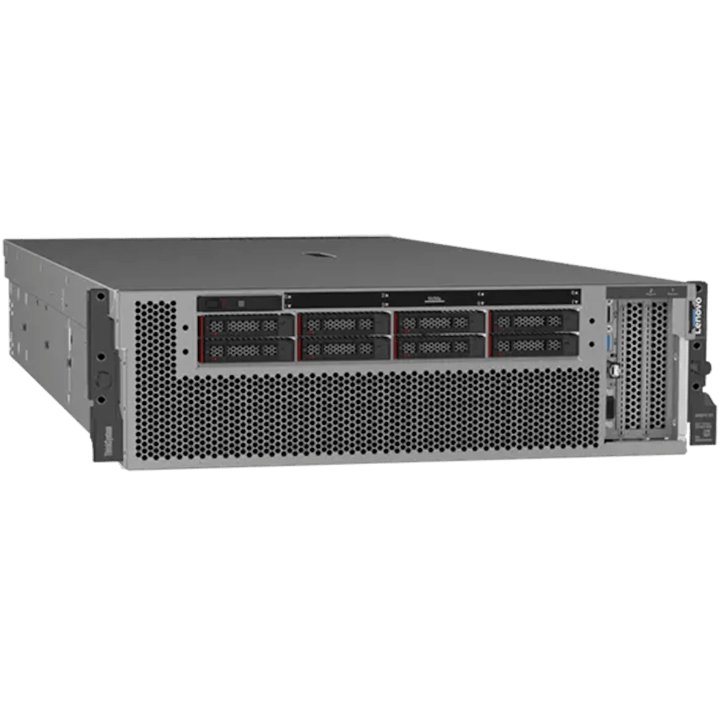


Lenovo ThinkSystem SR670 Rack Server
PRODUCT DESCRIPTION
Lenovo ThinkSystem SR670 (Configure to Order) - Singapore Local Warranty
Before You Read On: Lenovo Has Withdrawn This Server
Lenovo Press records this server as withdrawn from marketing — Lenovo Press marks every generation of this server withdrawn from marketing. That means no new production; what exists is channel stock. It does not mean unsupported: Lenovo continues to honour warranties and publish firmware and drivers for withdrawn machines. Every generation of this server is withdrawn, and no current generation exists. Lenovo has not published an SR670 V3. If you need a GPU server today, the current machines are in the ordering table below and we will size one against your actual workload. Everything below stays accurate for the server as Lenovo built it, so you can compare it honestly against what replaces it. If you are buying new infrastructure, buy current. If you are extending or matching an existing estate and need this exact platform, ask us and we will check the channel rather than guess at availability.
2U rack (the later SR670 V2 is 3U), 2 sockets
Lenovo's own words: "AI, HPC, and VDI workloads". Processors, memory, storage and networking are all selected at order time — the sections below describe what the chassis will take, and we configure the rest with you.
What This Chassis Will Actually Hold
Up to 1.5 TB of memory across its DIMM slots, and eight 2.5-inch hot-swap bays. Expansion runs to 7 or 11 front slots, pcie 3.0. The full detail, including which drive form factors combine with which, is in the specification tables below.
Managed the Way the Rest of Your Estate Is
XClarity Controller (first generation), with optional Advanced and Enterprise. Lenovo's XClarity tooling handles firmware, configuration and monitoring across a fleet rather than a box at a time, which is most of the reason organisations standardise on one server vendor in the first place.
Lenovo ThinkSystem SR670 Datasheet — Technical Specifications
General
| Product | Lenovo ThinkSystem SR670 |
| Lenovo's Full Product Name | Lenovo ThinkSystem SR670 Server (Xeon SP Gen 2) |
| Lenovo Press Document | LP1051 |
| Lifecycle Status | Withdrawn from marketing (Lenovo Press marks every generation of this server withdrawn from marketing) |
| Form Factor | 2U rack (the later SR670 V2 is 3U) |
| Sockets | 2 sockets |
| How It Is Bought | Configure-to-order through Lenovo's Data Center Solution Configurator. The price on this listing is an indicative starting figure for a base chassis, not a quotation |
| Local Warranty (Singapore) | Included with every SourceIT purchase, with GST invoice |
Platform
| Processors | 2nd Generation Intel Xeon Scalable, up to 28 cores, up to 3.8 GHz, TDP up to 205 W |
| Memory | 24 DIMM slots, Lenovo TruDDR4 at 2933 MHz, maximum 1.5 TB |
| Operating System Support | Red Hat Enterprise Linux and SUSE Linux Enterprise Server only. Lenovo publishes no Windows Server or VMware support for this generation |
| Management | XClarity Controller (first generation), with optional Advanced and Enterprise |
Storage and Expansion
| Drive Bays and Capacity | 8 x 2.5-inch hot-swap. Maximum 245.76 TB |
| Storage Controllers | Not published in the specification summary |
| PCIe Expansion | 7 or 11 front slots, PCIe 3.0 |
| Accelerators | Up to 8 single-wide (PCIe x8) or 4 double-wide (PCIe x16) GPUs. The GPUs Lenovo names for this generation are the NVIDIA Tesla V100 and T4 — parts of that era. The earlier Gen 1 guide additionally names V100S, P40, Quadro RTX, A100 and A40 |
Networking, Power and Cooling
| Networking | No standard networking — network adapters are selected as options |
| Power Supplies | Two 2000 W 80 PLUS Platinum supplies. Requires a 200 to 240 V supply |
| Cooling | Air-cooled, six 60 mm fans with N+1 redundancy |
| Total System Power Draw | Not published by Lenovo. Lenovo states that the configurator calculates power consumption precisely for a specific build. Any figure derived from multiplying the power supplies together is a capacity ceiling, not a draw — ask us and we will run the real calculation for your configuration |
| Physical | 448 x 87 x 906 mm deep; 32 kg |
Warranty and Support
| Lenovo Base Warranty | Lenovo publishes three years, one year, or no-warranty options, customer-replaceable unit with 9x5 onsite next business day |
| Service Level | 9x5 next business day, customer-replaceable unit and onsite. Faster response and committed-fix upgrades are available from Lenovo as chargeable options and are cheaper bought with the server |
| Local Warranty (Singapore) | Included with every SourceIT purchase, with GST invoice |
Compatibility & Fit
Model numbers are reused across generations — check which one you are buying
Lenovo reuses ThinkSystem model numbers across generations that sit on completely different processor platforms. There have been several distinct machines called SR630 and several called SR650, on different sockets, different memory generations and different PCIe generations. A quotation that says only "SR650" is genuinely ambiguous, and the machines it could mean are years apart.
This page describes Lenovo ThinkSystem SR670 Server (Xeon SP Gen 2), which is the machine Lenovo documents in LP1051. When you compare quotes, compare the full name including any V-number, and ask for the machine type. We will always put both on ours.
How these are actually bought, and what the price on this page means
A ThinkSystem server is not a product you take off a shelf. It is configure-to-order: the chassis is one line item, and the processors, memory, drives, RAID controllers, network adapters, accelerators, power supplies and the warranty term are all selected separately, through Lenovo's Data Center Solution Configurator. Two machines with the same model name can differ by an order of magnitude in price.
Lenovo publishes no list price for any ThinkSystem server — not in Lenovo Press, not in PSREF, nowhere public. The figure on this listing is our indicative starting price for a base chassis, so that the product has a number against it and can be found and compared. It is not a quotation, and it does not describe a fully populated machine. Tell us the workload and we will configure and quote it properly. That conversation is genuinely worth having: on a server, the difference between a good configuration and a merely adequate one usually costs less than the mistake does.
The warranty is a choice you make at order time, not a fixed number
This is worth reading, because server warranties do not work like laptop warranties and the difference matters when something fails at two in the morning.
Lenovo's published base warranty on this server is three years, one year, or no-warranty options, customer-replaceable unit with 9x5 onsite next business day. The term is fixed by the machine type you order — on several ThinkSystem servers Lenovo assigns one machine type to the one-year build and a different machine type to the three-year build, so the term is a configuration decision made at the point of order rather than something that can be added afterwards.
Read the service level as carefully as the term: it is 9x5 next business day, customer-replaceable unit and onsite. Business hours, next business day — not 24x7, and not four-hour response. For a machine running production workloads that is often not enough, and Lenovo sells the upgrades: 4-hour and 2-hour response, 6-hour committed fix, and term extensions. They are chargeable options and they are considerably cheaper bought with the server than bolted on later. Ask us to price the service level alongside the hardware — it is the part of a server quotation people most often regret leaving out.
Every unit SourceIT sells also carries local Singapore warranty support and a GST invoice.
Package Contents & ThinkSystem Ordering Information
In the box, per Lenovo PSREF:
- The ThinkSystem SR670 chassis, built to the configuration on your order
- Processors, memory, drives, controllers and network adapters as configured
- Power supplies as configured
- Rail kit and cable management arm, where selected
- Documentation and warranty information
A configure-to-order server has no fixed carton contents — what arrives is what was configured on the order, built and tested at the factory. That is why this page describes what the chassis will take rather than what is in the box. Your quotation is the bill of materials, and we will walk you through it line by line before you sign it. Rack rails, cable management and the rack itself are separate line items and are easy to forget — we will not let you.
Lenovo ThinkSystem Server Ordering Information
| SR250 | Lenovo ThinkSystem SR250 — 1U, 1 socket, Xeon E-2200. Withdrawn — successor SR250 V3 |
| SR530 | Lenovo ThinkSystem SR530 — 1U, 2 socket, Xeon SP Gen 1/2. Withdrawn, line discontinued |
| SR550 | Lenovo ThinkSystem SR550 — 2U, 2 socket, Xeon SP Gen 1/2. Withdrawn, line discontinued |
| SR630 | Lenovo ThinkSystem SR630 — 1U, 2 socket, Xeon SP Gen 1/2. Withdrawn — successors V3 and V4 |
| SR650 | Lenovo ThinkSystem SR650 — 2U, 2 socket, Xeon SP Gen 1/2. Withdrawn — successors V3 and V4 |
| SR645 | Lenovo ThinkSystem SR645 — 1U, 2 socket, AMD EPYC. Withdrawn — successor SR645 V3 |
| SR655 | Lenovo ThinkSystem SR655 — 2U, single socket, AMD EPYC. Withdrawn — successor V3 |
| SR665 | Lenovo ThinkSystem SR665 — 2U, 2 socket, AMD EPYC. Withdrawn — successor SR665 V3 |
| SR670 (this listing) | Lenovo ThinkSystem SR670 — 2U/3U GPU server. Withdrawn — no current generation exists |
| SR675 | Lenovo ThinkSystem SR675 V3 — 3U AI server, 4 or 8 GPUs. Current |
| SR680a | Lenovo ThinkSystem SR680a V3 — 8U, 8 x NVIDIA SXM5 AI training node |
| SR685a | Lenovo ThinkSystem SR685a V3 — 8U, 8 x AMD MI300X or NVIDIA SXM5 AI training node |
| SR780a | Lenovo ThinkSystem SR780a V3 — 5U, 8 GPUs, liquid-cooled — needs facility water |
| HS350X | Lenovo ThinkSystem Ready Node HS350X V3 — 2U storage node, 24 bays, 576 TB. No GPUs. Withdrawn |
Datasheet & Downloads
Lenovo Press is Lenovo's own technical documentation library and is the authoritative source for ThinkSystem servers — richer than PSREF for this range, and the only place Lenovo publishes withdrawal status. The product guide linked above is the document every figure on this page is taken from. If you need a specification we have marked as not published, ask us and we will raise it with Lenovo rather than guess at it.
Frequently Asked Questions — Lenovo ThinkSystem SR670
Is this server still current?
No. Lenovo Press records it as withdrawn from marketing — Lenovo Press marks every generation of this server withdrawn from marketing. Withdrawn means no new production; it does not mean unsupported, and Lenovo continues to honour warranties and publish firmware. There is no successor generation under this name. Ask us and we will tell you honestly whether the channel can still supply this platform, and what we would recommend instead.
Why is there a price on the page if it is configure-to-order?
Because a product with no price cannot be found, compared or shortlisted. The figure is our indicative starting price for a base chassis, and Lenovo publishes no list price for any ThinkSystem server. The real number depends on the processors, memory, drives, controllers, network adapters, rails and warranty term. It is not a quotation and it does not describe a fully populated machine. Send us the requirement and we will quote it properly.
What warranty does it come with?
Lenovo publishes three years, one year, or no-warranty options, customer-replaceable unit with 9x5 onsite next business day The service level is 9x5 next business day, customer-replaceable unit and onsite — business hours, not 24x7. On several ThinkSystem servers the term is fixed by the machine type ordered, so it is a decision made at the point of order rather than something added afterwards. Lenovo sells 4-hour and 2-hour response and committed-fix upgrades, and they cost considerably less bought with the server. Ask us to price the service level alongside the hardware. Every unit SourceIT sells also carries local Singapore warranty support and a GST invoice.
How do I know which generation I am being quoted?
Ask for the machine type and the full model name including any V-number. Lenovo reuses model numbers across generations built on completely different processor platforms — there have been several distinct machines called SR630 and several called SR650. A quote that says only "SR650" could mean hardware years apart in capability. This page describes Lenovo ThinkSystem SR670 Server (Xeon SP Gen 2). Ours will always name both.
Can you help size it?
Yes, and it is the part of this we are actually useful for. Tell us the workload — how many virtual machines or users, how much data and how fast it grows, what has to keep running when a component fails, and whether it is going in a data centre or a comms room. We will come back with a configuration, a bill of materials that includes the rails and the service level, and an honest note on anything we think is over- or under-specified.


