Should You Buy Two ASUS ProArt GR1X Units Instead of One Expensive GPU Workstation?

Not if the goal is to run one bigger or faster model. Two ASUS ProArt GR1X units don't combine into a single 256 GB AI computer. RTX Spark machines drop the ConnectX-7 200 GbE port that lets two DGX Spark-class boxes work together, so the fastest link between two GR1X units is 10 Gigabit Ethernet. No supported clustering method for RTX Spark PCs had been published at the time of writing. Two units make sense as two separate machines, for two users, two workloads or a spare. For one large model, a GPU workstation or a pair of Linux GB10 boxes built to be linked is the better buy.
How do the options compare?
| Factor | Two ASUS ProArt GR1X 128 GB | Two ASUS Ascent GX10 128 GB | One RTX PRO 6000 workstation |
|---|---|---|---|
| AI memory | Two separate 128 GB pools (Windows gives the GPU a fixed share of each) | Two 128 GB pools on Linux, linkable | 96 GB on one GPU, plus system RAM |
| Link between units | 10 GbE, about 1.25 GB/s; no supported clustering | ConnectX-7 200 GbE, about 25 GB/s; supported by NVIDIA | Not needed |
| Memory bandwidth per GPU | About 300 GB/s (reviewers' calculation) | 273 GB/s | 1,792 GB/s |
| Largest model on one system | About 100 GB-class per unit, e.g. gpt-oss-120b | 235B-class across two units (NVIDIA ran Qwen3 235B) | About 90 GB of weights, e.g. gpt-oss-120b or Llama 3.3 70B FP8 |
| Operating system | Windows 11 on Arm | NVIDIA DGX OS (Linux) | Windows or Linux on x86 |
| Hardware price in Singapore | About S$18,000–21,600 (SourceIT estimate, not an official ASUS price) | S$20,700 at S$10,350 each (listed 8 Nov 2026), plus a QSFP cable | S$29,100 for the card (listed 8 Nov 2026), plus the host system |
Source: ASUS ProArt GR1X techspec (no ConnectX/QSFP, 10G RJ45); NVIDIA RTX Spark and DGX Spark pages; NVIDIA developer blog on dual DGX Spark (24 Oct 2025); RTX PRO 6000 specifications; SourceIT listings. Link speeds in GB/s are our conversion from Gb/s. The GR1X estimate is twice our per-unit range for the 128 GB / 2 TB model.
Can two GR1X units work as one bigger AI computer?
Not in any supported way. The DGX Spark and ASUS Ascent GX10 include ConnectX-7 networking specifically so two units can split a model between them. RTX Spark keeps the same kind of CPU and GPU but drops that interface. As one NVIDIA forum user put it, RTX Spark is "minus CX-7, so no scaling".
General tools exist for splitting a model across machines over ordinary Ethernet, such as llama.cpp's RPC mode. But we found no published result of two RTX Spark PCs doing it over 10 GbE or USB-C as of November 2026. The physics isn't encouraging. 10 GbE moves about 1.25 GB/s, roughly 240 times slower than the N1X's own memory (our arithmetic). Even the GB10's 200 GbE link, about 20 times faster than 10 GbE, was described by Dataiku as "fast for a network, but slow compared to the memory bandwidth within a single DGX Spark" (22 Sep 2026).
If you split a model that fits on one unit across two, you'd expect it to run slower, not faster. Splitting is only worth trying for a model too big for one unit, and then you'd be relying on unsupported, untested settings.
Two GR1X units give you two good AI desktops. They don't give you one AI computer with twice the memory.
When do two units make sense?
When you want two independent machines:
- Two people or two teams, each with their own Windows desktop and model. That avoids the per-user slowdown we cover in whether one GR1X can serve multiple users.
- Separate workloads, for example one unit running agents around the clock and the other for creative work, so a long job doesn't block someone's desktop.
- A spare. If one unit is down for repair or updates, work moves to the other.
- Testing, such as comparing two model versions side by side.
In each case, the largest model you can run is still limited by one unit's memory.
What does a GPU workstation give you instead?
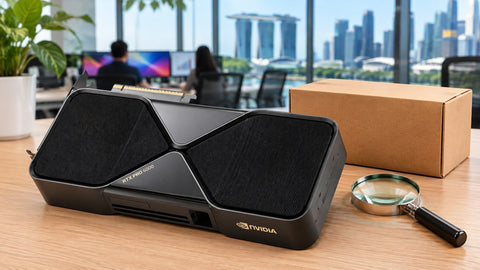
Speed and room to grow. An RTX PRO 6000 Blackwell has 96 GB at 1,792 GB/s, about six times the N1X's bandwidth, so models that fit run much faster. It can be partitioned with MIG into up to four isolated 24 GB instances for several users, and the tower can take more RAM, more storage or a second card later. The cost is higher: S$29,100 for the card, plus a host with a suitable power supply, and a 600 W card alone uses more power than two GR1X units. Our GR1X vs RTX PRO 6000 post compares the two directly, and building an RTX PRO 6000 workstation covers the host system.
A workstation doesn't help with models larger than about 96 GB on one card. Beyond that, you're looking at multiple cards, a GB10 pair or a larger system.
What about two GX10s?
That's the route designed for this. Two ASUS Ascent GX10 or DGX Spark units connect directly over ConnectX-7 with a QSFP cable. NVIDIA showed a pair running Qwen3 235B in NVFP4 at 11.73 tokens per second (24 Oct 2025), a model no single 128 GB box can hold. The trade-off is Linux instead of Windows, and the GB10's slightly lower memory bandwidth (273 GB/s). See our ASUS Ascent GX10 guide and DGX Spark vs RTX Spark.
What's the total investment beyond the hardware?
- Electricity. As an upper bound at the 240 W adapter rating, running 24/7, one GR1X would cost about S$655 a year and two about S$1,310 at SP Group's Q4 2026 tariff of 31.16¢/kWh with GST (our arithmetic; real draw is usually lower). A workstation drawing 1 kW around the clock would be about S$2,730 a year on the same basis.
- Administration. Two Windows machines means two sets of updates, model files, security settings and backups.
- Software risk. CUDA on Windows on Arm is a developer preview, and vLLM isn't native on Windows. That applies to both units.
- Future growth. GR1X memory is soldered, so neither unit can grow. A tower can. Our GR1X vs DIY AI workstation post looks at repair and expansion in more detail.
Buying in Singapore
The ASUS ProArt GR1X is listed as price on request. ASUS hasn't published a price. As a SourceIT estimate based on comparable RTX Spark devices, not an official ASUS price, expect roughly S$9,000–10,800 per 128 GB / 2 TB unit, including GST. For a pair designed to link, the ASUS Ascent GX10 128 GB / 1 TB is S$10,350 each, with an ASUS QSFP cable to connect them (ask us for cable availability). For a single-GPU route, the RTX PRO 6000 Blackwell Workstation Edition is S$29,100 (both prices listed 8 Nov 2026). Prices change, so ask for a current quotation. Use Request for Quotation on the product page, call (65) 6978 3502, email Sales@sourceit.com.sg or use our contact page.
Frequently asked questions
Can I cluster two ASUS ProArt GR1X units? There's no supported method. The GR1X has 10 GbE but no ConnectX-7 port, and no published results of RTX Spark PCs sharing a model over Ethernet were available at the time of writing.
Do two GR1X units give me 256 GB for one model? No. Each unit has its own memory, and the link between them is far slower than memory. A model has to fit in one unit's GPU share.
Is two GR1X cheaper than one RTX PRO 6000 workstation? Probably. Our estimate for two 128 GB units is about S$18,000–21,600, against S$29,100 for the RTX PRO 6000 card alone. But the workstation runs models that fit in 96 GB several times faster and can be expanded.
What should I buy if I need to run a 235B model? Two linked GB10 systems such as the ASUS Ascent GX10 or DGX Spark, multiple GPUs, or a larger unified-memory system. No single 128 GB box can hold it.
When are two GR1X units a good idea? When you want two independent Windows AI desktops: for two users, to separate agents from creative work, or to keep a spare.