Spend on SSD where a GPU is waiting for data, and on hard drives for everything else. An SSD reads many times faster than a hard drive, and thousands of times faster when access jumps around randomly, which is exactly how training reads a dataset. A hard drive stores a terabyte for a fraction of the price. AI projects need both: a relatively small amount of fast flash next to the GPU for the data in active use, and a large amount of inexpensive, redundant hard-drive capacity for raw data, the model library, finished projects and backups. The mistake in either direction is costly: all-flash for data that sits untouched, or a GPU worth tens of thousands idling behind a hard-drive array.
How do HDD and SSD compare?
| Hard drive (HDD) | SATA SSD | NVMe SSD | |
|---|---|---|---|
| Sequential speed | Up to about 250 MB/s per drive | About 500 MB/s | Several thousand MB/s |
| Random access | Slow: a mechanical arm must move | Fast | Fastest |
| Cost per TB | Lowest | Several times higher | Several times higher; more for enterprise grade |
| Capacity per drive | Up to 20TB and beyond | Commonly up to a few TB | Up to tens of TB in enterprise models, at a price |
| Wear | Mechanical wear over years | Limited total writes | Limited total writes |
| Failure pattern | Often gradual, with warning signs | Can be sudden | Can be sudden |
| Power, heat, noise | Higher | Low | Low power; can run hot under load |
| Best for | Bulk capacity, sequential data, backup | Cache, small fast volumes | Active datasets, model loading, indexes |
Speeds are typical for each class, not specifications of a particular drive.
What does a terabyte cost?
CALC. An enterprise hard drive listed from S$835 for 12TB works out at 835 / 12 = about S$70 per terabyte. Enterprise SSDs cost several times that per terabyte, and the gap moves with the market: flash prices rise and fall sharply with supply. So 40TB of datasets on hard drives is a manageable purchase, and the same capacity in enterprise flash is a major one. Get current quotations for both before fixing a design; see the AI storage crisis for why flash pricing has been volatile.
Why does AI training punish hard drives?
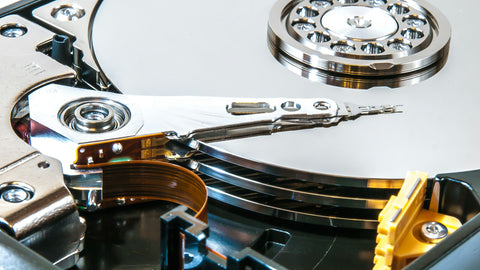
Training reads the dataset in a shuffled order, again on every pass, to avoid learning the order of the examples. For a dataset of millions of small files that means millions of tiny reads scattered across the disk. A hard drive manages perhaps a hundred or two of those a second, because its arm has to move each time. An NVMe SSD manages hundreds of thousands. The GPU can process data far faster than a hard-drive array can supply it in this pattern, so it sits partly idle. Packing small files into large archive-style formats helps, by turning random reads into sequential ones, but the simplest fix is to keep the active dataset on flash. See why data locality matters.
What goes on which?
| Data | Access | Put it on |
|---|---|---|
| Dataset for the current training run | Random, repeated | NVMe in the workstation |
| Models being served | Loaded on start and on switching | NVMe in the workstation |
| Vector index, databases | Random read and write | NVMe in the workstation |
| Scratch and cache during training | Heavy writes | NVMe, with endurance in mind |
| Checkpoints | Large sequential writes | NVMe for the latest; hard drives for the retained set |
| Raw and source data | Read occasionally, sequentially | Hard drives in a NAS |
| Model library not in use | Rare | Hard drives in a NAS |
| Finished projects, archives | Rare | Hard drives in a NAS |
| Backups | Sequential writes | Hard drives; tape for large offline archives |
| Shared active data for several workstations | Random, concurrent | SSD volume or cache in the NAS |
How should a budget be split?
Work from the data, not a percentage.
- Measure the hot set. How large is the data in active use at any one time? Often it is a small share of the total.
- Buy flash for the hot set, with headroom. Usually this is the AI system's internal NVMe; choose the larger capacity option if datasets are big. See 1TB vs 2TB vs 4TB.
- Buy hard-drive capacity for everything else, with redundancy, sized for two years of growth. See Synology NAS for AI developers.
- Budget for the backup copy of what cannot be recreated.
- Add flash to the NAS only for a measured need. See SSD cache vs all-flash NAS.
CALC. A team holds 30TB in total, of which 2TB is in active use. Flash is needed for about 2TB plus headroom, say 4TB, which the AI system's internal drive can provide. The other 28TB, plus growth, belongs on hard drives: four 16TB drives with single redundancy give (4 - 1) x 16 = 48TB usable. Buying 30TB of flash would be paying a premium on 28TB that gains nothing from it.
The price of slow storage is not the minutes spent waiting. It is the GPU doing nothing during them. Put flash where that happens, and nowhere else.
What about endurance and reliability?
- SSDs have a rated write life. Training workloads that write checkpoints and caches constantly use it faster than office work. Choose drives rated for the duty and watch the wear indicator.
- Consumer and enterprise SSDs differ in endurance, sustained speed and power-loss protection.
- Hard drives should match the job. NAS-rated or enterprise drives for arrays that run all day. See IronWolf vs IronWolf Pro vs Exos.
- Neither replaces backup. SSDs in particular can fail without warning. See what happens if your AI workstation SSD fails.
Does the network change the answer?
Yes. Flash in a NAS is only as fast as the link to it. Behind gigabit Ethernet, an SSD volume delivers about 110 MB/s, no better than a single hard drive. If the plan includes shared flash, the plan includes 10GbE. See 10GbE vs 2.5GbE.
Buying in Singapore
Capacity drives: Seagate Exos X24, 12TB to 24TB, from S$835, and Seagate IronWolf Pro from S$390. NAS to hold them: the Synology DS1825+ (S$2,148). SSDs for NAS cache or volumes: Synology SAT5221 enterprise SATA SSD from S$334.80. AI system with 4TB of internal NVMe: the NVIDIA DGX Spark 4TB (S$9,450) (listed 12 Nov 2026; prices change; ask for a current quotation). Enterprise NVMe such as the Micron 7600 PRO is price on request. To start, use Request for Quotation on the product page, call (65) 6978 3502, email Sales@sourceit.com.sg or use our contact page.
Frequently asked questions
Should AI datasets be stored on HDD or SSD? Both. Keep the dataset in active use on SSD, ideally NVMe in the AI machine, and keep raw data, archives and backups on hard drives, which cost far less per terabyte.
Why are hard drives slow for AI training? Training reads data in random order on every pass. Hard drives handle random reads slowly because a mechanical arm must move for each one, so the GPU waits for data.
Is all-flash storage worth it for AI? Only for the data that is actively and randomly accessed. Paying flash prices for data that sits unused brings no benefit.
Do SSDs wear out with AI workloads? They have a limited write life, and training workloads that write checkpoints and caches continuously consume it faster. Use drives rated for heavy writing and monitor wear.