DGX Station GB300 Procurement for Singapore Universities and Government Agencies

Write the specification around NVIDIA's DGX Station GB300 platform, not around one manufacturer. All six OEM versions sold in Singapore (ASUS, Dell, HP, MSI, GIGABYTE and Supermicro) use the same NVIDIA GB300 board, so a brand-neutral spec can be met by any of them. Make the platform features mandatory, score the things that genuinely differ (warranty and onsite service, storage, cooling safeguards, form factor and commissioning), ask for an itemised bill of materials so quotes can be compared even though none carries a public list price, and write acceptance tests into the contract. This post gives a sample specification and evaluation approach. For GeBIZ mechanics, see navigating GeBIZ and why government IT procurement can fail before the equipment arrives.
What should an OEM-neutral specification include?
| Requirement | Suggested treatment | Why, and how to verify |
|---|---|---|
| NVIDIA GB300 Grace Blackwell Ultra Desktop Superchip | Mandatory | Defines the platform; check the model against NVIDIA's DGX Station partner list |
| 748 GB coherent memory (252 GB HBM3e + 496 GB LPDDR5X) | Mandatory | NVIDIA's current figure; reject quotes still citing the superseded 784 GB spec without explanation |
| ConnectX-8: 2× QSFP112 (400 Gb/s each), plus 10GbE and 1GbE BMC | Mandatory | Standard on the platform; state which ports your network will use |
| Out-of-band management (IPMI, Redfish, remote console) | Mandatory | Needed for remote admin and firmware updates |
| Supported Linux image and update path | Mandatory (state which) | NVIDIA's reference image is Ubuntu 24.04-based; some OEMs add Ubuntu Pro or RHEL certification |
| Installed NVMe capacity and drive type | Scored | Populated drives differ by OEM; set a minimum and score above it |
| Warranty length, onsite service, response time, drive retention | Scored (set a minimum) | Hardware warranty comes from the OEM, and terms differ; ask for Singapore terms in writing |
| Cooling safeguards (leak detection, redundant pump) | Scored | All use closed-loop liquid cooling; extras differ by OEM |
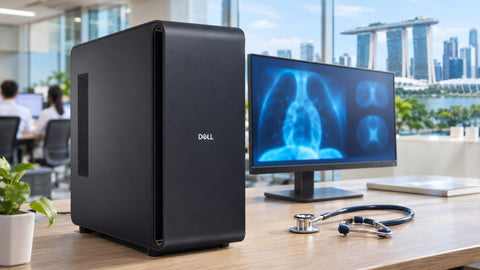
| Form factor: tower or rack-mount | Mandatory if you need a rack | HP includes 5U rails; Supermicro offers tower or 5U |
| Display card (RTX PRO) | Optional line item | The GB300 has no display output; a card over 300 W cuts the GB300's power share to 950 W |
| Power: 1,600 W system, 200–240 V input | Mandatory (site compatibility) | Ask for input current at 230–240 V; Dell specifies 8 A at 240 V |
| Delivery, installation, commissioning and handover | Scored | Define what "commissioned" means (see acceptance criteria below) |
Source: NVIDIA DGX Station product page and datasheet (Aug 2026); NVIDIA DGX Station Development Guide; OEM specifications and reviews compiled 4 Nov 2026 (ServeTheHome, StorageReview, Dell, HP). Suggested treatments are SourceIT's view, not a government template.
Why write the spec around the platform, not a brand?
Because the core hardware is the same. ServeTheHome found three Stations within about 2% of each other on CPU tests, and StorageReview found the ASUS within 2% of the MSI on 24 of 28 model-serving tests. A spec that names one OEM's chassis or part number shuts out equivalent offers and invites challenge. MOF's Guide for Suppliers says bids are evaluated "based strictly on the criteria indicated in the Tender document", and that critical criteria "must be met in order for the bid to be considered for award". So the job is to turn what you actually need into criteria that any compliant GB300 can meet, then let the scored criteria separate the offers. MOF also says value for money takes in total cost of ownership, and that "quality, relative risk, timeliness, and reliability are also taken into consideration".
On thresholds, one line is enough: MOF lists Small Value Purchases up to S$6,000, quotations up to S$90,000 and tenders above that, with Tender Lite up to S$1 million. With public US prices for DGX Station GB300 systems mostly around US$93,000–100,000 before tax (see choosing the right supplier), most agency purchases will go to tender. Universities run their own procurement: NUS and NTU source through SAP Ariba, and NTU says it is moving away from GeBIZ sourcing. Don't assume their limits match MOF's.
What should be mandatory and what should be scored?
Keep the mandatory list short and objective: the platform, memory, networking, management, supported OS and site compatibility. Everything that varies by OEM and affects your risk belongs in the scored criteria: warranty and onsite terms, installed storage, cooling safeguards, delivery and commissioning, and the supplier's documentation support. A common mistake is making an OEM-specific extra mandatory (for example, a particular rack-rail kit) when a scored criterion would do. Another is leaving warranty out entirely, which lets a one-year carry-in offer compete with three years onsite on price alone.
Make the platform mandatory and score what differs. If two compliant offers can only be separated on price, your scored criteria aren't doing their job.
How do you compare quotes when there is no list price?
None of the six OEM listings carries a public Singapore price; that is a supplier condition. So comparison has to be done on the quote itself. Ask every bidder for:
- An itemised bill of materials with OEM part numbers for the base unit, each drive, any display card and any warranty upgrade.
- Warranty terms as a separate line: years, onsite or carry-in, response time and drive retention.
- Delivery, installation and commissioning as separate, defined lines.
- Quote validity and the basis of the delivery date, given that supply is allocated.
Then normalise to the same configuration before comparing. Our worked example in HP ZGX Fury vs MSI DGX Station quotations shows how two quotes for "the same" Station can differ in what's included.
What acceptance criteria belong in the contract?
The Auditor-General's Office reported inadequate checks on goods delivered at several agencies in its FY2024/25 report, so define acceptance in writing. Reasonable criteria include:
- The delivered unit matches the BOM: model, serial number, drives and any card.
- The GPU, memory and network ports are visible to the operating system, and MIG can be enabled.
- The BMC is reachable on your management network, with default passwords changed.
- The OS image, driver and firmware versions are recorded at handover.
- A defined burn-in or stability period passes without errors.
- Warranty is registered to the end-user organisation, with the support contact documented.
Our post on what happens after your DGX Station arrives turns these into a handover checklist.
How do budget cycles interact with supply?
Supply is tight and quotes may have short validity. NVIDIA told investors in August 2026 that it expects memory supply to stay tight through its fiscal 2028, and no manufacturer publishes GB300 lead times in weeks. For grant-funded or end-of-financial-year purchases, build in time for clarifications, evaluation and the end-user information suppliers request (see KYC and EUC requirements explained), and avoid award dates that leave no room for allocation. The end-to-end sequence is in from quotation to delivery.
Buying in Singapore
SourceIT lists DGX Station GB300 systems from ASUS, Dell, HP, MSI, GIGABYTE and Supermicro, supplied through each OEM's channel: the ASUS ExpertCenter Pro ET900N G3, Dell Pro Max with GB300, HP ZGX Fury G1n, MSI XpertStation WS300, GIGABYTE W775-V10-L01 and Supermicro ARS-511GD-NB-LCC, all price on request. For a quotation or tender, we can prepare an itemised BOM, a technical compliance statement against your specification and the end-user information suppliers request. For research labs, see how research labs can run their own GB300 and our DGX Station GB300 buyer's guide. This article is general information, not procurement or legal advice; follow your organisation's procurement rules and officers. To get a quotation, use Request for Quotation on the product page, call (65) 6978 3502, email Sales@sourceit.com.sg or use our contact page.
Frequently asked questions
Can a tender specify a DGX Station GB300 without naming a brand? Yes. All six OEM versions use the same NVIDIA GB300 board, so you can specify the platform, memory, networking and management as mandatory and score the differences.
Will a DGX Station GB300 purchase need a tender? For government agencies, MOF's thresholds put purchases above S$90,000 into tender. With public US prices mostly around US$93,000–100,000, most will. Universities follow their own procurement rules.
How do we evaluate quotes when there is no list price? Ask for an itemised bill of materials with OEM part numbers, warranty and commissioning as separate lines, then compare on the same configuration.
What should acceptance testing cover? That the unit matches the BOM, the GPU and memory are visible to the OS, the BMC is secured and reachable, versions are recorded, a burn-in period passes, and the warranty is registered to your organisation.
Do NUS and NTU buy through GeBIZ? Both run sourcing through SAP Ariba, and NTU says it is moving away from GeBIZ sourcing. Check each institution's supplier pages.

SourceIT Approved
Researched and verified by the SourceIT team for Singapore buyers.