An AI hallucination is an answer that is fluent, confident and wrong: an invented statistic, a citation to a document that does not exist, a product feature nobody built. It happens because a language model generates the most plausible next words, not verified facts. When it has the information, plausible and true usually coincide. When it does not, it still produces something plausible. Hallucination cannot be switched off, but it can be reduced sharply by giving the model the source material, asking it to cite, allowing it to say it does not know, and checking the outputs that matter.
Why do language models hallucinate?
- They predict text, they do not look things up. A model has no internal database to consult. Facts are stored as statistical tendencies, and rare facts are stored weakly.
- They are trained to answer. Training rewards a helpful-sounding response more than an admission of ignorance.
- Their knowledge stops at a date. Anything newer is guessed from older patterns.
- They know nothing about your company. Ask about your own policy without supplying it and the model will describe a typical policy as if it were yours.
- Long inputs get blurred. Details in the middle of a very long prompt can be missed or mixed up.
Which tasks are most at risk?
| Lower risk | Higher risk |
|---|---|
| Rewriting or summarising text you supply | Specific numbers, dates, prices and quotations from memory |
| Drafting emails and reports for review | Citations, case law, standards clause numbers |
| Classifying and extracting from a document in front of it | Questions about your own company with no documents supplied |
| Brainstorming options | Recent events and niche technical details |
| Explaining well-known concepts | Arithmetic and multi-step calculations without a tool |
The pattern: the more the answer depends on a precise fact the model was not given, the higher the risk.
How do you reduce hallucinations?
- Ground the model in your documents. Retrieval-augmented generation supplies the relevant passages with each question, so the model answers from text in front of it. This is the single most effective measure. See RAG vs fine-tuning vs long context.
- Require citations. Ask for the source passage with every claim, and show it to the user. A claim with no source is a warning sign.
- Allow it to decline. Instruct the model to say when the supplied documents do not contain the answer. Test that it does.
- Use tools for facts and maths. Calculations, database lookups and live prices should come from a tool call, not from the model's memory.
- Constrain the output. Structured formats, fixed option lists and shorter answers leave less room to invent.
- Choose the model for the task. Larger and more recent models generally hallucinate less on general knowledge. Heavy quantisation can cost a little accuracy; see quantisation explained.
- Add a check for high-stakes output. A second pass, by a person or another model, that verifies each claim against the source.
- Measure it. Keep a fixed set of questions with known answers and re-run it after every change. See AI monitoring and observability.
The model is not lying, because it does not know what is true. It is completing a pattern. Your job is to make sure the pattern it completes starts from your facts.
Does RAG eliminate hallucinations?
No. It changes the failure. A RAG system can retrieve the wrong passage, retrieve an outdated version, or have the model misread a correct one. Tables, scanned pages and documents that contradict each other are common causes. Good retrieval quality, clean source documents and visible citations do more than any prompt wording.
Does the hardware matter?
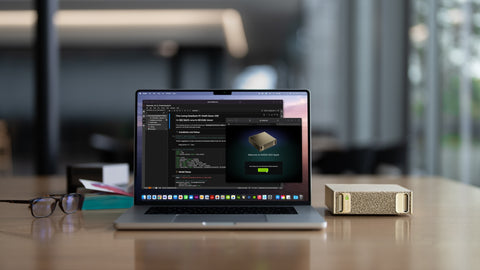
Indirectly. Hardware does not make a given model more truthful. It decides which model you can run and how much checking you can afford. More memory allows a larger model at higher precision, a longer context to hold more source text, and room for an embedding model and a second verification pass alongside the main one. A machine that is only just large enough pushes teams toward smaller, more heavily compressed models and shorter prompts. See small vs large language models and why 128GB of unified memory matters.
What should a business policy say?
- AI output is a draft. A named person is accountable for anything sent to a customer, regulator or court.
- Figures, citations and legal or medical statements are verified against the source before use.
- Internal assistants answer from company documents and show their sources.
- Staff know how to report a wrong answer, and reports are reviewed.
For the governance side, see is your company ready for Singapore's AI governance requirements.
Buying in Singapore
For a grounded internal assistant with room for a larger model and an embedding model, the NVIDIA DGX Spark 4TB (S$9,450), ASUS Ascent GX10 1TB (S$10,350) or HP ZGX Nano G1n 4TB (S$11,499), each with 128GB of unified memory. For more users and longer context, the NVIDIA RTX PRO 6000 Blackwell Workstation Edition (S$29,100) (listed 11 Nov 2026; prices change; ask for a current quotation). DGX Station GB300 systems such as the MSI XpertStation WS300 are price on request. To start, use Request for Quotation on the product page, call (65) 6978 3502, email Sales@sourceit.com.sg or use our contact page.
Frequently asked questions
What is an AI hallucination? It is an AI-generated answer that sounds confident and plausible but is factually wrong or invented, such as a made-up figure or a citation to a source that does not exist.
Why do AI models make things up? Language models generate the most likely next words based on patterns in their training data. They do not look facts up, so when information is missing they still produce a plausible-sounding answer.
Can hallucinations be eliminated? No, but they can be greatly reduced by supplying source documents through retrieval, requiring citations, letting the model decline, using tools for calculations and checking important outputs.
Does better hardware reduce hallucinations? Not directly. Hardware determines which model you can run and how much source text and checking fit in memory, which in turn affects accuracy.

SourceIT Approved
Researched and verified by the SourceIT team for Singapore buyers.