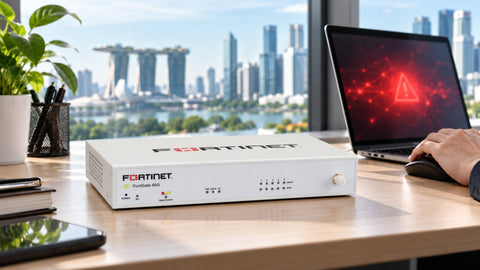
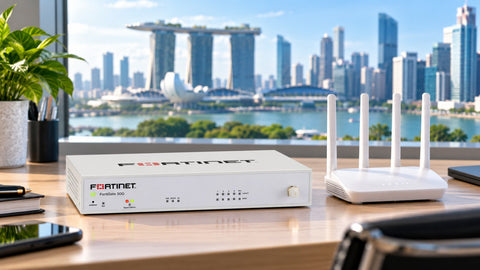
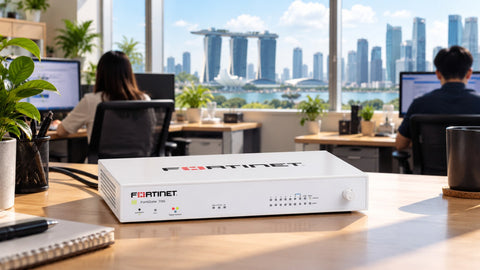
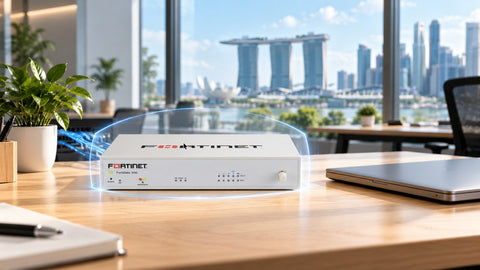
Yes, for a pilot or a small team, and no, if "corporate ChatGPT" means the whole company on day one. A single NVIDIA GB10 system such as the ASUS Ascent GX10 (from S$8,100) or NVIDIA DGX Spark (S$8,800) has the memory to run a strong open model in the 70B to 120B class entirely on your premises. What it does not provide is the rest of a chatbot service: sign-in, a chat interface, access to company documents that respects permissions, logging, guardrails, updates and someone to look after it. The hardware is usually the easiest of these to get right. Prices at SourceIT, listed 28 Oct 2026.
What does an internal ChatGPT actually consist of?
| Layer | What it does | Typical options | Does the GB10 provide it? |
|---|---|---|---|
| Model | Generates answers | Open-weight models such as GPT-OSS, Llama, Qwen, DeepSeek distills, NVIDIA Nemotron | Runs it; you choose and update it |
| Inference server | Serves the model over an API | vLLM, NVIDIA NIM, Ollama, llama.cpp | Supported on DGX OS |
| Chat interface | What staff see and type into | Open-source web UIs, or a front end your developers build | No, you install one |
| Identity | Who can sign in | Single sign-on with Microsoft Entra ID or Google Workspace | No |
| Company knowledge | Answers from your documents | Retrieval-augmented generation (RAG) with a vector database | Runs it; you build the pipeline |
| Permissions | Stops staff seeing documents they should not | Document-level access control carried into retrieval | No, a design task |
| Guardrails | Blocks unsafe or off-policy output | Policy prompts, filters, NVIDIA NeMo Guardrails | Supported, you configure |
| Logging and retention | Audit trail, PDPA compliance | Central logs with a retention policy | No, a policy and tooling task |
The software names above are examples of widely used open-source and NVIDIA tools, not endorsements; the right stack depends on your IT environment.
Is the hardware the hard part?
Usually not. The GB10's 128 GB of unified memory holds a 70B model at 8-bit or 4-bit, or a 120B-class model such as GPT-OSS-120B at 4-bit, with room for a retrieval index. That covers the quality most internal assistants need: summarising, drafting, answering policy questions, searching documents and helping with code. Our guide to running LLMs locally shows which model sizes fit which machines.
Where the hardware does matter is concurrency. Every user's answer is generated from the same 273 GB/s memory system, so the GB10 suits a pilot group or a team, not 300 staff at nine o'clock on Monday. We work through the numbers in Can One GB10 Support 20 Employees Using AI at the Same Time?, and the step up to a shared GB300 system is covered in GB10 vs GB300: when to move.
Why is permission-aware search the real project?
A chatbot that answers from company documents is only as safe as its retrieval. If HR files, board papers and client contracts all go into one index, the model will happily quote them to anyone who asks the right question. Copying document permissions into the retrieval layer, so a user only retrieves what they could already open in SharePoint or the file server, is the piece most demos skip and most production projects spend time on. We cover the indexing side in Can NVIDIA GB10 Analyse Thousands of Company Documents Without Sending Them to the Cloud?
The model is a download. The permissions, logs and support are the project.
What about PDPA and data residency?
Keeping prompts and documents on a machine in your office is the main reason Singapore organisations look at local AI. It removes the question of where a cloud provider stores and processes data. It does not remove your obligations under the PDPA: you still decide what personal data goes into the index, who can query it, how long chat logs are kept and how a request to access or correct data is handled. A local system makes those controls easier to enforce, because you own every log. The wider risk picture is in Your AI Assistant Might Be Your Biggest Security Risk.
Which model should a corporate assistant use?
- Start smaller than you think. A 20B to 30B model answers quickly and handles most drafting and Q&A. Move up only where it falls short.
- Use a 70B or 120B-class model for reasoning-heavy work such as long reports, contract review or analysis, accepting slower answers on GB10.
- Check the licence. Open-weight licences differ on commercial use, attribution and acceptable-use terms.
- Plan for updates. New open models arrive every few months. Budget time to test and swap them.
For how vendors' "up to 120B" and "up to 200B" claims translate into real use, read What NVIDIA's 120B and 200B AI Model Claims Really Mean.
How should a Singapore SME roll it out?
- Pick one use case with clear documents and a willing team, such as HR policy questions or IT helpdesk answers.
- Buy one GB10 system and keep it on the office network behind your firewall.
- Connect sign-in to your existing Microsoft or Google accounts before anyone uses it.
- Index only the documents for that use case, with permissions carried over.
- Turn on logging and agree a retention period with whoever handles PDPA in your company.
- Measure for a month: how many users, how many questions, how long answers take, how often they are wrong.
- Then decide whether to add GB10s, move to a GB300, or keep some workloads on a cloud service.
Why many AI projects stall after the pilot is covered in Why AI Projects Look Amazing in Demos but Fail in Real Offices, and the cost comparison with cloud APIs in Local AI vs Cloud API Cost.
Buying in Singapore
SourceIT supplies the ASUS Ascent GX10 (1 TB S$8,100, 2 TB S$8,300, 4 TB S$10,635), the NVIDIA DGX Spark (S$8,800), the HP ZGX Nano G1n (S$11,499) and the other GB10 systems with local warranty and a GST invoice, and can deliver units commissioned with your chosen model. Browse the NVIDIA DGX Spark collection or size a system with the AI hardware calculator. For a quotation, use Request for Quotation on the product page, call (65) 6978 3502, email Sales@sourceit.com.sg or use our contact page. Government buyers can purchase through GeBIZ.
Frequently asked questions
Can NVIDIA GB10 run a private ChatGPT for my company? Yes, for a pilot or a team. A GB10 system runs 70B to 120B-class open models on premises, but you also need a chat interface, sign-in, permission-aware document search, logging and support.
Which model should an internal company chatbot use? Start with a 20B to 30B open model for speed, and move to a 70B or 120B-class model for reasoning-heavy work. Check each model's licence for commercial use.
Does a local AI chatbot make us PDPA compliant? No. It keeps data on your premises, which helps, but you still control what personal data is indexed, who can access it and how long logs are kept.
How many users can one GB10 support? A pilot group or a small team comfortably. Every request shares the same 273 GB/s memory, so a whole company at peak needs more systems or a GB300-class machine.
How much does the hardware cost in Singapore? At SourceIT on 28 Oct 2026, the ASUS Ascent GX10 starts at S$8,100 and the NVIDIA DGX Spark is S$8,800. GB300 systems are price on request.

SourceIT Approved
Researched and verified by the SourceIT team for Singapore buyers.