It depends on the size of the models you work with. A gaming PC with a desktop RTX 5090 is the faster tool for models up to about 32B parameters, for image and video generation, and for anything that also needs Windows, x86 software or games. The ASUS Ascent GX10 is the better tool when the model, its context and your fine-tuning jobs need more than 32 GB. Its 128 GB of unified memory holds 70B–120B models that a single 5090 can't, in a 1.5 kg box that draws a fraction of the power. Many AI developers end up wanting both: one for speed, one for size.
Which workloads suit each machine?
| Workload | Desktop RTX 5090 PC | ASUS Ascent GX10 (128 GB) | Evidence |
|---|---|---|---|
| Chat and coding models up to 32B (4-bit) | Better: much faster replies | Runs, slower | Qwen3 32B 4-bit decode: 61.4 vs 9.4 tok/s (5090 vs GB10) |
| gpt-oss-120b | Only with layers offloaded to system RAM | Better: fits in memory | Roughly 10–30 tok/s offloaded vs 58.7 tok/s on GB10 |
| Llama 70B at 4-bit or FP8 | Doesn't fit on one card | Fits; slow decode | GB10: 4.4 tok/s (4-bit), 2.7 tok/s (FP8) |
| Fine-tuning (QLoRA) | Up to about 32B | Up to 70B | Unsloth minimums: 32B 26 GB, 70B 41 GB |
| Serving a team on a small model | Better | Adequate | gpt-oss-20b: 4,844 tok/s at 64 users (5090) vs about 1,600 at batch 64 (GX10); different harnesses |
| Image and video generation | Better for speed | More room for large models; slower GPU | Bandwidth 1,792 vs 273 GB/s |
| Gaming, Windows apps, Blender | Yes | No (Arm Linux) | DGX OS on a 20-core Arm CPU |
Source: hardware-corner (Oct–Nov 2025, llama.cpp); llama.cpp DGX Spark benchmarks (Feb 2026); Ollama (23 Oct 2025) and LMSYS (13 Oct 2025) GB10 results; Knoop and Holtmann, arXiv 2601.09527 (Jan 2026, vLLM); StorageReview ASUS Ascent GX10 review (3 Mar 2026); Unsloth requirements page. The GX10 uses the same GB10 chip as the DGX Spark, and StorageReview found differences between GB10 systems "incremental", so DGX Spark results apply to it.
What exactly is the ASUS Ascent GX10?
It is ASUS's version of NVIDIA's GB10 desktop AI computer, the same platform as the DGX Spark. Inside are a Grace Blackwell GB10 chip with a 20-core Arm CPU, LPDDR5X memory shared by CPU and GPU, an NVIDIA ConnectX-7 network card for two 200 Gb/s QSFP links, 10GbE, Wi-Fi 7 and NVIDIA's DGX OS. It measures 150 x 150 x 51 mm and weighs 1.48 kg. StorageReview measured the system at up to about 180 W.
ASUS sells it with 64 GB or 128 GB of memory and 1 TB, 2 TB or 4 TB of storage. The memory choice matters most. A 64 GB unit costs much less, but gpt-oss-120b's 65 GB of weights alone exceed it, so it can't run that model in memory. For most developers buying a GX10 for big models, 128 GB is the version to get. Two GX10s can be linked with ASUS's cluster tools for larger models; ASUS's launch material mentioned Llama 3.1 405B across two units (launch claim).
Why consider a gaming PC instead?
Because for a lot of everyday AI development, speed matters more than size. Token generation is limited mainly by memory bandwidth, and the desktop 5090's 1,792 GB/s is about 6.6 times the GB10's 273 GB/s. On models that fit, that shows up almost one-for-one: Qwen3 32B at 4-bit generated about 6.5 times faster on the 5090. For coding assistants, RAG experiments on mid-sized models, or iterating on prompts all day, that responsiveness is the difference you feel.
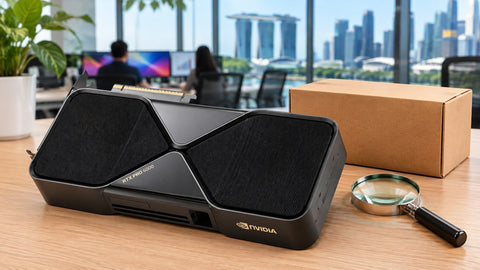
A gaming PC is also more flexible. It runs Windows and x86 Linux, so desktop tools, games, Blender and Adobe software all work. You can upgrade the GPU or storage later. And CUDA code you write on it moves to servers and cloud GPUs. The catches: the card alone is rated at 575 W, NVIDIA requires a 1,000 W power supply, the box is large, and you need Blackwell-ready software (CUDA 12.8 or later builds). See 575 watts for one graphics card for the power side.
Buy the gaming PC for speed and flexibility. Buy the GX10 for memory. If you can't decide, write down the largest model you need to run this year.
Where does 128 GB of unified memory pay off?
- Models over 32 GB: 70B at 4-bit (42.5 GB) or FP8 (70.6 GB), and gpt-oss-120b (65 GB), load and run without splitting across GPUs or spilling to system RAM.
- Long context: the KV cache grows with every token of context. On a 5090, Qwen3 32B at 4-bit maxed out at about 45,000 tokens of context in hardware-corner's test. A 128 GB system has far more room.
- Bigger fine-tuning jobs: 70B QLoRA needs about 41 GB (Unsloth), and NVIDIA says GB10 systems can fine-tune models of up to 70 billion parameters. Our GB10 fine-tuning guide covers this.
- A desk-side match for deployment: NVIDIA positions GB10 for building and testing agents and models that later run on DGX systems or in the cloud, using the same software stack.
The catch is speed. Big models run, but decode on 70B is single-digit tokens per second. If you need big models and fast responses, compare the RTX PRO 6000's 96 GB or a DGX Station.
So should AI developers buy a gaming PC instead?
- Yes, the gaming PC if you mostly use models of 32B and under, care about response speed, generate images or video, or want one machine for work and play.
- No, the GX10 if you regularly need 70B–120B models, long context or 70B fine-tuning, want a quiet, low-power box on the desk or network, or are building for NVIDIA DGX or cloud deployment.
- Both is a common answer: a GeForce PC for fast daily work and a GX10 on the network for big-model jobs. The GX10 can be reached remotely, so it doesn't need to sit next to you.
For the related DGX Spark comparison, see RTX 5090 vs DGX Spark. Creators can read ROG NUC vs ASUS GX10 for creators, and the ASUS Ascent GX10 guide covers setup.
Buying in Singapore
SourceIT lists the ASUS Ascent GX10 in four versions (listed 6 Nov 2026):
- GX10 64GB/1TB: S$6,670
- GX10 128GB/1TB: S$10,350
- GX10 128GB/2TB: S$10,500
- GX10 128GB/4TB: S$13,335
All are in our ASUS Ascent GX10 collection. Desktop RTX 5090 cards are not in stock at the time of writing; ask us about availability. For a ready-built gaming system, the ASUS ROG NUC 16 Edition 20 (S$11,888.40) uses the RTX 5090 Laptop GPU. That is a 24 GB, up-to-175 W chip that reviewers measured at roughly half the desktop card's gaming performance, so size your models to 24 GB. Prices change, so ask for a current quotation. Use Request for Quotation on the product page, call (65) 6978 3502, email Sales@sourceit.com.sg or use our contact page.
Frequently asked questions
Is the ASUS Ascent GX10 the same as a DGX Spark? It uses the same NVIDIA GB10 chip and DGX OS, with ASUS's own chassis and storage options. Reviewers found performance differences between GB10 systems small.
Should I buy the 64 GB or 128 GB GX10? Buy 128 GB if you want 70B–120B models. A 64 GB unit can't hold gpt-oss-120b's 65 GB of weights. The 64 GB version suits smaller models, agents and development work at a lower price.
Is an RTX 5090 faster than the GX10? On models that fit in 32 GB, yes, by about four to six and a half times at generating text in published tests. On larger models the GX10 is faster or the only one that can run them.
Can the GX10 play games or run Windows? No. It runs DGX OS, a Linux distribution, on an Arm CPU. Use a GeForce PC for games and Windows software.
Can I link two GX10s? Yes. ASUS supports linking two GX10 systems over their ConnectX-7 ports to run larger models across both.