Less than most people expect per PC, and more than most expect across a fleet or a 24/7 deployment. We ran this as a paper experiment, not a meter test: we have not measured these machines ourselves, so every figure below comes from ENERGY STAR's certified product records and SP Group's tariff. On ENERGY STAR's typical office-use figure, an ASUS NUC 16 Pro costs about S$36 in electricity over five years, against about S$82 for a Dell Pro Essential office tower and about S$157 for an HP Elite Tower 800 G9, at 31.16 cents per kWh including GST (SP Group, Q4 2026). That is S$46 to S$121 saved per PC over five years: not enough to justify a purchase on its own, but S$2,290 or more across 50 desks. The NUC 16 Pro Ultra 5 325, 16GB, 512GB, Windows 11 Pro is S$1,704.07 at SourceIT (listed 3 Nov 2026).
What does ENERGY STAR say each PC uses?
| Model (ENERGY STAR record) | Type | Typical energy (TEC) kWh/year | Short idle W | Cost per year | Cost over 5 years |
|---|---|---|---|---|---|
| ASUS NUC 16 (NUC16WCK, Core 7) | Mini | 18.0 | 2.9 | S$5.61 | S$28.04 |
| ASUS NUC 15 Pro (NUC15CRS/CRH/CRK) | Mini | 20.4 | 4.2 | S$6.36 | S$31.78 |
| ASUS NUC 16 Pro (NUC16GDK, Core Ultra X7) | Mini | 23.3 | 4.8 | S$7.26 | S$36.30 |
| Lenovo ThinkCentre M70q Gen 5 | Tiny | 28.4 | 7.4 | S$8.85 | S$44.25 |
| Lenovo ThinkCentre neo 50s Gen 5 | Small form factor | 46.5 | 12.0 | S$14.49 | S$72.45 |
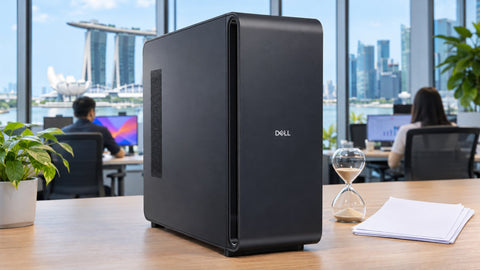
| Dell Pro Essential Tower | Tower | 52.7 | 18.4 | S$16.42 | S$82.11 |
| HP Elite Tower 800 G9 | Tower | 100.8 | 27.2 | S$31.41 | S$157.05 |
ENERGY STAR certified computer records (2025 to 2026), one tested configuration each; costs are our arithmetic at SP Group's Q4 2026 regulated tariff of 31.16 cents per kWh including GST. TEC is ENERGY STAR's weighted office duty cycle of off, sleep and idle time, not a figure under load.
Why are the per-PC savings so small?
Because modern office PCs, towers included, spend most of their lives idle or asleep, and idle power has fallen a long way. The Dell Pro Essential Tower idles at 18.4W. The gap only widens with towers that don't drop into a deep idle state: ENERGY STAR shows the two HP towers in its records holding about 25 to 26W even in long idle, which is why they sit near 100 kWh a year. If your current towers are older or never sleep, your savings will be nearer the top of the range.
What does it look like across a fleet?
- 50 desks, NUC 16 Pro instead of Dell Pro Essential towers: (52.7 − 23.3) kWh x 5 years x 50 PCs = 7,350 kWh, or about S$2,290 over five years.
- 50 desks, NUC 15 Pro instead of HP Elite 800 G9 towers: (100.8 − 20.4) kWh x 5 x 50 = 20,100 kWh, or about S$6,263 over five years.
Air-conditioning has to remove that heat too, so the real saving in a Singapore office is a little higher; we haven't put a number on that.
A mini PC won't pay for itself in electricity. It will quietly take a few hundred dollars a year off a busy office's bill, and a lot more off a 24/7 one.
What changes when the PC runs 24/7?
Signage players, kiosks and monitoring PCs never sleep, so idle power counts every hour of the year. Using ENERGY STAR's short-idle figures as a floor (8,760 hours a year):
| Model | Short idle W | kWh/year | Per year | 5 years |
|---|---|---|---|---|
| ASUS NUC 16 (NUC16WCK) | 2.9 | 25.4 | S$7.92 | S$39.58 |
| ASUS NUC 15 Pro | 4.2 | 36.8 | S$11.46 | S$57.32 |
| ASUS NUC 16 Pro | 4.8 | 42.0 | S$13.10 | S$65.51 |
| Dell Pro Essential Tower | 18.4 | 161.2 | S$50.22 | S$251.12 |
| HP Elite Tower 800 G9 | 27.2 | 238.3 | S$74.25 | S$371.23 |
Twenty 24/7 kiosks on NUC 16 Pro instead of Dell Pro Essential towers would save about S$3,712 over five years at idle alone. Real signage and kiosk loads are higher than idle, and no published load figure exists for the NUC 15 Pro or NUC 16 Pro, so treat these as lower bounds. See ASUS NUC for 24/7 Operations and Can One ASUS NUC Power an Entire Digital Signage Network?
So should energy decide the purchase?
Rarely on its own. The price gap between models is usually larger than five years of electricity: for example, the ASUS NUC 16 Core 7 350, 16GB, 1TB is S$1,850.22 and the Lenovo ThinkCentre M70q Gen 5 Tiny is S$1,351.10 (listed 3 Nov 2026), while their five-year energy difference on ENERGY STAR figures is about S$16. Buy for the job, space, noise and support, and count the electricity as a bonus that grows with fleet size and running hours. For more on office power use, see How Much Power Does Your IT Equipment Consume? and Your Next Desktop PC Could Be Smaller Than Your Lunchbox.
Buying in Singapore
SourceIT supplies the ASUS NUC 16 Pro Ultra 5 325, 16GB, 512GB, Windows 11 Pro (S$1,704.07), the NUC 16 Core 7 350, 16GB, 1TB (S$1,850.22), the NUC 15 Pro Tall Ultra 5 225H, 16GB (2x8GB), 512GB (S$1,363.06) and the Lenovo ThinkCentre M70q G5 Tiny (S$1,351.10), all listed 3 Nov 2026. Browse the ASUS NUC collection. For a quotation, use Request for Quotation on the product page, call (65) 6978 3502, email Sales@sourceit.com.sg or use our contact page.
Frequently asked questions
How much electricity does an ASUS NUC use? ENERGY STAR lists the NUC 16 Pro at 23.3 kWh a year of typical office use and 4.8W short idle, about S$7.26 a year at SP Group's Q4 2026 tariff.
How much does a mini PC save over a tower? On ENERGY STAR figures, about S$46 over five years against a Dell Pro Essential Tower and S$121 against an HP Elite Tower 800 G9, per PC.
Did SourceIT measure these figures? No. They come from ENERGY STAR certified product records for one tested configuration each, with costs calculated at 31.16 cents per kWh including GST.
Is the saving bigger for 24/7 PCs? Yes. At idle around the clock, a NUC 16 Pro uses about 42 kWh a year against 161 kWh for a Dell Pro Essential Tower, about S$186 less per PC over five years.
Should energy savings decide which PC to buy? Rarely on their own. Price differences between models usually exceed five years of electricity; savings matter at fleet scale and for 24/7 use.

SourceIT Approved
Researched and verified by the SourceIT team for Singapore buyers.