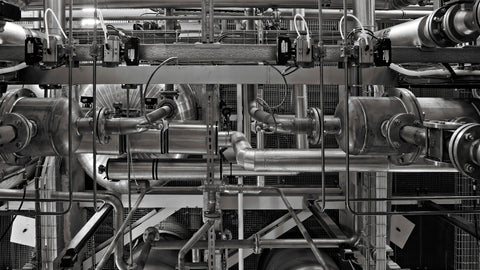
With an air-cooled server, warranty is simple. One vendor made the box. If it fails, that vendor fixes it.
A liquid-cooled AI rack is not one box. It is servers from one company, a coolant distribution unit that may come from another, pipework installed by a contractor, coolant chosen by someone, and chilled water supplied by the building. When something leaks, the first question is not "how do we fix it" but "whose is it". That question is much cheaper to answer before you sign than after.
Why this is harder than it looks
Schneider Electric lists warranty confusion as one of the main risks of liquid cooling for AI. Its point is that server and cooling systems are now tied together: run the coolant outside the server maker's specification and you put performance at risk, and without one party responsible end to end, a fault can turn into finger-pointing.
The Uptime Institute describes the same thing from the operator's side. The line between what facilities staff look after and what IT looks after is not fixed, and has to be agreed for each site.
Sources: Schneider Electric: three risks of liquid cooling, Uptime Institute on direct liquid cooling operations
The chain of responsibility
| Part of the system | Commonly sits with | The question to ask |
|---|---|---|
| 🧠 Servers and cold plates | Server maker | Does the warranty still apply if a cooling fault caused the damage? |
| 🔀 Rack manifolds and hoses | Rack or server maker | Who made the connections on site, and are they covered? |
| 💧 Coolant distribution unit | CDU supplier, which may be the server maker or a third party | Is this CDU validated by the server maker for this rack? |
| 🧪 The coolant itself | Whoever maintains the loop | Which fluid is specified, who tests it, and how often? |
| 🏢 Facility water to the CDU | Building or colocation operator | What temperature, flow and quality are guaranteed in the contract? |
| 🚨 Damage to other equipment nearby | Often nobody by default | Is consequential damage covered by any warranty, or only by insurance? |
This is a general map based on the sources cited in this article. It is not legal advice, and your contracts decide the actual position.
Three things buyers assume, and should not
"The warranty covers leak damage"
A product warranty normally covers defects in that product. One liquid-cooled server warranty we read states plainly that coverage applies only to the server itself and does not extend to other equipment in the same rack. That is a typical shape. Damage to neighbouring systems is a separate matter.
The market has noticed the gap. One cooling supplier now sells a support programme, backed by a warranty insurer, that offers up to US$100,000 per rack for internal damage caused by leaks from its own system. That such a product exists tells you the cover is not standard.
Sources: Puget Systems warranty terms for a liquid-cooled server, Data Center Dynamics on Accelsius NeuGuard
"Coolant is fit and forget"
It is a maintained fluid. Dell's service description for its own CDUs sets out maintenance visits every six months, with visual inspection, a check of the leak detection system, a filter check, and a coolant sample sent to a laboratory. If a warranty depends on coolant staying within specification, someone has to be doing this, and you need to know who.
Source: Dell: Preventative maintenance for PowerCool DLC systems
"Our colocation provider handles the cooling"
They handle their side of it. Vertiv describes several ways the work can be divided. In one, the IT owner manages everything from rack manifolds to cold plates. In another, the facility manages up to the rack CDU or manifold and IT handles the plumbing inside the servers. Neither is wrong. Not knowing which one you have is the problem.
Source: Vertiv: Liquid cooling services and the IT-facilities divide
Eight questions to settle in writing
- Which CDUs and coolants has the server maker validated for this rack?
- If we use a different CDU or fluid, what happens to the server warranty?
- Who performs the fill and commissioning, and is their work warranted?
- Who tests the coolant, how often, and who keeps the records?
- Where exactly does the building's responsibility end?
- If a leak damages equipment, which warranty or insurance policy responds?
- Who do we call first at 3 a.m., and do they have authority to act?
- What is the response time, and are parts held in Singapore?
The view suppliers will not volunteer
Buying the whole system from one vendor costs more than mixing suppliers, and vendors use the warranty argument to justify that. It is a sales argument. It is also true. A single accountable party is worth real money on the day something goes wrong, and the saving from mixing suppliers should be weighed against that day.
The fair counter-point: single-vendor does not mean risk-free. Read the exclusions, whichever route you take.
Related on SourceIT

SourceIT Approved
Researched and verified by the SourceIT team for Singapore buyers.